
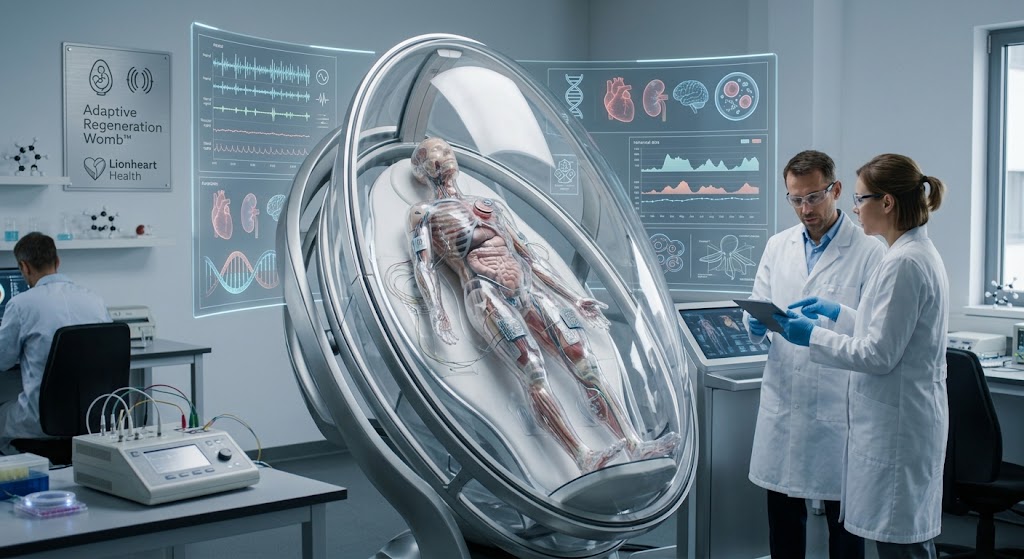
What if an adult body could be given a carefully controlled environment that supports its own repair—one that senses what each organ needs, delivers appropriate signals, and measures whether function improves?
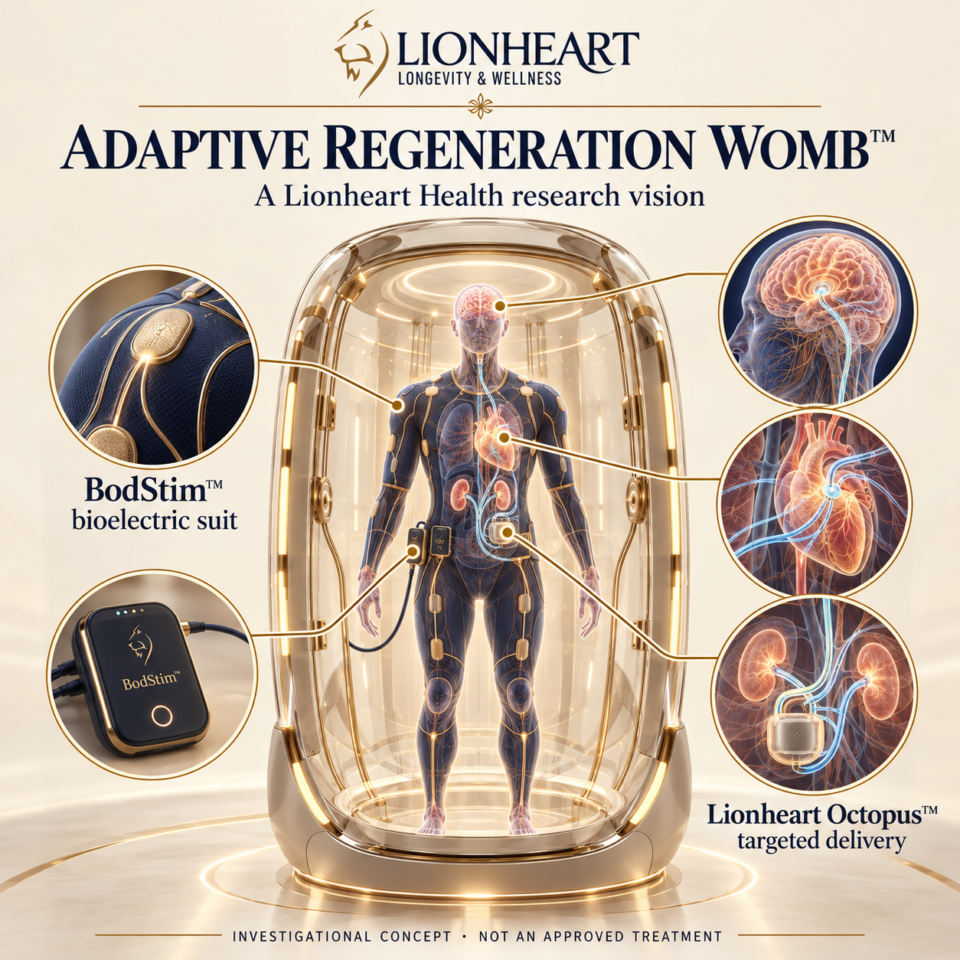
We call that long-range research vision a “womb for adults.” The name describes an ambition, not a literal return to development or a promise to reverse anyone’s age. Lionheart Health’s Adaptive Regeneration Womb™ and BioLeonhardt Whole Body Regeneration Chamber would bring together technologies now being developed separately: BodStim™ bioelectric exercise, organ-specific stimulation, a refillable Lionheart Octopus™ delivery system, regenerative materials, a controlled recovery environment, and continuous assessment. Lionheart has publicly described the chamber as an early-stage research and engineering concept.
“Patient Zero” is our name for the first carefully studied participant we hope this development pathway can eventually support. No one has yet been enrolled in a combined Womb for Adults study, and no date for human use of the complete system has been established. An initial study may test only a subset of noninvasive components. Implantable delivery, cell products and gene-based approaches would require their own preclinical evidence, manufacturing controls, regulatory authorization, ethical review and informed consent before human study.
Why bring the components together?
An aging heart, kidney, brain and muscle do not age in isolation. Reduced circulation can deprive tissue of oxygen. Inflammation can impede healing. Muscle loss can diminish mobility and metabolic health. An organ-directed regenerative signal may accomplish little if the surrounding system remains poorly nourished or stressed.
Lionheart’s hypothesis is that the order, location and timing of interventions matter. The chamber would provide a monitored setting. BodStim™ would engage muscle through neuromuscular electrical stimulation. Programmable bioelectric systems would investigate tissue-specific responses. The Octopus™ architecture would, in a later investigational stage, explore repeatable targeted delivery of regenerative materials. Imaging, biomarkers and functional tests would tell the team whether a response is useful, absent or unsafe.
A proposed journey for Patient Zero
First, map the starting point. The research team would document strength, walking capacity, cognition, sleep, inflammation, cardiovascular and kidney measures, and patient-reported function. Where appropriate, AI-assisted imaging and longitudinal biomarker panels—including Klotho—could establish baseline measures. These are research measurements, not proof that one number represents a person’s biological age.
Then, prepare the recovery environment. Nutrition, sleep, breathing, temperature, activity and stress management would be personalized and tracked. The controlled chamber concept also contemplates red and near-infrared light, pulsed electromagnetic fields, oxygenation strategies and selected acoustic or mechanical stimulation. Each element would need a defined purpose, dose and safety assessment; their effects should not be assumed to add together.
Next, engage muscle and systemic function. BodStim™ Plus, worn on the body, would provide a structured electrical muscle stimulation and exercise component. The proposed platform could pair it with a Lionheart 240 Stimulus™ program selected for the tissue under investigation. The objective would be to measure functional outcomes—such as strength and mobility—alongside exploratory molecular markers, rather than infer clinical benefit from a protein change alone.
Later, investigate precise organ delivery. The Lionheart Octopus™ concept includes a refillable reservoir beneath the skin, a self-sealing access septum, organ-directed delivery routes and a coordinated bioelectric controller. Proposed materials under separate investigation include Klotho-expressing cells suspended in nutrient hydrogel, soluble proteins, platelet-rich fibrin-derived signals, defined extracellular vesicles or exosomes, and selected growth factors. KlothoPatch™ II envisions a localized, potentially retrievable organ bioreactor with sensing and microstimulation. Alternative replenishment concepts include endovascular docking or the subcutaneous Octopus™ reservoir. These are research proposals, not components ready for routine clinical implantation.
Finally, listen to the response. Continuous physiologic sensing and scheduled tests would inform whether to continue, change or stop an intervention. A future AI-guided controller could help clinicians compare signals with organ function over time. It must be validated against clear clinical endpoints and operate under human oversight.
The biological language we hope to study
The Leonhardt and Lionheart research portfolio publicly describes Klotho; Sestrins; Sirtuins including SIRT6; SDF-1/CXCL12 and PDGF for cell recruitment and tissue organization; VEGF, eNOS and HIF-1α for vascular signaling; Follistatin and related muscle pathways; BDNF, GDF10, GDF11 and Sonic Hedgehog for neural or tissue research; Tropoelastin and COL17A1 for tissue structure; and BMP9, OPG, RANKL and Osteocalcin for bone-related signaling. Newer announced research targets include FOXO3–AMPK–mTOR, Wnt, HMGB1, Menin, OSER1, Apelin, NANOG, CXCL5, Thymulin and 15-PGDH. The publicly described portfolio spans different patent statuses and research stages.
These targets are not one switch to turn up together. Expression can have different effects by organ, dose and disease state. Patent coverage, laboratory observations and biological rationale do not establish that a chamber can control every target—or that changing a target improves a patient’s health. The work ahead is to identify reproducible signals, verify tissue responses, and connect them to meaningful function and safety.
What new science contributes—and what it does not
Partial epigenetic reprogramming has strengthened the case for studying cellular state. In a laboratory study, transient exposure of human skin cells to reprogramming factors shifted some molecular-age measurements toward younger patterns. In June 2026, a separate company announced the first participant dosed in a Phase 1 trial of ER-100, which uses controlled OCT4, SOX2 and KLF4 expression for optic nerve conditions. That trial primarily examines safety and tolerability in an eye-specific application. Neither result demonstrates whole-body age reversal or validates Lionheart’s proposed system.
Lionheart’s distinct research question is this: can a coordinated environment, programmable signals, targeted support and repeated measurement help preserve or restore function in several connected organ systems? It demands staged experiments, independent review and honest reporting of negative as well as positive results.
The road to the first participant
Our next steps are concrete: finish the engineering architecture; test the chamber and its noninvasive components separately; establish device and biologic quality controls; define one initial population and a small number of measurable primary outcomes; complete preclinical work for invasive components; and seek the applicable regulatory and institutional approvals for a staged human feasibility protocol.
The first participant should enter a specific, authorized study, not a promise of regeneration. We would measure whether the program is feasible and safe before asking whether it improves muscle, brain, kidney, cardiovascular or other outcomes. Only then could larger controlled studies determine which components contribute real benefit.
The “womb for adults” began as a bold picture of what regenerative medicine might become. Patient Zero will matter when that picture becomes a disciplined experiment—with a defined protocol, transparent endpoints and the courage to let the evidence decide.
Investigational research notice: The Adaptive Regeneration Womb™, BioLeonhardt Whole Body Regeneration Chamber, Lionheart Octopus™ implanted delivery architecture, KlothoPatch™ II and the combined organ-regeneration uses described here are investigational concepts. They have not been established as safe or effective or approved for whole-body regeneration, age reversal, or treatment of disease. Individual components may have different regulatory statuses and intended uses.