
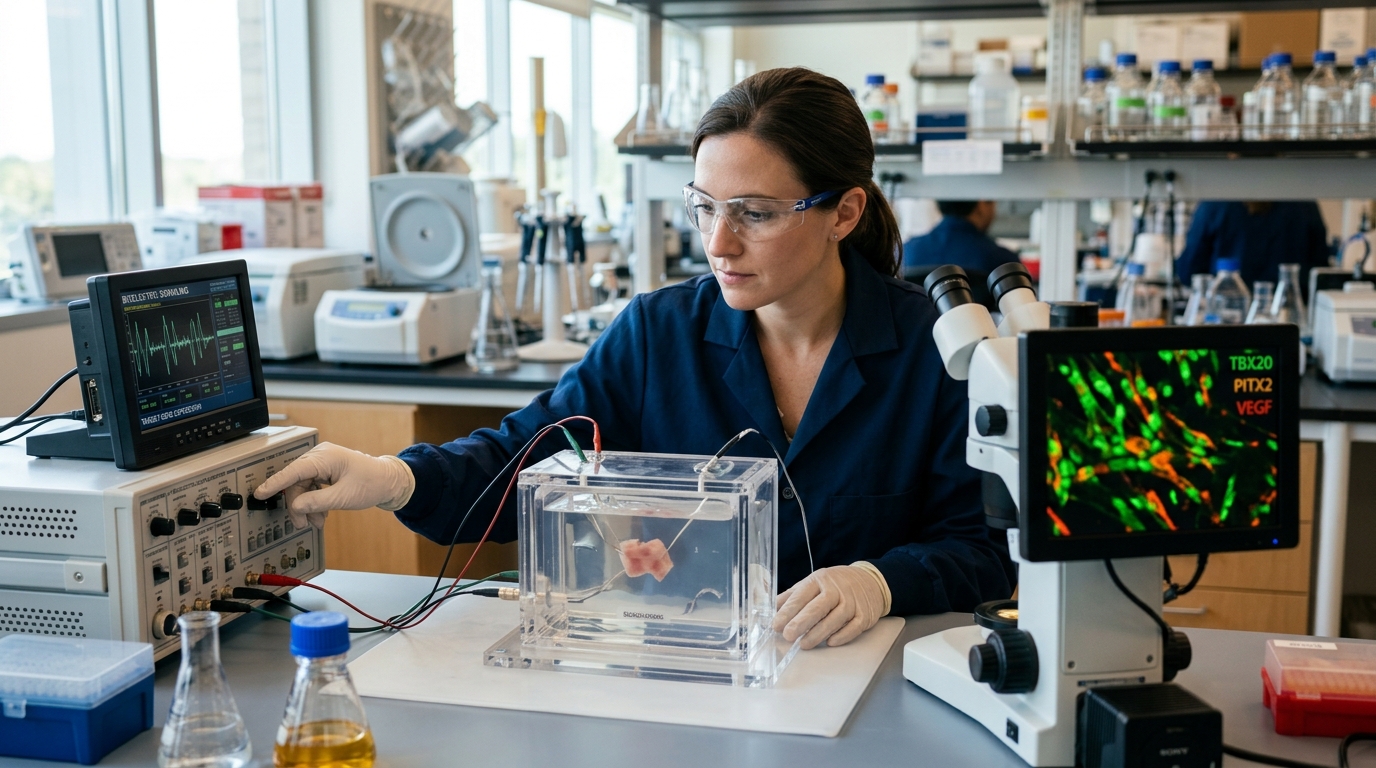
Company plans research program combining precisely controlled bioelectric signaling, regenerative protein-expression targets, Klotho-expressing cells and nutrient hydrogel for cardiovascular and multi-organ regeneration applications
HUNTINGTON BEACH, Calif. — August 2026 — Lionheart Health, Inc. and Leonhardt Ventures LLC announced plans to expand their bioelectric regenerative medicine research platform to investigate a new group of cardiac repair and tissue-regeneration targets: TBX20, PITX2/PITX2c, MEIS1, VEGF and NPPA/pro-ANP, including combinations with the company’s developing Klotho-expressing stem-cell and nutrient-hydrogel platform.
The research initiative is designed to determine whether precisely programmed bioelectric signaling can safely modulate endogenous expression or activity of regenerative pathways associated with cardiomyocyte renewal, vascularization, cellular stress resistance and tissue repair.
The program builds upon Lionheart’s broader strategy of using bioelectric stimulation to influence endogenous regenerative signaling rather than relying solely on repeated administration of recombinant proteins.
Five New Regenerative Targets
TBX20 — Cardiac Development, Reprogramming and Cardiomyocyte Proliferation
TBX20 is a cardiac transcription factor involved in heart development and maintenance. Preclinical research has associated increased TBX20 activity with cardiomyocyte proliferation and cardiac regenerative programs. TBX20 has also improved contractility, mitochondrial respiration and maturation during experimental human cardiac reprogramming. (PubMed)
Lionheart intends to investigate bioelectric signaling protocols designed to modulate TBX20-associated pathways for potential applications including myocardial recovery, cardiac muscle regeneration and cellular reprogramming.
PITX2/PITX2c — Cardiac Repair and Oxidative-Stress Defense
PITX2 is a transcription factor associated with developmental cardiac biology and regenerative signaling. In preclinical research, PITX2 gain-of-function enhanced repair following myocardial infarction and activated genes involved in mitochondrial function and reactive-oxygen-species defense. (PubMed)
Lionheart plans to study PITX2/PITX2c modulation as part of a broader strategy targeting cellular resilience and repair following ischemic injury.
MEIS1 — A Regenerative Target Requiring Down-Regulation Rather Than Expression
Unlike several of the other targets in the program, the scientific evidence suggests that MEIS1 generally should not simply be increased for cardiac regeneration. MEIS1 contributes to postnatal cardiomyocyte cell-cycle arrest; experimental deletion or inhibition has been associated with renewed cardiomyocyte proliferation. (PubMed)
Accordingly, Lionheart’s planned bioelectric research will examine whether specific signaling patterns can reduce or otherwise appropriately modulate MEIS1 activity, rather than treating MEIS1 as a conventional protein-expression target.
This illustrates a central principle of the platform: regenerative bioelectric medicine may ultimately require up-regulating some signals while down-regulating others in a carefully timed sequence.
VEGF — Angiogenesis and Microvascular Support
Vascular endothelial growth factor, or VEGF, is one of the best-characterized regulators of angiogenesis and vascular repair. VEGF signaling promotes endothelial activity and new vessel formation, potentially helping restore microcirculation to ischemic tissue. (PubMed)
Lionheart has long included VEGF within its bioelectric regenerative signaling research and intends to integrate VEGF with the newly identified cardiac targets.
NPPA/pro-ANP — A Newly Compelling Cardiac-Regeneration Target
Particular attention will be given to NPPA, the gene encoding the precursor pro-atrial natriuretic peptide, or pro-ANP.
In a 2026 Science study, researchers used self-amplifying RNA encoding NPPA to produce sustained pro-ANP expression. A single intramuscular administration produced pro-ANP for at least four weeks, after which circulating pro-ANP could be converted by cardiac corin to active ANP. The approach improved cardiac function, reduced infarct size and reduced fibrosis across several animal models, including swine. (PMC)
Lionheart believes this work provides a compelling rationale to determine whether bioelectric signaling can influence the body’s endogenous NPPA/pro-ANP pathway without requiring the same delivery mechanism.
Proposed Multi-Signal Regenerative Sequence
Rather than viewing these targets as isolated proteins, Lionheart’s research strategy will investigate them as components of a coordinated regenerative environment:
Bioelectric signaling → regenerative gene/protein modulation → improved vascular support → cellular protection → controlled cell-cycle activity → tissue remodeling and repair.
Potential targets may include:
| Target | Proposed Research Role |
| TBX20 | Cardiomyocyte proliferation, cardiac identity, reprogramming and mitochondrial function |
| PITX2/PITX2c | Cardiac repair, antioxidant response and cellular resilience |
| MEIS1 ↓ | Investigate controlled reduction/modulation to release cardiomyocyte cell-cycle arrest |
| VEGF ↑ | Angiogenesis, endothelial support and microvascular regeneration |
| NPPA/pro-ANP ↑ | Cardioprotection, regenerative paracrine signaling and fibrosis modulation |
| Klotho ↑ | Longevity-associated cellular protection and regenerative signaling |
Combining Bioelectric Signaling With Klotho-Expressing Cells and Nutrient Hydrogel
A second component of the program is planned to evaluate combinations of bioelectric signaling with Klotho-expressing regenerative cells embedded within a supportive nutrient hydrogel.
The concept is to develop a localized regenerative microenvironment in which cells, extracellular matrix support, nutrients and programmed bioelectric signals work together.
The nutrient hydrogel is envisioned as a temporary supportive matrix designed to improve cellular retention and create a local environment for paracrine signaling, while Klotho-expressing cells are being investigated as a potential source of sustained regenerative signaling.
The bioelectric component would be studied as the programmable control layer, potentially modulating different molecular targets at different stages of repair.
Potential Applications Beyond the Heart
Although cardiovascular regeneration is the initial focus for TBX20, PITX2, MEIS1 and NPPA/pro-ANP, Lionheart intends to evaluate portions of the platform across multiple regenerative medicine programs where scientifically appropriate.
Potential research applications include post-myocardial-infarction repair, ischemic tissue recovery, peripheral vascular regeneration, skeletal-muscle regeneration, kidney support, neurological recovery, skin and wound healing, hair and scalp regeneration, musculoskeletal repair and healthy-aging research.
Targets would be selected separately for each tissue rather than assuming that a cardiac regenerative pathway should be activated universally.
Toward Programmable Regenerative Medicine
“Our objective is not simply to deliver another growth factor,” said Howard J. Leonhardt, Executive Chairman and Co-CEO of Lionheart Health. “We are working toward a programmable regenerative platform capable of telling tissue when to recruit repair cells, when to build circulation, when to protect cells from stress, when to activate regenerative pathways and, equally importantly, when those signals should be turned back down.”
The expanded program is expected to evaluate combinations of Lionheart’s established and developing bioelectric targets with TBX20, PITX2/PITX2c, controlled MEIS1 modulation, VEGF, NPPA/pro-ANP and Klotho-associated signaling.
Scientific Rationale
The program is supported by a rapidly expanding body of preclinical research showing that cardiac regeneration involves coordinated control of cardiomyocyte proliferation, dedifferentiation, angiogenesis, metabolic reprogramming, extracellular-matrix remodeling and paracrine signaling—not a single regenerative molecule. (PubMed)
Recent NPPA research further demonstrates the potential importance of sustained endogenous production of therapeutic proteins, providing additional rationale for exploring methods that stimulate the body to produce regenerative signals for extended periods. (National Institutes of Health (NIH))
Research and Regulatory Status
The TBX20, PITX2/PITX2c, MEIS1 and NPPA/pro-ANP applications described in this announcement are research-stage concepts. Lionheart has not established in humans that its bioelectric stimulation technology can reliably or therapeutically modulate these targets, nor has the combined Klotho-expressing cell/nutrient-hydrogel approach been established as safe or effective for the applications described above.
The company plans laboratory validation of target expression and dose-response relationships before advancing appropriate combinations toward preclinical and, where justified, regulated clinical investigation.
Selected Scientific References
- Zhang K, et al. Single intramuscular injection of self-amplifying RNA of Nppa to treat myocardial infarction. Science. 2026;391:edau9394. (PubMed)
- Mahmoud AI, et al. Meis1 regulates postnatal cardiomyocyte cell cycle arrest. Nature. 2013. (PubMed)
- Tao G, et al. Pitx2 promotes heart repair by activating the antioxidant response after cardiac injury. Nature. 2016. (PubMed)
- Xiang FL, et al. Tbx20 promotes cardiomyocyte proliferation and persistence of fetal characteristics in adult mouse hearts. (PubMed)
- TBX20 improves contractility and mitochondrial function during direct human cardiac reprogramming. (PubMed)
- Review literature identifies VEGF and related angiogenic signaling as important components of vascular repair following myocardial infarction. (PubMed)
About Lionheart Health, Inc.
Lionheart Health is developing bioelectric, biologic and regenerative medicine technologies focused on healthspan, tissue repair and healthy aging. Its research platform investigates combinations of programmable bioelectric stimulation, regenerative signaling, cell-based approaches, biomaterials and complementary technologies across cardiovascular and other regenerative medicine applications.
Forward-Looking Statement
This release contains forward-looking statements regarding research programs, proposed mechanisms, product concepts and potential future applications. Many of the technologies and combinations described are investigational and have not been established as safe or effective for treating disease. Preclinical findings cited from independent research do not establish that Lionheart’s technologies will reproduce those results.