

Investigational Lionheart Octopus™ platform is designed to combine localized regenerative-cell delivery, nutrient hydrogel support, repeatable/refillable dosing and targeted pancreatic bioelectric stimulation
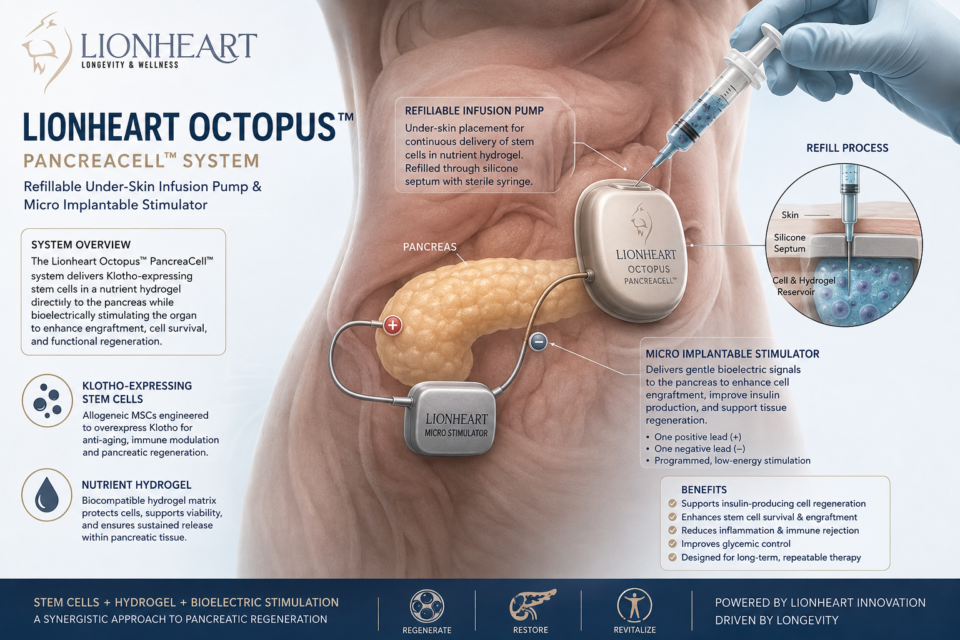
HUNTINGTON BEACH, Calif. — August 31, 2026 — Lionheart Health, Inc. today announced plans to develop a clinical study evaluating its investigational Lionheart Octopus™ PancreaCell™ platform for people with Type 1 diabetes.
The proposed study builds on encouraging advances in stem-cell-derived islet replacement. A landmark 2024 Phase I report described a woman with Type 1 diabetes who received autologous chemically induced pluripotent-stem-cell-derived islets beneath the abdominal anterior rectus sheath. She achieved insulin independence beginning 75 days after transplantation, while time in the target glucose range increased from 43.18% at baseline to 96.21% by month four and subsequently exceeded 98%.
More recently, the Phase 1/2 FORWARD study of the allogeneic stem-cell-derived islet therapy zimislecel provided broader clinical validation of cell replacement as a potential strategy for Type 1 diabetes. Among 12 full-dose participants followed for at least one year, all achieved HbA1c below 7% and freedom from severe hypoglycemic events, and 10 of 12 were insulin independent at day 365. That treatment, however, was administered into the portal vein and required immunosuppression.
PancreaCell™: A Next-Generation Combination Approach
Lionheart’s proposed PancreaCell™ program is intended to investigate whether several regenerative technologies can be combined into one integrated platform rather than relying upon a single cell administration.
The investigational configuration is expected to include:
- Lionheart Octopus™ refillable subcutaneous infusion pump, incorporating a silicone septum designed to permit percutaneous refill and repeat dosing.
- Klotho-expressing regenerative cells in a nutrient-supporting hydrogel, subject to final cell source, manufacturing specifications and regulatory authorization.
- Localized delivery toward the pancreatic region, designed to investigate sustained or repeatable administration rather than a single irreversible cell dose.
- Lionheart implantable microstimulator, with positive and negative electrodes positioned to create a controlled bioelectric field across or adjacent to the pancreas.
- Programmable bioelectric signaling, being investigated for its potential effects on the local regenerative environment, vascularization, inflammation, cellular survival and pancreatic function.
- Continuous glucose monitoring and metabolic testing to quantify changes in insulin requirements, glucose control and endogenous insulin secretion.
The key scientific question is whether cells + supportive hydrogel + repeatable localized delivery + bioelectric stimulation can ultimately improve upon cell therapy alone. These advantages remain hypotheses to be tested and should not be interpreted as established clinical benefits.
Proposed Clinical Study Design
Lionheart anticipates beginning with a carefully controlled early-phase safety and feasibility study, subject to IRB/ethics committee and applicable regulatory approvals.
The protocol is expected to evaluate adults with established Type 1 diabetes and may prioritize patients with impaired awareness of hypoglycemia, recurrent severe hypoglycemic events or substantial exogenous insulin requirements.
The study is expected to track patients for at least 12 months, with longer-term follow-up for implanted-device and cell-therapy safety.
Primary endpoints are expected to focus initially on safety and feasibility, including procedure- and device-related adverse events, cell-therapy safety, infection, inflammatory and immune responses, abnormal tissue growth, device integrity and the feasibility of pump implantation, refill and stimulation.
Key exploratory efficacy endpoints are expected to include stimulated and fasting C-peptide, HbA1c, continuous-glucose-monitoring time in range, daily exogenous insulin requirement, severe hypoglycemic events, glucose-responsive insulin secretion and the proportion of participants achieving partial or complete insulin independence.
These measurements would allow meaningful comparison with the emerging stem-cell-derived islet literature without presuming that PancreaCell™ will reproduce those outcomes.
Designed to Address Limitations of First-Generation Cell Replacement
The 2024 Cell study demonstrated that stem-cell-derived islets implanted at an accessible extrahepatic site could restore insulin independence in an individual patient. Meanwhile, the larger zimislecel experience demonstrated detectable C-peptide and islet function in all 14 participants analyzed after treatment, providing additional evidence that stem-cell-derived replacement cells can restore physiologic islet activity.
Lionheart believes the next major challenge is not simply delivering cells, but creating an environment capable of supporting them over time.
The Lionheart Octopus™ concept therefore adds something fundamentally different: an implanted reservoir designed for repeatable access. Rather than viewing cell transplantation necessarily as a one-time intervention, the system is being designed so investigators could potentially replenish or modify its therapeutic payload as permitted by the clinical protocol.
The second differentiator is bioelectric stimulation. The PancreaCell™ research program will test whether carefully programmed electrical signaling can favorably influence the cellular microenvironment and pancreatic regenerative response when combined with regenerative-cell therapy.
Klotho as an Investigational Regenerative Component
Lionheart also plans to investigate Klotho-enhanced cellular approaches within the PancreaCell™ research program.
Klotho is associated with multiple pathways involving cellular aging, oxidative stress, inflammation and metabolic homeostasis. Lionheart’s hypothesis is that increasing Klotho activity within an appropriately characterized regenerative-cell product could potentially improve the environment for cellular survival and function.
This hypothesis has not yet been clinically demonstrated to reverse Type 1 diabetes and will require rigorous preclinical and clinical testing.
Aiming Beyond a Single-Dose Cell Transplant
“The extraordinary progress being reported with stem-cell-derived islets tells us that restoration of insulin production is no longer merely a theoretical objective. Our goal with PancreaCell™ is to investigate the next question: can we create a maintainable regenerative system combining cells, nutrient support, repeatable delivery and precisely controlled bioelectric stimulation? The Octopus™ architecture is being designed around the concept that regenerative medicine may benefit from an adjustable, refillable platform rather than a one-time intervention.”
— Howard J. Leonhardt, Executive Chairman & Co-CEO, Lionheart Health
Lionheart intends to finalize the PancreaCell™ protocol with diabetes, cell-therapy, transplantation, bioengineering and regulatory specialists before initiation.
The company will also evaluate whether early studies should employ autologous, allogeneic or other appropriately manufactured regenerative-cell populations and what immune-management strategy would be required. These questions are particularly important because Type 1 diabetes involves autoimmune destruction of insulin-producing beta cells.
The Goal: Durable Restoration of Glucose Control
The long-term objective of the PancreaCell™ program is ambitious: determine whether a refillable, bioelectrically supported regenerative platform can safely restore clinically meaningful endogenous insulin production, substantially reduce insulin requirements and eventually enable durable insulin independence in appropriately selected patients.
Lionheart emphasizes that PancreaCell™, Lionheart Octopus™, Klotho-expressing cell therapy and the pancreatic bioelectric-stimulation approach described here are investigational concepts. They have not been proven to cure, reverse or treat Type 1 diabetes and should not be represented as FDA-approved therapies. Clinical studies may begin only following the required regulatory and ethics approvals.
About Lionheart Health
Lionheart Health develops regenerative medicine, bioelectric stimulation, cell-therapy delivery and healthspan technologies designed to activate or augment the body’s regenerative processes. Its development pipeline combines programmable bioelectric signaling with biologics, cellular therapies, biomaterials and implantable or non-invasive delivery technologies.
Scientific context: The 2024 Cell Phase I report provides the closest model for the proposed study, while the subsequent zimislecel results provide important independent clinical evidence for stem-cell-derived islet replacement.
Read the original Cell study on PubMed
Read the NEJM zimislecel clinical study
Forward-Looking Statement
This release contains forward-looking statements regarding investigational technologies, proposed clinical studies and potential therapeutic applications. Actual study design, regulatory pathway, enrollment criteria, cell composition, endpoints and clinical outcomes may differ materially. No investigational Lionheart product described in this release has been demonstrated to cure Type 1 diabetes.