

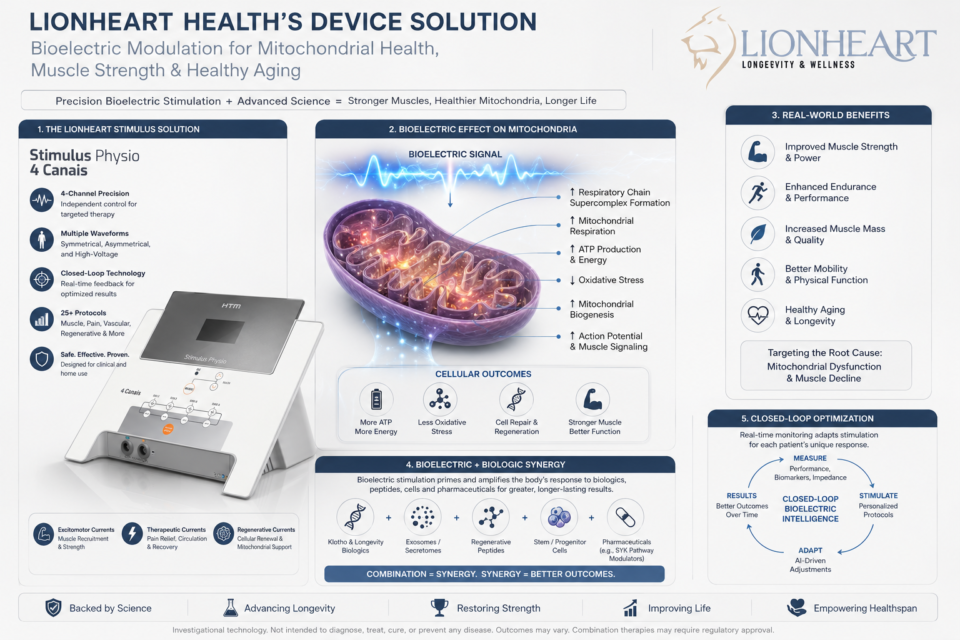
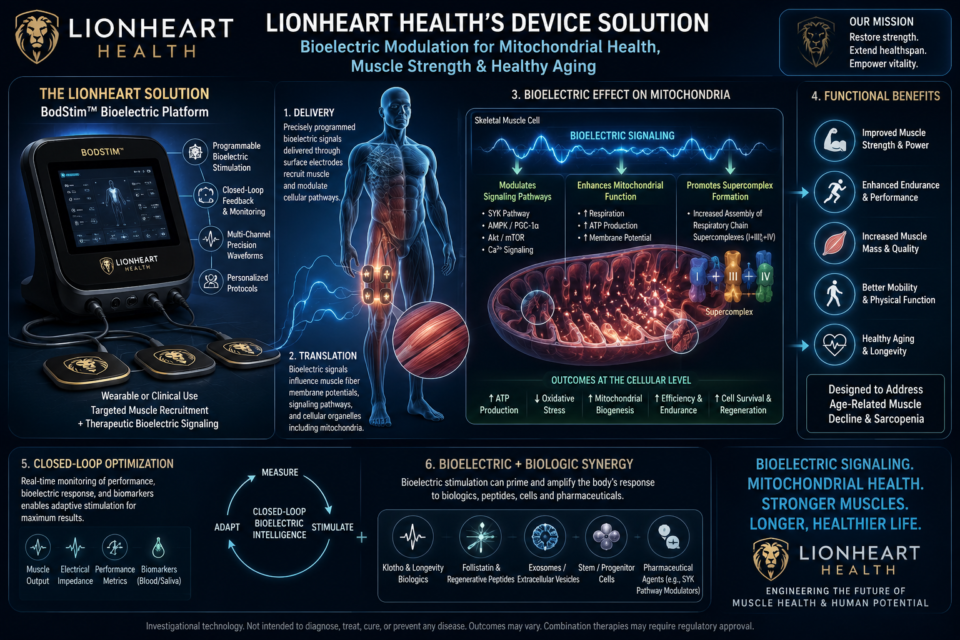
Novel platform is designed to use programmed bioelectric signaling—alone or in combination with biologics, pharmaceuticals and regenerative therapies—to promote mitochondrial respiratory-chain function, muscle regeneration and healthy aging
HUNTINGTON BEACH, Calif. — August 31, 2026 — Leonhardt Ventures LLC and Lionheart Health, Inc. today announced the filing and development of intellectual property covering novel bioelectric systems and methods intended to enhance mitochondrial function, skeletal-muscle performance and regeneration, including potential applications in age-related muscle decline and sarcopenia.
The patent strategy includes programmable electrical stimulation protocols designed to influence cellular pathways associated with mitochondrial respiration, mitochondrial respiratory-chain supercomplex formation, muscle action potentials, muscle protein synthesis, vascularization and regenerative signaling.
The invention further contemplates combining bioelectric stimulation with selected biologics, cells, extracellular vesicles, peptides, proteins, gene-based therapies or pharmaceutical agents when combination therapy may produce a stronger or more durable biological response than bioelectric stimulation alone.
Scientific Rationale
The patent initiative follows growing evidence that mitochondrial organization and signaling may represent important therapeutic targets for preserving muscle function during aging.
A peer-reviewed study published August 24, 2026 in Scientific Reports reported that inhibition of spleen tyrosine kinase (SYK) with fostamatinib/R406 promoted formation of mitochondrial respiratory-chain supercomplexes and increased mitochondrial respiration in mouse-derived muscle cells. In aged mice, fostamatinib treatment promoted respiratory-chain supercomplex formation and improved grip-strength and wire-hanging performance. RNA sequencing also identified increased expression of genes associated with actin nucleation and action-potential activity.
The study did not test Lionheart technology or bioelectric stimulation and does not establish efficacy in humans. Rather, the findings identify biological pathways that Lionheart and Leonhardt Ventures believe may be valuable targets for further bioelectric and combination-therapy research.
Proposed Bioelectric Mitochondrial & Muscle Regeneration Platform
The patent application is intended to encompass embodiments using precisely programmed electrical fields, currents and stimulation sequences to modulate one or more pathways associated with:
- Mitochondrial respiratory-chain organization and supercomplex formation
- Oxidative phosphorylation and cellular ATP production
- Muscle-cell mitochondrial respiration
- Muscle action-potential signaling
- Actin organization, muscle contraction and structural remodeling
- Mitochondrial biogenesis and quality control
- Muscle protein synthesis and regeneration
- Satellite-cell activation and myogenesis
- Angiogenesis and improved skeletal-muscle perfusion
- Neuromuscular recruitment and muscle strength
- Age-associated sarcopenia and loss of physical function
The companies intend to investigate whether selected stimulation protocols can directly or indirectly influence the SYK-associated signaling network and downstream mitochondrial respiratory-chain organization, while also exploring pathways that may achieve similar functional outcomes without requiring systemic pharmacological SYK inhibition.
Bioelectric + Biologic Combination Therapy
An important component of the intellectual-property strategy is the potential use of bioelectric signaling as a biological amplification and conditioning platform.
Potential combination embodiments may include bioelectric stimulation administered before, during or after delivery of:
Klotho or Klotho-enhancing therapies; follistatin-related approaches; regenerative peptides; extracellular vesicles/exosomes; stem or progenitor cells; cell-derived secretomes; nutrient or extracellular-matrix hydrogels; mitochondrial-supportive agents; and selected pharmaceutical compounds, potentially including agents affecting SYK-associated pathways.
The objective is to determine whether programmable stimulation can create a more favorable cellular environment for mitochondrial restoration and muscle regeneration while potentially allowing biologic or pharmacologic therapies to be delivered in a more targeted, synergistic manner.
Potential Integration With Lionheart’s BodStim™ Platform
One contemplated implementation utilizes Lionheart Health’s BodStim™ electrical muscle stimulation platform, with programmable electrode configurations designed to simultaneously recruit skeletal muscle and deliver investigational bioelectric signaling patterns intended to influence regenerative and mitochondrial pathways.
Future embodiments may incorporate closed-loop monitoring of muscle performance, electrical impedance, metabolic biomarkers, circulating proteins and other physiological measurements so that stimulation parameters can be dynamically adjusted.
The broader goal is development of a precision bioelectric muscle-health platform capable of addressing muscle strength, mitochondrial health and regenerative signaling simultaneously.
Beyond Traditional EMS
“Traditional electrical muscle stimulation primarily focuses on producing muscle contraction. Our intellectual-property strategy goes substantially further by investigating electrical signaling as a means of directing the underlying cellular biology of aging muscle,” said Howard J. Leonhardt, Executive Chairman and Co-CEO of Lionheart Health and Founder of Leonhardt Ventures LLC.
“Our objective is to determine whether precisely programmed bioelectric signals, alone or combined with regenerative biologics, can improve mitochondrial performance, stimulate beneficial protein-expression pathways and ultimately help preserve or restore muscle function with aging.”
Development Program
Leonhardt Ventures and Lionheart Health anticipate evaluating candidate stimulation protocols through staged laboratory and clinical research measuring endpoints that may include:
mitochondrial respiration and oxygen-consumption rate; respiratory-chain supercomplex formation; ATP production; muscle strength and endurance; muscle mass and quality; functional performance; Klotho and other regenerative biomarkers; inflammatory markers; and transcriptomic/proteomic changes associated with mitochondrial and skeletal-muscle function.
The companies envision applications in healthy aging, healthspan extension, age-related muscle weakness, physical rehabilitation and sarcopenia, subject to appropriate preclinical validation, clinical studies and regulatory authorization.
Reference
Takeiwa T, Sato W, Azuma K, et al. SYK inhibitor fostamatinib promotes mitochondrial respiratory chain supercomplex formation and improves skeletal muscle function in aged mice. Scientific Reports. Published August 24, 2026.
Important Notice
The technologies described in this announcement include investigational concepts and patent-pending or patent-application subject matter. Certain proposed indications, biologics and combination therapies have not been established as safe or effective for the uses described and may require FDA or other regulatory authorization before commercialization. References to published third-party research do not imply collaboration with, endorsement by, or validation of Lionheart Health or Leonhardt Ventures by the study authors or publishers.
The strongest patent angle, in my view, is not merely “EMS for sarcopenia,” but closed-loop bioelectric modulation of mitochondrial respiratory-chain supercomplex formation and associated pathways, with claims covering bioelectric-only and bioelectric + biologic/pharmaceutical combinations. That gives the application a more differentiated mechanistic focus.
Read the Scientific Reports study on Nature
Howard J. Leonhardt