
Investigational platform combines a refillable infusion pump, Klotho-expressing stem cells in a nutrient hydrogel, and targeted bioelectric stimulation
HUNTINGTON BEACH, Calif., September 10, 2026 — Lionheart Health, Inc. today announced plans to launch a preclinical feasibility study of LiverCell™, an investigational regenerative-medicine platform designed to support damaged liver tissue through repeat cell delivery and localized bioelectric signaling.
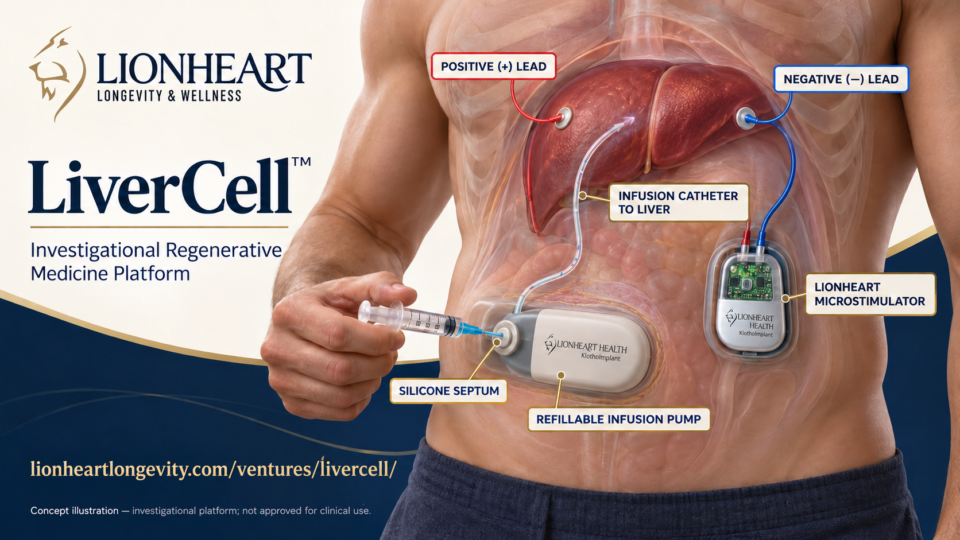
The LiverCell™ study will examine a system comprising a refillable implanted infusion pump intended to receive daily replenishment with Klotho-expressing stem cells suspended in a nutrient hydrogel, together with an implantable microstimulator designed to apply localized bioelectric signals.
The research hypothesis is that the combined platform may improve cell retention or recruitment near the liver and stimulate the local release of selected regenerative proteins. These effects have not yet been established in humans and will be evaluated through staged laboratory and preclinical testing.
“Liver failure is usually a transplant conversation. LiverCell™ is designed to explore whether regenerative support can become a repeatable, localized process that works alongside the patient’s own liver,” said Howard J. Leonhardt, Executive Chairman and Co-CEO of Lionheart Health.
“Our study will test the component technologies carefully and measure whether cell delivery combined with bioelectric protein signaling can provide the foundation for a new type of liver-support platform.”
How LiverCell™ Is Designed to Work
Repeatable delivery: A refillable infusion architecture is intended to allow scheduled replenishment rather than relying on a single, fixed cell dose.
Cell-supporting matrix: A nutrient hydrogel is intended to protect and support the administered cells while helping keep the formulation localized.
Klotho-expressing cells: The investigational cell component is designed to express Klotho, a protein associated in preclinical research with cellular resilience, inflammation regulation, and tissue-repair pathways.
Bioelectric targeting: An implantable microstimulator is designed to deliver localized signals intended to encourage stem-cell homing and the expression or release of additional regenerative proteins.
Adjustable platform: Pump refills and programmable stimulation may allow investigators to study and refine cell dose, delivery timing, and bioelectric signal parameters over time.
Relationship to MIT Satellite Liver Research
MIT engineers reported in March 2026 that primary human hepatocytes mixed with supportive fibroblasts and injectable hydrogel microspheres could form vascularized “satellite liver” grafts following ultrasound-guided injection.
In immune-suppressed mice, the grafts remained viable for at least two months and produced liver-associated enzymes and proteins. MIT described the concept as a potential method of providing “booster” liver function while leaving the failing organ in place.
The MIT work provides important independent scientific support for investigating minimally invasive, hydrogel-supported cellular therapies for liver function.
LiverCell™ is a separate Lionheart Health investigational platform. Its proposed differentiating features include:
- Repeat replenishment through a refillable implanted pump
- Klotho-expressing stem cells rather than primary hepatocytes
- A nutrient hydrogel intended to support cell viability and localization
- A paired implantable microstimulator intended to promote cell homing
- Programmable bioelectric signals intended to stimulate the release or expression of additional regenerative proteins
- The potential to adjust cell-delivery and stimulation parameters over time
These design features may offer potential advantages in adjustability, cell support, localization, and regenerative signaling. However, LiverCell™ has not been compared directly with MIT’s platform, and no superiority in durability, liver function, safety, or clinical benefit has been demonstrated.
Study Focus
The planned LiverCell™ research program will begin by evaluating:
- System integration
- Cell and hydrogel formulation
- Pump compatibility and refill performance
- Hydrogel flow characteristics
- Sterility
- Cell viability
- Bioelectric stimulation parameters
- Cell localization and biodistribution
- Cell retention and survival
- Klotho expression
- Target regenerative-protein responses
- Liver injury and regeneration biomarkers
- Liver-function measures
- Immune responses
- Device performance
- Overall safety
Subject to completion of formal protocols and all required ethics and regulatory reviews, later preclinical studies are expected to examine whether the integrated platform can provide measurable support to damaged liver tissue.
Lionheart Health intends to develop the study with qualified investigators and manufacturing, cell-therapy, biomaterials, and regulatory partners. The final model, endpoints, dosing schedule, study duration, and development timeline will be established through formal protocol development.
A New Model for Organ Support
Whole-organ transplantation remains lifesaving and is the established treatment for many patients with end-stage liver disease. LiverCell™ is not intended to diminish the importance of organ donation or liver transplantation.
The LiverCell™ research program instead asks whether future medicine may supplement a failing organ through repeat delivery of living cells, supportive biomaterials, and programmable regenerative signals.
If eventually proven safe and effective, such a platform might be studied as a bridge to transplantation, an adjunct to conventional treatment, or a new method of supporting selected patients who are not candidates for transplantation.
About Lionheart Health
Lionheart Health, Inc. develops bioelectric stimulation technologies, regenerative biologics, and implantable and noninvasive platforms intended to advance healthspan and tissue repair.
The company’s research programs combine programmable bioelectric signals with cells, biologics, biomaterials, and delivery technologies across multiple organ-health, regenerative-medicine, and wellness applications.Important Notice
LiverCell™ is investigational. It has not been approved or cleared by the U.S. Food and Drug Administration or any other regulatory authority and is not available for sale or clinical use.
The announced study is intended to generate scientific evidence. This news release does not establish the safety, effectiveness, superiority, or suitability of LiverCell™ for any patient.
Statements concerning anticipated studies, biological mechanisms, outcomes, regulatory pathways, and development plans are forward-looking and subject to scientific, clinical, regulatory, manufacturing, financing, and other risks.
Contact
Lionheart Health, Inc.
Website:
http://www.
http:
http
Email: howard@LionheartLongevity.com
Sources
Massachusetts Institute of Technology. “Injectable ‘satellite livers’ could offer an alternative to liver transplantation.” MIT News, March 3, 2026.
https://news.mit.edu/2026/
Kumar V, et al. “Image-guided injectable niche for hepatocyte transplantation.” Cell Biomaterials, 2026, Article 100378.
Stem cells, organoids and extracellular vesicles
- Mohamadnejad M, et al. Randomized placebo-controlled trial of mesenchymal stem-cell transplantation in decompensated cirrhosis. 2013. PubMed PMID 23763455
- Liang J, et al. Effects of allogeneic mesenchymal stem-cell transplantation in patients with liver cirrhosis. 2017. PubMed PMID 28217916
- Watanabe T, et al. Development of a rapid NASH-fibrosis model and treatment with human mesenchymal stem cells and their small extracellular vesicles. 2020. PubMed PMID 32455155
- Winkler S, et al. Human mesenchymal stem cells differentiated into hepatocyte-like cells correct NASH in mice. 2014. PubMed PMID 24786317
- Yang Z, et al. Human mesenchymal stem-cell treatment alleviates steatosis, inflammation and fibrosis and modifies the microbiome and metabolome in experimental NASH. 2020. PubMed PMID 33168782
- Hu J, et al. Human umbilical-cord mesenchymal stem cells attenuate Western-diet-induced obesity, NASH and liver fibrosis through lipid-metabolism and PPAR pathways. 2024. PubMed PMID 38356602
- Zhang B, et al. Mesenchymal-stem-cell small extracellular vesicles reduce liver fibrosis in a mouse model of NASH. 2023. PubMed PMID 37175803
- Zong R, et al. Umbilical-cord MSC-derived exosomes alleviate liver fibrosis through inhibition of Hedgehog/SMO signaling. 2024. PubMed PMID 39138757
- Khalil MR, et al. Therapeutic effects of bone-marrow mesenchymal stem cells in carbon-tetrachloride-induced liver fibrosis. 2021. PubMed PMID 32389821
- Yan Y, et al. Adipose-derived mesenchymal stem-cell therapy in experimentally induced acute liver injury. 2019. PubMed PMID 31635840
- Takebe T, et al. Vascularized and functional human liver generated from induced pluripotent stem-cell-derived liver buds. Nature. 2013. PubMed PMID 23823721
- Nie YZ, et al. Human liver organoids generated from multiple cell types derived from a single donor rescue mice from acute liver failure. 2018. PubMed PMID 29321049
These studies provide evidence for antifibrotic, immunomodulatory and liver-support effects, but results across MSC trials have been heterogeneous.
Klotho, liver disease and liver cancer
- Chen L, et al. Klotho as a tumor suppressor and modulator of the Wnt/β-catenin pathway in human hepatocellular carcinoma. Laboratory Investigation. 2015. PubMed PMID 26237271
- Shu G, et al. Restoration of Klotho expression induces apoptosis and autophagy and reduces invasion in hepatocellular-carcinoma cells. 2013. PubMed PMID 23248036
- Xie B, et al. Epigenetic silencing of Klotho expression correlates with poor prognosis in human hepatocellular carcinoma. 2013. PubMed PMID 23123137
- Sun H, et al. Overexpression of Klotho suppresses liver-cancer progression and induces apoptosis through negative regulation of Wnt/β-catenin signaling. 2015. PubMed PMID 26499380
- Poh W, et al. β-Klotho suppresses hepatocellular-carcinoma growth by regulating Akt/GSK-3β/cyclin-D1 signaling. 2013. PubMed PMID 23383245
- Chen TH, et al. Klotho increases hepatoma-cell anoikis resistance through VEGFR2/PAK1 activation. 2013. PubMed PMID 23516476
- Liu WY, et al. Protective association between the Klotho rs495392 genetic variant and histological severity of NAFLD. 2022. PubMed PMID 34839623
- Valenti L, et al. β-Klotho gene variation is associated with liver damage in pediatric NAFLD. 2019. PubMed PMID 31655133
- Lee KJ, et al. Expression of FGF21 and β-Klotho in human liver inflammation and fibrosis. 2018. Full text at PubMed Central
- Tan H, et al. Klotho-derived peptide 1 ameliorates hepatic fibrosis associated with alpha-Klotho deficiency and liver injury. 2026. PubMed PMID 41608630
The overall Klotho literature is encouraging but biologically complex. Several experiments support tumor-suppressive activity, while one study found increased migration and anoikis resistance in certain hepatoma models. That conflict makes cell type, expression level, tumor genotype, dose control and long-term tumorigenicity testing essential.
Hydrogels, scaffolds and localized liver delivery
- Kumar V, et al. Image-guided injectable niche for hepatocyte transplantation using primary human hepatocytes and hydrogel microspheres. Cell Biomaterials. 2026. PubMed PMID 41676514
- Lee JS, et al. Liver extracellular matrix provides two-dimensional coating and three-dimensional hydrogel platforms for hepatocyte culture and transplantation. 2014. PubMed PMID 24350561
- Hussein KH, et al. Decellularized hepatic extracellular-matrix hydrogel as a therapeutic platform for liver fibrosis. 2020. PubMed PMID 32806289
- Mardpour S, et al. Hydrogel-mediated sustained systemic delivery of mesenchymal-stem-cell extracellular vesicles for liver regeneration. 2019. PubMed PMID 31525863
- Liu S, et al. Self-assembling peptide/heparin hydrogel delivering anti-TNF-α and hepatocyte growth factor for liver regeneration. 2020. PubMed PMID 31843715
- Oe S, et al. Gelatin microspheres providing sustained hepatocyte-growth-factor delivery promote regeneration in rat liver cirrhosis. 2003. PubMed PMID 12628327
- Zheng Q, et al. Carboxymethyl-chitosan/
oxidized-hyaluronic-acid hydrogel carrying umbilical-cord MSC exosomes promotes liver regeneration after hepatectomy. 2025. PubMed PMID 39914972 - Yang H, et al. ROS-responsive injectable hydrogel carrying exosomal miR-4500 for experimental liver fibrosis. 2025. PubMed PMID 39405826
- Bolinas DKM, et al. Mesenchymal stem cells delivered in injectable alginate hydrogel enhance liver growth and reduce fibrosis. 2025. PubMed PMID 40277686
- Tai YC, et al. Injectable, self-healing chitosan-based hydrogel for regression of experimental liver fibrosis. 2025. PubMed PMID 40051386
Hydrogels may improve localization, survival and sustained delivery of cells or paracrine products, but formulation must be validated for cell viability, diffusion, biodegradation, catheter flow, immune response and vascular safety.
Bioelectric, pulsed-electric and electromagnetic approaches
- Costa FP, et al. Treatment of advanced hepatocellular carcinoma with very-low-level, tumor-specific, amplitude-modulated electromagnetic fields. British Journal of Cancer. 2011. PubMed PMID 21829195
- Zimmerman JW, et al. Cancer-cell proliferation is inhibited by tumor-specific modulation frequencies. 2012. PubMed PMID 22134506
- Jimenez H, et al. Tumor-specific amplitude-modulated radiofrequency electromagnetic fields induce hepatocellular-carcinoma differentiation through Cav3.2 T-type calcium channels. 2019. PubMed PMID 31160272
- Blackstock AW, et al. Safety and efficacy of amplitude-modulated radiofrequency electromagnetic-field treatment for advanced hepatocellular carcinoma. PubMed PMID 41550248
- Capareli F, et al. Feasibility study of personalized low-frequency electromagnetic-field exposure in patients with advanced hepatocellular carcinoma. 2023. PubMed PMID 37184216
- Chen X, et al. Long-term survival of mice with hepatocellular carcinoma treated with nanosecond pulsed electric fields. 2012. PubMed PMID 22181334
- Chen R, et al. Protective effect following clearance of orthotopic rat hepatocellular carcinoma using nanosecond pulsed electric fields. European Journal of Cancer. 2014. PubMed PMID 25081978
- Chen X, et al. Electric ablation with irreversible electroporation in porcine liver: feasibility and safety study. 2015. PubMed PMID 26549662