
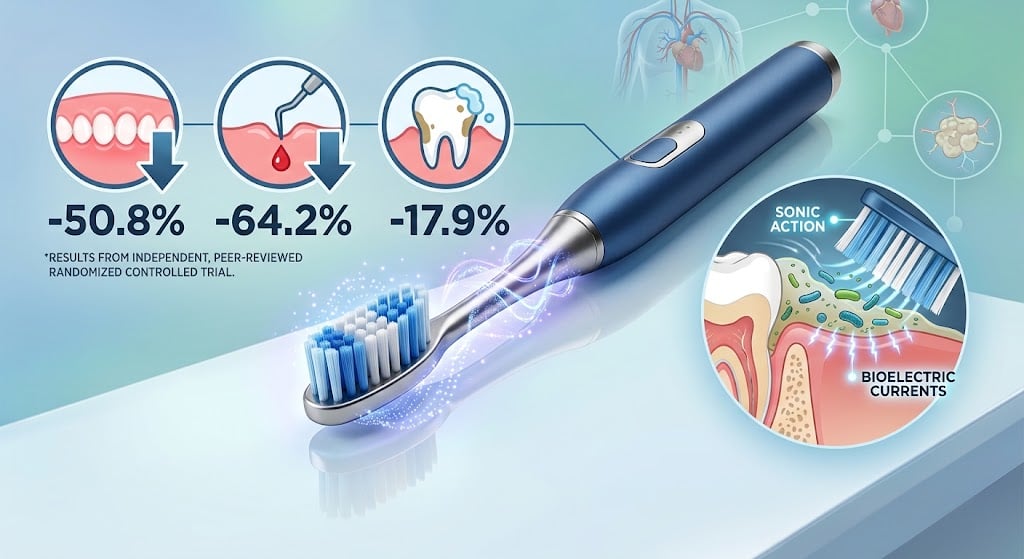
PEER-REVIEWED CLINICAL RESULTS
-
50.8% Less Gum Inflammation
-
64.2% Less Bleeding on Probing
-
17.9% Less Plaque Buildup
Results from an independent, peer-reviewed randomized controlled trial.

A sonic + bioelectric toothbrush combines two ways of tackling plaque: fast-moving bristles help sweep it away, while tiny electrical currents are designed to loosen the sticky bacterial film that holds it together. That second action may add benefits for gum health. Laboratory research supports this mechanism, although results depend on the brush and how it is used. PMC
Think of plaque as a community of bacteria living inside a sticky coating on your teeth:
-
An ordinary manual toothbrush removes plaque wherever you guide the bristles.
-
A sonic toothbrush adds rapid bristle movements to help clean those surfaces.
-
A sonic + bioelectric toothbrush adds gentle microcurrents intended to weaken the plaque’s attachment, helping the brushing action do its job. PMC
The most promising extra benefit is healthier gums. In a four-week randomized trial involving 99 adults with gingivitis, the tested bioelectric brush reduced gum inflammation more than either a manual brush or a sonic brush. It also reduced bleeding more than the manual brush. Its plaque-removal results were similar to the sonic brush. Scientific Reports
The appeal is effective cleaning plus an additional approach to controlling the bacterial film that irritates gums—all during the same brushing routine.
Oral health is relevant to healthy aging through inflammation, vascular and metabolic health, preservation of chewing function, and interactions between oral bacteria and other organs. The following references support those connections, with evidence ranging from clinical trials to observational studies and laboratory research.
Healthspan, longevity, and systemic health
|
Reference
|
Evidence type
|
Finding and relevance
|
|---|---|---|
|
Romandini M, et al. (2021). Periodontitis, Edentulism, and Risk of Mortality: A Systematic Review with Meta-analyses.Journal of Dental Research. DOI: 10.1177/
|
Meta-analysis of cohort studies
|
Periodontitis and complete tooth loss were associated with increased mortality. Supports an oral health–longevity connection, but does not establish that treatment extends lifespan. journals.sagepub.com
|
|
Guo X, et al. (2023). Periodontal disease and subsequent risk of cardiovascular outcome and all-cause mortality: A meta-analysis of prospective studies. PLOS ONE.DOI: 10.1371/journal.pone.
|
Cohort-study meta-analysis
|
Evaluates associations between periodontal disease, cardiovascular outcomes, and mortality—important outcomes for healthy aging. PLOS One
|
|
Ramsay SE, et al. (2018). Influence of Poor Oral Health on Physical Frailty: A Population-Based Cohort Study of Older British Men. Journal of the American Geriatrics Society. DOI: 10.1111/jgs.
|
Human longitudinal cohort
|
Links poor oral health with physical frailty. Nutrition and inflammation are plausible pathways, although their contributions require further study. Wiley Online Library
|
|
Tonetti MS, et al. (2007). Treatment of Periodontitis and Endothelial Function. New England Journal of Medicine. DOI: 10.1056/
|
Randomized clinical trial
|
Intensive periodontal treatment improved vascular endothelial function at six months, following a temporary inflammatory response immediately after treatment. Demonstrates a systemic benefit on a vascular measure, rather than proof of fewer cardiovascular events. New England Journal of Medicine
|
|
Simpson TC, et al. (2022). Treatment of periodontitis for glycaemic control in people with diabetes mellitus. Cochrane Database of Systematic Reviews. Article CD004714
|
Systematic review of randomized trials
|
Moderate-certainty evidence supports improved blood glucose control after periodontal treatment in people with both diabetes and periodontitis. One of the stronger clinical demonstrations of an oral–systemic connection. Cochrane
|
Gut health and the oral–gut axis
|
Reference
|
Evidence type
|
Finding and relevance
|
|---|---|---|
|
Schmidt TSB, et al. (2019). Extensive transmission of microbes along the gastrointestinal tract. eLife. DOI: 10.7554/
|
Human microbiome study
|
Identified shared microbial strains between the mouth and intestine, supporting the mouth as a reservoir for gut microbes. Such transmission also occurs in health and is not inherently harmful. PMC
|
|
Atarashi K, et al. (2017). Ectopic colonization of oral bacteria in the intestine drives TH1 cell induction and inflammation. Science. DOI: 10
|
Human-derived bacteria studied in mouse models
|
Certain oral Klebsiella strains colonized the gut and activated inflammatory immune responses in susceptible experimental settings. Provides a mechanism connecting oral microbes with intestinal inflammation. PMC
|
|
Kitamoto S, et al. (2020). The Intermucosal Connection between the Mouth and Gut in Commensal Pathobiont-Driven Colitis. Cell. DOI: 10.1016/j.
|
Mechanistic animal research
|
Oral inflammation supplied both bacteria and bacteria-reactive immune cells that worsened intestinal inflammation. Supports an oral–gut immune pathway; it does not establish that brushing treats inflammatory bowel disease. pmc.ncbi.nlm.nih.gov
|
Brain health and cognition
|
Reference
|
Evidence type
|
Finding and relevance
|
|---|---|---|
|
Asher S, et al. (2022). Periodontal health, cognitive decline, and dementia: A systematic review and meta-analysis of longitudinal studies.Journal of the American Geriatrics Society.DOI: 10.1111/jgs.17978
|
Review of 47 longitudinal studies
|
Poor periodontal health was associated with cognitive decline (OR 1.23) and dementia (HR 1.21). Evidence quality was low, and reverse causation—cognitive decline worsening oral care—partly explained the associations. PubMed
|
|
Demmer RT, et al. (2020). Periodontal disease and incident dementia: The Atherosclerosis Risk in Communities Study (ARIC). Neurology. DOI: 10.
|
Human prospective cohort
|
Severe periodontal disease was associated with a modest increase in subsequent dementia risk: adjusted HR 1.22, 95% CI 1.01–1.47. This is an association, not proof of causation. pubmed.ncbi.nlm.
|
|
Dominy SS, et al. (2019). Porphyromonas gingivalis in Alzheimer’s disease brains: Evidence for disease causation and treatment with small-molecule inhibitors. Science Advances. DOI: 10.1126/sciadv.
|
Human postmortem tissue plus laboratory and animal studies
|
Detected bacterial proteins in Alzheimer’s brain tissue and investigated neuroinflammatory mechanisms experimentally. Despite the title, the study does not establish that gum disease causes Alzheimer’s in humans or that oral care prevents it. PMC
|
Visit our full eSHOP to browse additional health optimization products > https://lionheartlongevity.