
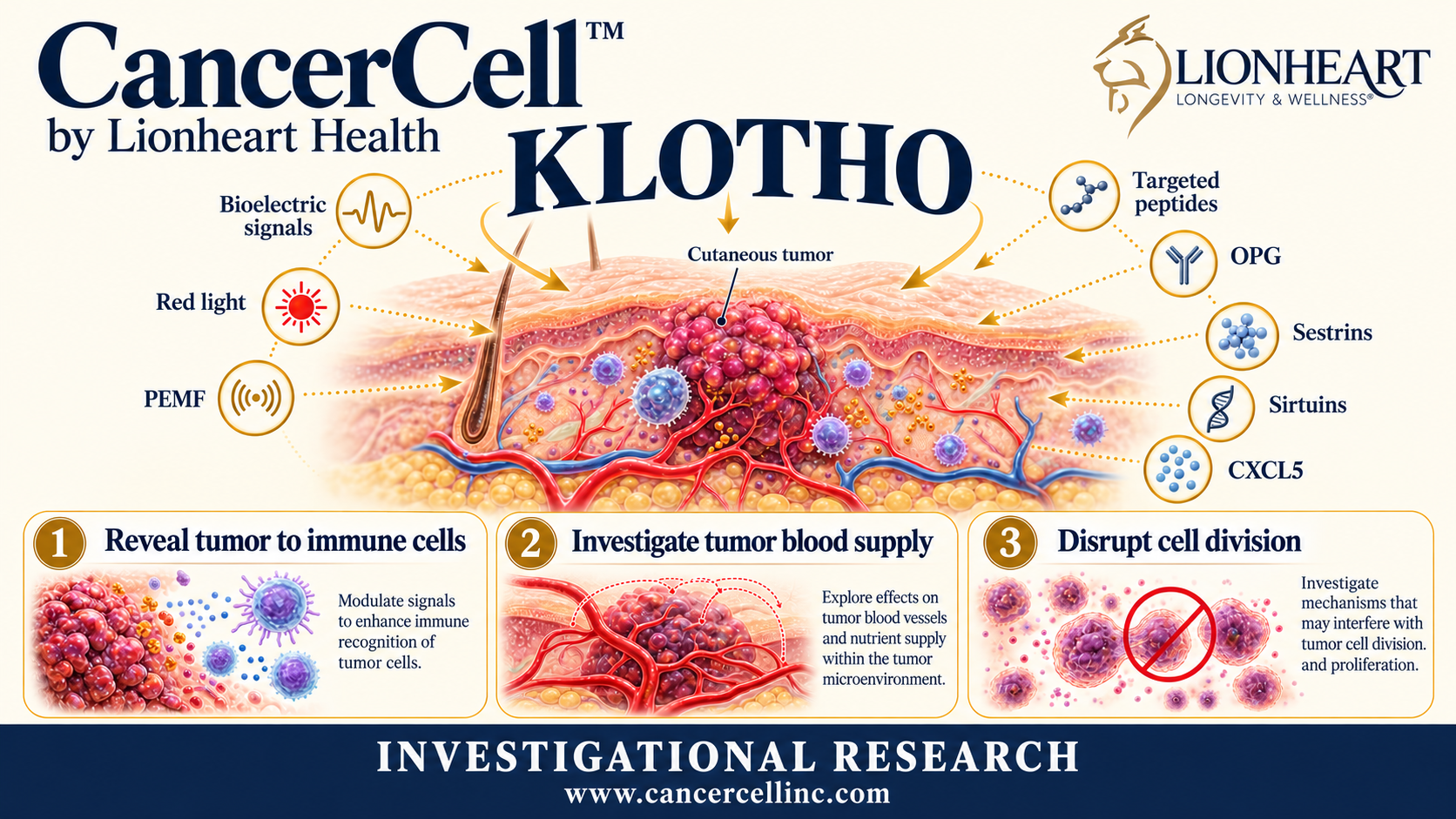
CancerCell begins with tumor-directed signals. Lionheart states that it licenses the Schuler cancer patents on its issued-patent list. Those records describe measuring or processing electrical signals associated with cancer cells, transmitting modified signals, and proposed ways to induce tumor-cell death. Leonhardt and Genovese’s US 11,185,691 adds a description of treatment adjusted in response to information gathered from a tumor. Together, the disclosures frame a research program. They do not yet tell us which waveform, dose, delivery method or cancer type will respond in patients. lionheartlongevity.
Klotho supplies a biological question. Leonhardt’s US 12,226,639 describes stimulation intended to increase Klotho expression. Separately, published researchers have reported that Klotho manipulation can suppress growth or signaling in several experimental cancer models. Particularly relevant to the gene-therapy question, a lymphoma study reported less growth in mouse tumors associated with Klotho overexpression vector treatment or recombinant Klotho. That is animal evidence for investigating the approach, not a demonstrated human cancer treatment. Effects may differ across tumor types and Klotho family members. patents.justia.com
The OPG patent adds another pathway. Leonhardt and Genovese’s US 11,691,007 describes bioelectric signals intended to upregulate osteoprotegerin and affect the OPG/RANKL/RANK pathway. That gives investigators a specific target to measure, particularly in questions involving bone. A useful study would establish that the intended signal changes the target in the relevant tissue, then determine whether that change improves an outcome without unacceptable effects. patents.justia.com
BodStim™ addresses a different need. People receiving cancer treatment may lose muscle or struggle to exercise. A BodStim oncology protocol in development could test whether supervised neuromuscular stimulation helps preserve strength and function alongside usual care. Studies of related electrical muscle-stimulation approaches in cancer populations offer a basis for designing muscle-outcome research. They cannot be used to claim that BodStim destroys tumors. pubmed.ncbi.nlm.nih.
Combinations require their own experiments. Lionheart is interested in bioelectric stimulation with red light, pulsed electromagnetic fields and selected peptides. Each component has a different evidence base. For example, published PEMF work includes cancer-cell experiments, while a breast-cancer study examined PEMF for radiation dermatitis, a treatment-related skin problem rather than tumor control. Peptide approaches are being investigated in oncology, but a result for one defined peptide cannot validate an unspecified peptide combination. There is currently no cited clinical study establishing that Lionheart’s proposed four-part combination treats cancer. pmc.ncbi.nlm.nih.gov
The posted CancerCell protocol offers a practical starting question: Does active stimulation change tumor growth compared with sham stimulation in a specified mouse model? Its proposed imaging and caliper measurements could answer that question if a current study defines the waveform, delivery schedule, randomization, safety measures and analysis in advance, and reports the results.
That is how the portfolio can become useful evidence: first show that a signal reaches its target and reliably changes the intended biology; then test tumor or supportive-care outcomes in appropriate models; and only then assess human safety and benefit through the required clinical and regulatory path. Patients should continue established oncology care while these approaches are investigated.
Lionheart Health’s proposed cancer research plan is multimodal: it will investigate tumor-directed bioelectric signals alongside Klotho modulation, osteoprotegerin and other tumor-relevant pathways, selected peptides, red-light photobiomodulation, and pulsed electromagnetic fields (PEMF). A separate BodStim™ study would examine whether muscle stimulation helps preserve strength and physical function during cancer treatment. Researchers would first test each component’s dose, target engagement and safety, then study carefully defined combinations to determine whether they provide benefits beyond any single component. The combined approach remains investigational; its effects on tumor growth and patient outcomes have not been established.
“Lionheart’s cancer research strategy draws on 13 issued U.S. patents: nine licensed Schuler CancerCell patents and four Leonhardt-led grants covering adaptive tumor stimulation, osteoprotegerin signaling and two Klotho modulation inventions. Our broader research portfolio also includes issued patents relevant to inflammation and GDF10, along with published applications involving Sestrins, Sirtuins and other bioelectric protein-expression targets. The strength of this platform lies in the range of precise questions we can test—identifying which signal, target and combination may benefit a particular cancer, and proving the answer through rigorous studies.” — Howard J. Leonhardt, Executive Chairman and Co-CEO, Lionheart Health, Inc.
Selected scientific references
-
Wolf I, et al. Klotho in human breast cancer and IGF-1/FGF signaling. Oncogene, 2008. PubMed. pubmed.ncbi.nlm.
nih.gov -
Abramovitz L, et al. KL1, Klotho signaling and pancreatic cancer models. Clinical Cancer Research, 2011. PubMed. pubmed.ncbi.nlm.
nih.gov -
Klotho overexpression vector and recombinant Klotho in diffuse large B-cell lymphoma models. Journal of Hematology & Oncology, 2017. PubMed. This is the clearest gene-delivery-related cancer experiment identified here; it is preclinical. pubmed.ncbi.
nlm.nih.gov -
Doi S, et al. Secreted Klotho and cancer xenograft metastasis in mice. Journal of Biological Chemistry, 2011. PubMed. pubmed.ncbi.nlm.
nih.gov -
Stupp R, et al. Tumor treating fields plus temozolomide in glioblastoma. JAMA, 2017. Study. This trial concerns a distinct device and treatment regimen. jamanetwork.com
-
Whole-body electrical muscle stimulation with nutrition in advanced cancer: controlled pilot study. PubMed. pubmed.ncbi.
nlm.nih.gov -
Neuromuscular electrical stimulation during breast-cancer chemotherapy: randomized study of muscle outcomes. PubMed. pubmed.ncbi.
nlm.nih.gov -
PEMF and cancer-cell death: preclinical study. Full text. pmc.ncbi.nlm.nih.gov