
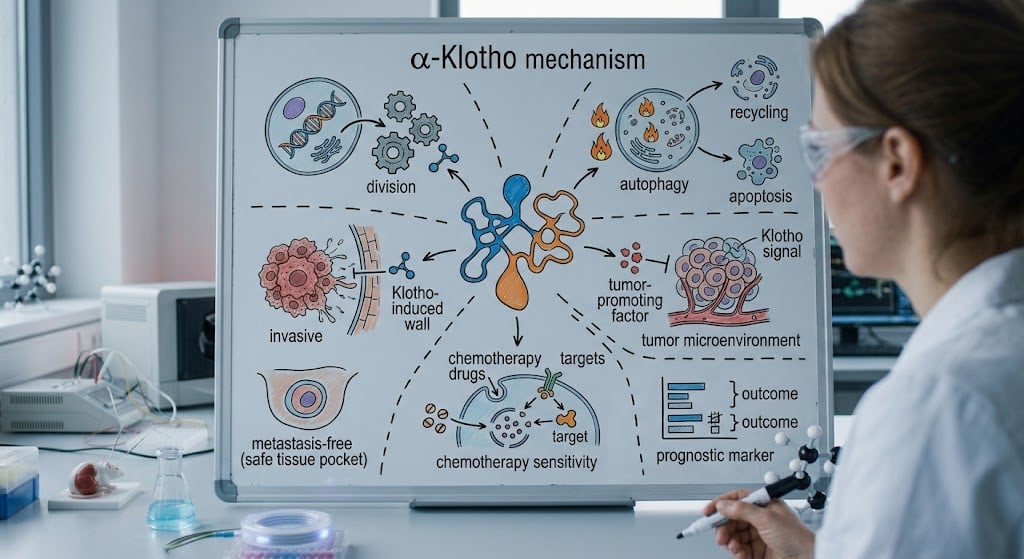
α-Klotho may help restrain several behaviors that let tumors grow and spread. In laboratory and animal studies, restoring α-Klotho or giving soluble Klotho has reduced growth in some cancer models. Its effects vary by cancer type pmc.ncbi.nlm.nih.gov. Studies are needed to determine what levels are right, when and where applicable to specific types of cancers. Getting the right balance seems to be key like so many things health related.
|
Possible mechanism
|
What studies suggest
|
What remains uncertain
|
|---|---|---|
|
Slower cell division
|
Klotho can dampen growth signals involving IGF-1/IGF-1R, PI3K–Akt, Wnt/β-catenin, and FGF in particular cancer models.
|
These pathways do not respond identically in every tumor; Klotho is not a universal “off switch.” www.nature.com
|
|
More cancer cell death
|
Restoring Klotho has increased apoptosis in some models. Studies have also observed changes in autophagy, the cell’s recycling process.
|
Autophagy can have different effects depending on the tumor and treatment setting. PMC
|
|
Less invasion and spread
|
Klotho can inhibit TGF-β signaling and epithelial-to-mesenchymal transition, or EMT, a change associated with cell movement. Administered Klotho reduced metastasis in a mouse experiment.
|
Blocking EMT markers in cells does not establish prevention of metastasis in patients. pmc.ncbi.nlm.nih.gov
|
|
Changes in the tumor surroundings
|
In a colorectal cancer model, administered Klotho weakened growth signals associated with senescent stromal cells. Growth factor effects may also influence a tumor’s blood supply.
|
Direct evidence that Klotho reliably blocks tumor blood vessel formation or reverses immune evasion in patients is limited. pmc.ncbi.nlm.nih.gov
|
|
Greater chemotherapy sensitivity
|
Experimental studies found improved responses to cisplatin in lung cancer models and investigated sensitivity to pemetrexed.
|
These findings do not establish a clinical benefit from adding Klotho to chemotherapy. PMC
|
|
A possible prognostic marker
|
Reduced Klotho expression in tumor tissue has been reported in several cancers, sometimes alongside poorer outcomes.
|
Tumor tissue expression and soluble Klotho measured in blood are different measurements.Neither is a validated stand-alone test of whether a cancer treatment is working. PMC
|
Summary: Klotho is a promising, context-dependent tumor suppressor in preclinical research. It may restrain growth signaling, promote cancer cell death, reduce invasion, and improve response to some drugs. The goal should be to investigate balanced, tissue-specific Klotho activity—not to assume that the highest achievable blood level offers the greatest cancer protection.