

Innovative inhalable therapy combines Klotho-expressing stem cells with bioelectric activation to target lung repair and functional restoration
HUNTINGTON BEACH, Calif., May 2, 2026 /PRNewswire/ — Leonhardt Ventures LLC today announced the filing of a provisional patent application for RegenaLung™, a novel inhalable regenerative therapy designed to restore lung function using Klotho-expressing stem cells combined with bioelectric activation technology. The company has granted an exclusive license for the technology to Lionheart Health, Inc. for clinical development and commercialization.
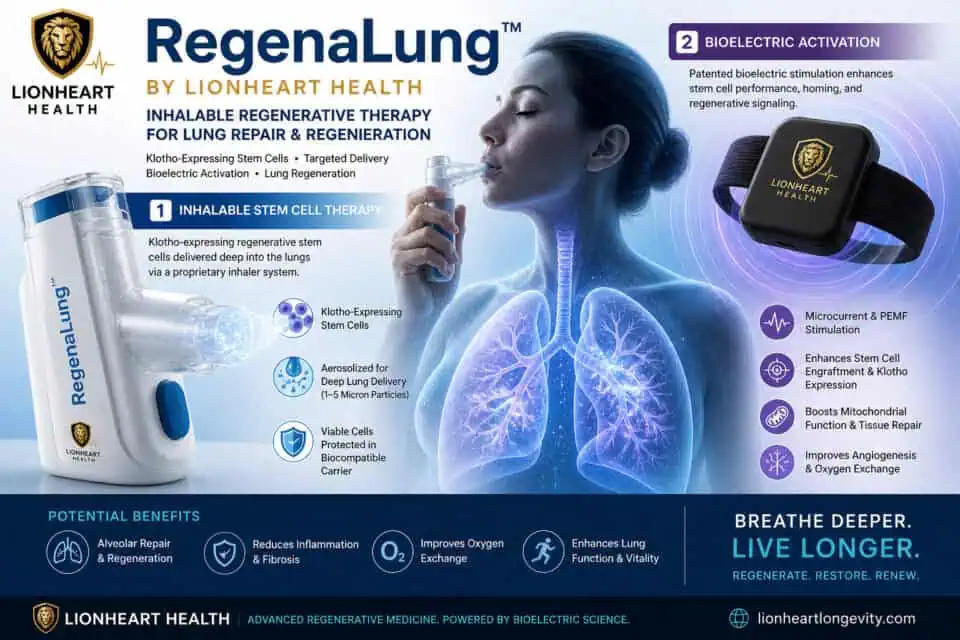
RegenaLung™ introduces a new category of non-invasive pulmonary regenerative therapy, enabling delivery of living regenerative cells directly into the lungs via inhalation, with the goal of promoting structural repair and improving respiratory performance.
Breakthrough Approach to Lung Regeneration
The ReganaLung™ platform integrates three core elements:
- Aerosolized stem cell delivery, engineered to preserve cell viability and enable deep lung penetration
- Klotho protein expression, associated with anti-aging, anti-inflammatory, and tissue-protective effects
- Bioelectric stimulation protocols, designed to enhance stem cell homing, protein expression, and regenerative signaling pathways
These combined mechanisms are designed to support:
- Alveolar repair and regeneration
- Reduction of fibrotic tissue
- Improved oxygen exchange capacity
- Enhanced pulmonary vascular function
Platform Expansion and Scientific Foundation
ReganaLung™ builds upon Leonhardt Ventures’ broader bioelectric protein expression platform, which combines electrical signaling with biologics to activate regenerative pathways across multiple organ systems.
Current applications across the platform include programs targeting:
- Skin regeneration (SkinStim™)
- Hair restoration (HairCell™)
- Joint health (OrthoStim™)
- Kidney function (KidneyCell™)
- Brain health (Brain Band™)
The platform is supported by:
- More than 700 patent claims (issued, pending, and in process)
- Data from over 1,000 patients across multiple indications
- A scientific and clinical network with 8,000+ publications
Clinical Development Strategy
Lionheart Health, Inc. plans to advance ReganaLung™ through:
- IRB-approved clinical studies
- Integration into lung health and longevity programs
- Potential expansion into healthspan-focused clinical protocols
Target indications include:
- Age-related lung function decline
- Post-viral respiratory impairment
- Chronic inflammatory and fibrotic lung conditions
Executive Commentary
“RegenaLung™ represents a major step forward in non-invasive organ regeneration,” said Howard J. Leonhardt, Executive Chairman of Leonhardt Ventures. “By combining inhalable Klotho-expressing stem cells with targeted bioelectric activation, we are working to address the underlying biological drivers of lung degeneration and functional decline.”
Commercialization Outlook
Under the licensing agreement, Lionheart Health, Inc. will lead:
- Clinical protocol development
- Deployment through licensed clinic networks
- Strategic partnerships in pulmonary and longevity medicine
Initial rollout is expected within regulated research environments, with broader commercialization to follow.
About Leonhardt Ventures LLC
Leonhardt Ventures LLC is a regenerative medicine innovation firm with more than 40 years of experience developing bioelectric, biologic, and device-based therapies. The company has contributed to multiple first-in-class medical technologies and maintains a substantial intellectual property portfolio.
About Lionheart Health, Inc.
Lionheart Health, Inc. is focused on commercializing bioelectric and regenerative therapies designed to improve healthspan and longevity through integrated clinic, device, and biologic platforms.
Forward-Looking Statements
This press release contains forward-looking statements, including statements regarding development timelines, clinical outcomes, regulatory pathways, and commercialization plans. These statements are based on current expectations and involve risks and uncertainties that could cause actual results to differ materially.
Media Contact
Lionheart Health, Inc.
Email: cs@lionhearthealthstim.com
- Mechanism of Action: Rather than replacing cells, inhaled stem cell products (secretome/exosomes) act as a “niche,” releasing growth factors and anti-inflammatory agents that signal the body to repair existing tissue.
- Delivery Method: Nebulizers (inhalers) are used to turn MSC-derived secretomes (often called MSEC or MSC-CM) into an aerosol for direct, localized delivery, reducing systemic side effects.
- Targeted Conditions: Research focuses on chronic, destructive lung diseases like COPD (emphysema/chronic bronchitis), pulmonary fibrosis, and post-COVID-19 lung damage.
References Supporting RegenaLung™ Approach
Inhaled / Aerosolized Cell or Cell-Secretome Delivery
- McCarthy SD et al. Nebulized mesenchymal stem cell–derived conditioned medium for lung injury models — supports feasibility of nebulized MSC secretome delivery.
- González HE et al. Nebulized MSC-conditioned medium showed deep airway penetration and retained anti-inflammatory activity after nebulization.
- Baghalishahi M et al. Nebulized MSC secretome in COVID-19 patients — supports prospective safety/utility of inhaled MSC-derived biologics.
- ClinicalTrials.gov NCT05787288. Nebulized mesenchymal stem cell extracellular vesicles for lung injury/COVID-19.
MSCs for Lung Repair / Pulmonary Disease
- Brave H et al. State-of-the-art review of cell therapy for pulmonary and respiratory diseases.
- Geiger S et al. Cell therapy for lung disease, European Respiratory Review — summarizes preclinical and clinical MSC lung disease data.
- Cruz FF et al. MSC therapy for chronic lung diseases — highlights therapeutic promise, especially earlier-stage disease.
- Glassberg MK et al. Stem cell therapy for COPD — clinical trials show safety signals but need larger multicenter efficacy studies.
- Lai S et al. Stem cell therapies for COPD — 2024 review of MSC therapeutic potential in COPD.
- Mayo Clinic. Regenerative medicine in lung diseases — notes MSC research as reparative tools for chronic lung conditions.
Klotho and Lung Aging / COPD / Fibrosis
- Gao W et al. Klotho expression is reduced in COPD airway epithelial cells.
- Li L et al. Klotho reduction in alveolar macrophages contributes to sustained lung inflammation in COPD.
- Yan D et al. Association between α-Klotho levels and COPD in adults; Klotho linked to oxidative-stress defense in pulmonary epithelium.
- Shi Y et al. Serum Klotho and COPD prevalence in U.S. population data.
- Zhao X et al. Review of Klotho in inflammation and tissue fibrosis.
Bioelectric / PEMF Support for Stem Cell Activation
- Chen C et al. Electrical stimulation as a tool for regulating cell behavior and tissue engineering.
- Ross CL et al. PEMF effects on MSCs, cytokines, growth factors, angiogenesis, and regenerative function.
- Zhang Y et al. Electromagnetic fields promoted MSC migration, with reported increases up to 87% depending on frequency.
- Yin Y et al. PEMF promoted MSC proliferation and differentiation pathways.
- Childs M et al. 2025 review: electricity can enhance MSC regenerative potential and secretome activity.
Muse cells
- Yabuki H. et al. Human Multilineage-differentiating Stress-Enduring Cells Exert Pleiotropic Effects to Ameliorate Acute Lung Ischemia-Reperfusion Injury in a Rat Model.
Supports Muse cells homing to damaged lung tissue, reducing apoptosis, and promoting alveolar repair. - Que H. et al. Multilineage-
differentiating stress-enduring cells. Frontiers, 2024.
Review states Muse cells showed stronger homing to damaged lung tissue and better protection than MSCs in acute lung injury models. - Alanazi R.F. et al. Multilineage Differentiating Stress Enduring (Muse) Cells. 2023 review.
Supports Muse cells as stress-resistant, tissue-reparative, pluripotent-like cells present in mesenchymal tissues.
Adipose-derived cells / SVF
- Tzouvelekis A. et al. A prospective, non-randomized, no placebo-controlled, phase Ib clinical trial to study safety of adipose-derived stromal cells–stromal vascular fraction in idiopathic pulmonary fibrosis. J Transl Med, 2013.
Early human IPF safety study using adipose-derived SVF. - Ntolios P. et al. Longitudinal outcomes of patients enrolled in a phase Ib clinical trial of adipose-derived stromal cells–stromal vascular fraction in idiopathic pulmonary fibrosis. Clin Respir J, 2018.
Follow-up data from adipose-derived SVF IPF patients. - Nguyen T.T. et al. Autologous adipose-derived stem cells therapy in COPD. 2021.
COPD case report describing clinical course after autologous adipose-derived stem cell therapy. - Ouji-Sageshima N. et al. Adipose-Derived Mesenchymal Stem Cells Have Therapeutic Potential for Pulmonary Fibrosis. Cells, 2024.
Preclinical data showing ADSCs improved fibrotic lung changes in mouse and humanized IPF-like models. - Carstens M. et al. Adipose-derived stromal vascular fraction cells to treat long COVID pulmonary symptoms.2024.
Human study designed to assess safety of IV adipose-derived SVF for pulmonary long COVID symptoms.
- Yabuki H. et al. Human Multilineage-differentiating Stress-Enduring Cells Exert Pleiotropic Effects to Ameliorate Acute Lung Ischemia-Reperfusion Injury in a Rat Model.
Further Evidence References:
- Klotho and lung fibrosis/COPD biology
Klotho is reduced in COPD airway epithelial cells and is associated with lung aging, oxidative stress, inflammation, and fibrosis. Klotho protein has been reported to inhibit pulmonary fibrotic signaling via TGF-β/Smad-related pathways. - Klotho anti-inflammatory / anti-fibrotic mechanism
Recent reviews support Klotho as an anti-inflammatory and anti-fibrotic factor across organs, including modulation of macrophages, inflammatory cytokines, oxidative stress, and fibrosis pathways. - Klotho-loaded MSC extracellular vesicles
A 2025 study used MSC-derived small extracellular vesicles loaded with Klotho and reported improved tissue repair, reduced inflammation, and reduced fibrosis in kidney injury models. This supports the broader concept of Klotho-cargo delivery via stem-cell-derived vesicles, though not specifically lung inhalation. - Klotho protein + nanomaterials
A study of Klotho protein complexed with nanomaterials showed improved mesenchymal stem cell performance in diabetic ischemic wound repair, supporting the idea that nanomaterial-Klotho complexes may enhance regenerative cell behavior. - Klotho gene delivery nanoparticles
A 2025 Biomaterials paper reported nanoparticle-mediated Klotho gene therapy reduced kidney fibrosis and improved repair pathways, supporting the broader concept of nanoparticle Klotho delivery. - Klotho-derived peptides
Klotho-derived peptide work is emerging, including peptide approaches targeting fibrosis-related pathways such as fibroblast activation/TGF-β receptor signaling. This supports a patentable Klotho peptide / peptide-mimetic arm. - Nanoflowers and energized stem cells
Recent nanoflower stem-cell research reported increased mitochondrial transfer from stem cells to damaged/aged cells, supporting the concept that nanoflower-treated cells may become more regenerative. This is supportive but still early and not lung-specific. - Bioelectric stimulation for Klotho expression
Leonhardt-related patent publications describe low-voltage pulsed electrical stimulation for controlling Klotho expression, which supports the proprietary bioelectric-enhancement component.
“RegenaLung™ may further comprise aerosolized Klotho protein, Klotho-derived peptides, Klotho-loaded extracellular vesicles, Klotho gene-delivery nanoparticles, or Klotho-associated nanoflower structures, optionally combined with adipose-derived stromal cells, Muse cells, mesenchymal stem cells, or exosomes, and further activated by bioelectric stimulation protocols configured to enhance Klotho expression, stem cell homing, mitochondrial transfer, angiogenesis, anti-inflammatory signaling, and anti-fibrotic remodeling.”
“RegenaLung™ is also being designed to explore next-generation investigational biologics, including bioelectric-enhanced Klotho peptides, Klotho-loaded extracellular vesicles, and nanoflower-supported regenerative cell formulations intended to amplify mitochondrial support, anti-inflammatory signaling, and tissue repair pathways.”