
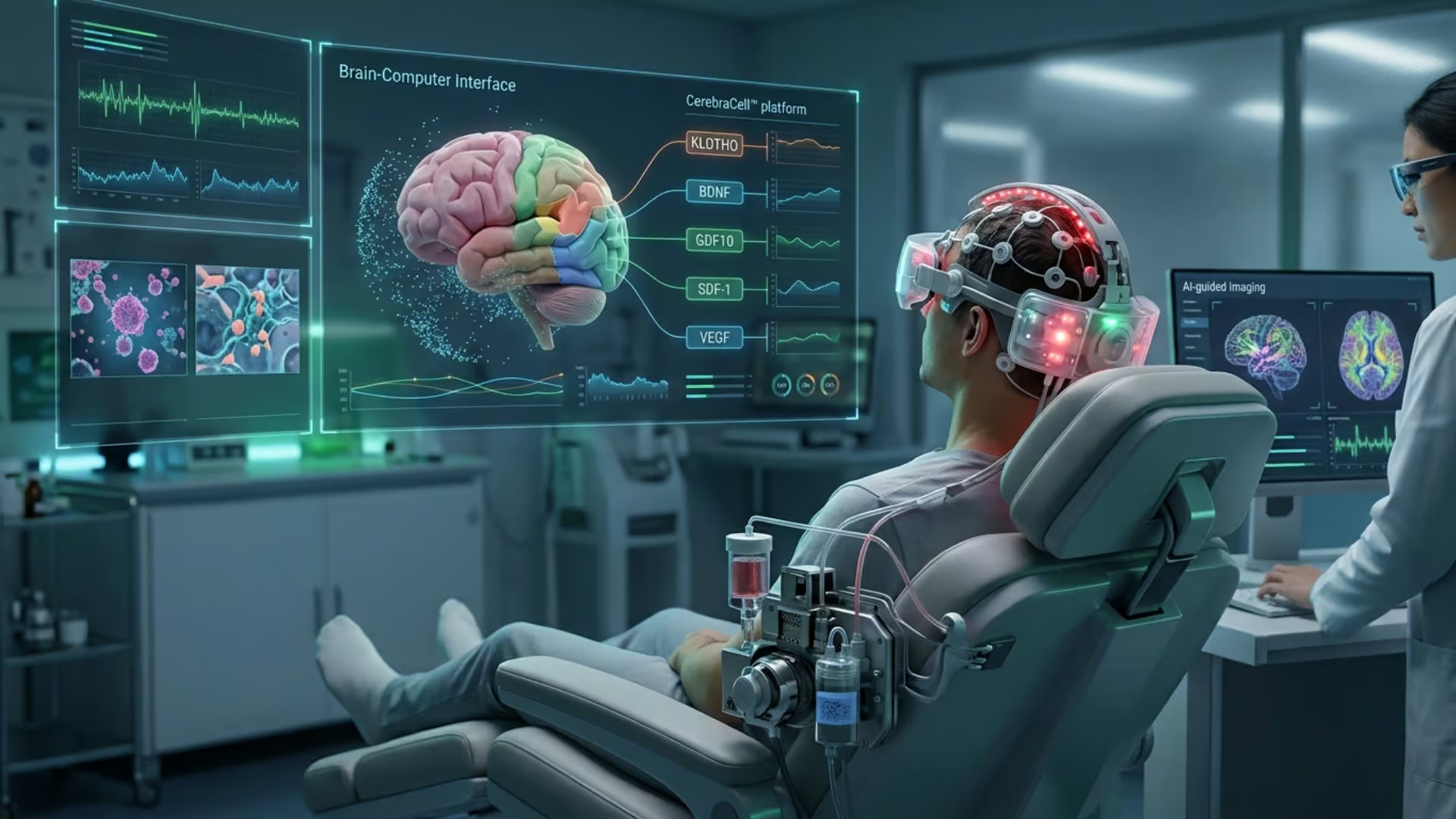
Investigational platform integrates programmable expression of more than 60 regenerative proteins with patent-pending Klotho-expressing stem cells in nutrient hydrogel, bioelectric-enhanced exosomes, Klotho Nanoflowers™, photobiomodulation, AI-guided imaging and advanced stroke rehabilitation technologies.
HUNTINGTON BEACH, Calif. — July 8, 2026 — Lionheart Health, Inc. today announced completion of a comprehensive provisional patent application covering its next-generation CerebraCell™ platform, an investigational regenerative medicine technology being developed to support recovery following ischemic stroke, hemorrhagic stroke, traumatic brain injury and other neurological disorders.
The CerebraCell™ intellectual property integrates decades of regenerative medicine research by Howard J. Leonhardt, Leonhardt Ventures and Eleanor Schuler, combining issued patents, licensed technologies and numerous recently announced provisional patent applications into what the company believes is one of the most comprehensive bioelectric neuroregeneration platforms under development.
Unlike conventional neurostimulation systems that primarily activate nerves or muscles, CerebraCell™ is designed to coordinate the body’s own regenerative biology by combining programmable bioelectric protein expression with regenerative biologics, photobiomodulation, precision rehabilitation and artificial intelligence.
A Systems Biology Approach to Brain Regeneration
The provisional patent application describes programmable bioelectric stimulation intended to influence expression of more than sixty endogenous regenerative proteins involved in neural repair, angiogenesis, stem cell recruitment, neuroplasticity, mitochondrial function, vascular regeneration and healthy brain aging.
Among the principal signaling pathways incorporated within the platform are:
Klotho — intended to support neuronal resilience, mitochondrial health, vascular function, reduction of oxidative stress and healthy brain aging.
Klotho Nanoflowers™ — patent-pending nanostructured Klotho delivery technology designed to provide sustained local presentation of Klotho protein while working synergistically with programmable bioelectric stimulation.
BDNF — intended to support neuroplasticity, synapse formation, learning, memory and neuronal survival.
GDF10 — intended to promote axonal sprouting and rewiring of damaged motor pathways following stroke.
GDF11 — being investigated for roles in vascular remodeling, tissue rejuvenation and endogenous repair.
HMGB1 — intended to enhance endogenous stem cell homing, tissue repair signaling and regenerative communication between injured tissues and circulating repair cells.
SDF-1 (CXCL12) — intended to recruit endogenous stem cells and progenitor cells into injured brain tissue.
PDGF — intended to support stabilization of newly developing blood vessels and tissue remodeling.
VEGF — intended to stimulate angiogenesis and restoration of cerebral microcirculation.
eNOS — intended to improve endothelial function and cerebral blood flow through nitric oxide signaling.
IGF-1 — intended to support neuronal survival and axonal regeneration.
Apelin — intended to enhance neurovascular coupling, endothelial health and cerebral perfusion.
Sestrins — intended to improve cellular resistance to ischemic stress and preserve mitochondrial function.
Sirtuins — intended to regulate DNA repair, mitochondrial efficiency, metabolism and healthy neuronal aging.
FOXO3 — intended to regulate autophagy, stem cell maintenance and cellular stress resistance.
AMPK — intended to restore cellular energy balance while promoting mitochondrial biogenesis and repair.
mTOR — intended to optimize protein synthesis and regenerative remodeling through balanced pathway modulation.
Wnt Signaling — intended to regulate neural stem cell proliferation, differentiation and reconstruction of damaged neural circuitry.
BMP9, OPG, Sonic Hedgehog (SHH), HIF-1α, CXCL5, LIM-domain proteins, S100 family proteins, follistatin, tropoelastin, collagen regulatory pathways and numerous additional regenerative signaling molecules described throughout the Leonhardt intellectual property portfolio are also incorporated within the platform.
Patent-Pending Bioelectric Enhanced Regenerative Biologics
A central feature of the provisional patent application is the integration of Lionheart Health’s patent-pending regenerative biologic technologies with programmable bioelectric stimulation.
These include:
Bioelectric-Enhanced Klotho-Expressing Stem Cells in Nutrient Hydrogel™
The provisional patent application covers mesenchymal stem cells engineered or selected to express elevated levels of Klotho and delivered within a proprietary nutrient hydrogel designed to improve cell survival, retention, integration and regenerative activity.
Programmable bioelectric stimulation is intended to further enhance survival of transplanted cells, promote regenerative protein expression, stimulate vascularization, improve stem cell homing and optimize communication between transplanted cells and host tissue.
Bioelectric-Enhanced Exosomes and Secretomes™
The patent application also covers exosomes and regenerative secretomes used in combination with programmable bioelectric stimulation.
The platform is intended to increase production, targeting and biological activity of regenerative extracellular vesicles while enhancing delivery of neuroprotective proteins, growth factors and microRNAs involved in tissue repair.
Lionheart believes combining bioelectric stimulation with regenerative biologics may create synergistic biological responses beyond those expected from either technology alone.
Integrated Precision Neurorehabilitation Platform
The CerebraCell™ platform is designed to combine:
- Programmable bioelectric protein expression therapy.
- Patent-pending bioelectric-enhanced Klotho-expressing stem cells in nutrient hydrogel.
- Patent-pending bioelectric-enhanced exosomes and regenerative secretomes.
- Klotho Nanoflowers™.
- Multi-wavelength red and near-infrared photobiomodulation.
- Pulsed electromagnetic field therapy (PEMF).
- Precision microcurrent stimulation.
- AI-guided treatment optimization.
- Remote patient monitoring.
- Personalized adaptive therapy software.
AI Imaging and Functional Recovery
The CerebraCell™ platform is intended to integrate advanced imaging and digital analytics, including:
- CoreViva™ AI MRI for quantitative assessment of structural and functional brain recovery.
- Connectome brain network analysis for evaluation of neural connectivity and individualized treatment planning.
- Biomarker-guided optimization of regenerative therapies.
- Artificial intelligence to continuously personalize stimulation protocols throughout rehabilitation.
Combination Stroke Rehabilitation
Lionheart Health also plans to integrate CerebraCell™ with FDA-cleared rehabilitation technologies it distributes, including Saebo® stroke rehabilitation systems designed to improve upper-extremity function, allowing regenerative therapies to be combined with evidence-based physical rehabilitation in a comprehensive neurorecovery program.
Broad Clinical Vision
The company believes the combination of programmable bioelectric protein expression, regenerative biologics, Klotho enhancement, photobiomodulation, artificial intelligence and precision rehabilitation represents a new systems biology approach to neurological recovery.
“Our vision is to recreate the biological environment of healing rather than relying on a single drug, device or growth factor,” said Howard J. Leonhardt, Executive Chairman and Co-CEO of Lionheart Health. “Nature repairs the brain by coordinating hundreds of biological signals. CerebraCell™ is designed to help orchestrate many of those regenerative pathways simultaneously by combining programmable bioelectric protein expression, Klotho-enhanced regenerative biologics, advanced imaging and precision rehabilitation into one integrated platform.”
Development of CerebraCell™ is expected to continue through engineering optimization, preclinical studies and future clinical investigations evaluating safety and effectiveness.
Forward-Looking Statements
CerebraCell™, Klotho Nanoflowers™, Bioelectric-Enhanced Klotho-Expressing Stem Cells in Nutrient Hydrogel™ and Bioelectric-Enhanced Exosomes™ are investigational technologies under development and have not been cleared or approved by the U.S. Food and Drug Administration for the treatment of stroke or other neurological diseases. Statements regarding intended biological mechanisms, anticipated therapeutic effects and future clinical applications represent research objectives and investigational hypotheses subject to further validation, regulatory review and clinical testing.