
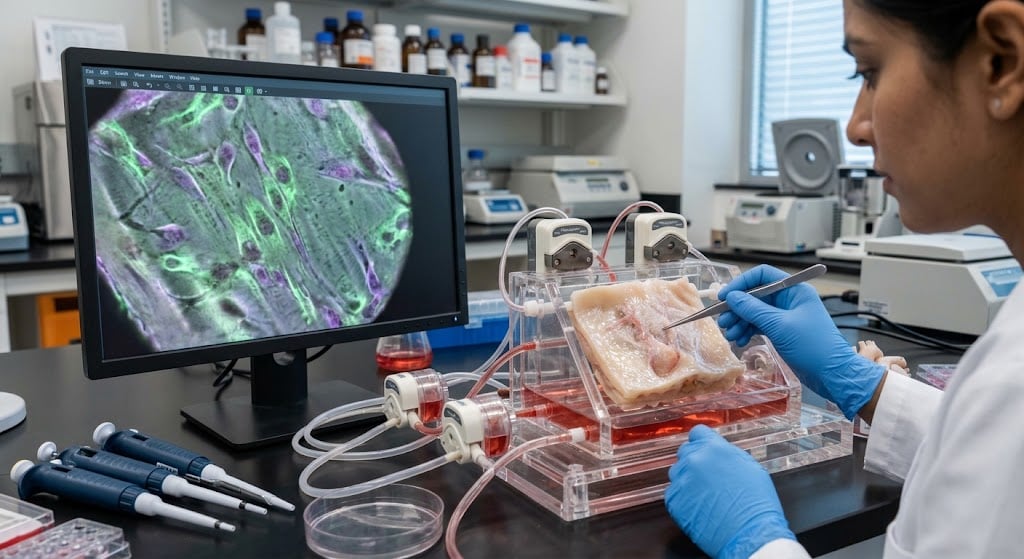
Company plans to integrate contractile myografts, AortaCell technologies, Leonhardt pulsatile grafts, bioelectric protein-expression systems, regenerative cells and circulatory-assist technologies for potential applications in healthy aging, heart support, aortic circulation, vascular repair and dialysis access
HUNTINGTON BEACH, Calif. — August 29, 2026 — Lionheart Health, Inc. today announced a new research and intellectual-property development initiative designed to combine living contractile muscle, AortaCell regenerative technologies and bioelectric control into a programmable biological platform for potential cardiovascular, vascular and healthy-aging applications.
The initiative follows publication on August 26, 2026 in Nature Aging of the study “Contractile myografts confer systemic anti-aging benefits.” The investigators reported that transplanted differentiated autologous myocytes formed mature, vascularized muscle structures that contracted continuously in mice and improved whole-body muscle mass and function as well as metabolic and regenerative outcomes in aging and obese animal models. The investigators further demonstrated the potential of myografts to serve as long-duration sources of engineered therapeutic proteins. (Nature)
Lionheart intends to investigate whether these findings can be extended through controlled bioelectric pacing, AortaCell regenerative support and vascular integration, rather than relying only upon spontaneous myograft contraction. The resulting platform could potentially function as a programmable “living muscle pump” and a localized regenerative organ.
One proposed architecture would place engineered autologous muscle tissue around or adjacent to a major blood-flow conduit and synchronize its contraction with the patient’s cardiovascular cycle using a miniaturized implanted or externally coupled bioelectric stimulator. AortaCell technologies could potentially be used to support vascularization, tissue integration, endothelial repair, cellular recruitment and regenerative remodeling around the graft or vascular interface.
Potential configurations under evaluation include a myograft associated with the aorta, around a vascular graft or arterio-venous dialysis-access graft, within a regenerative aortic or vascular repair construct, or positioned to provide mechanical assistance to the heart.
The concept builds upon Leonhardt’s existing pulsatile vascular-assist intellectual property. Published international patent application WO2024248816A1, “Pulsatile Vascular Stent Graft,” describes intravascular structures whose diameter can be actively changed to facilitate pulsatile blood flow. The filing contemplates placement in the ascending or descending aorta as well as peripheral arteries and veins and specifically describes possible use within hemodialysis grafts and arterio-venous grafts and fistulas. (Google Patents)
The patent describes sequentially actuated segments capable of constriction and expansion to contribute to pulsatile blood movement and discusses synchronization of this activity with the patient’s cardiac cycle. (Google Patents)
Lionheart believes that combining this mechanical-pulsatility intellectual property with living contractile muscle and AortaCell regenerative biology could create an additional approach: instead of producing all pumping action through an artificial mechanical actuator, living skeletal muscle could potentially provide part of the pumping force while AortaCell components support tissue integration and an implanted bioelectric controller determines when and how strongly the tissue contracts.
From a Myograft to a Programmable AortaCell Regenerative Organ
The Lionheart research concept would potentially integrate several complementary technologies into one platform:
- Autologous contractile myograft: engineered muscle tissue modeled on the approach recently reported in Nature Aging.
- AortaCell regenerative platform: application of AortaCell-derived cells, progenitors, matrices, biologic factors or related regenerative components to support vascularization, endothelial repair, tissue integration, remodeling and functional recovery at the implant site.
- AortaCell vascular-interface technology: potential use of AortaCell approaches to create a biologically active interface between living muscle, vascular graft material, the aortic wall and surrounding tissue.
- Micro-implantable bioelectric pacer: designed to stimulate the graft in a programmed sequence and, where appropriate, synchronize contraction to the ECG, arterial-pressure waveform or other physiological sensors.
- Leonhardt pulsatile vascular technology: pulsating graft or cuff architectures designed to augment blood movement while preserving pulsatility.
- Bioelectric protein-expression signaling: Leonhardt intellectual property covering low-voltage electrical signaling for modulation of regenerative proteins, including the company’s issued bioelectric-stimulator and Klotho-modulation patent families. U.S. Patent 10,960,206, for example, describes bioelectric stimulation for controlling protein expression including follistatin and specifically identifies epicardial stimulation for heart-related applications. (USPTO Report)
- Regenerative cell therapy: potential incorporation of autologous muscle progenitors, AortaCell populations, stromal cells, endothelial or vascular-support cells, regenerative-cell populations or genetically engineered cells.
- Regenerative biologics: investigational combinations with extracellular vesicles/exosomes, PRF-derived factors, peptides, cytokines and supportive matrices or hydrogels.
- Klotho-focused signaling: evaluation of bioelectric, AortaCell and cell-based strategies intended to modulate Klotho and other proteins associated with tissue maintenance and healthy aging.
- Sensor-based adaptive control: future systems could potentially adjust contraction amplitude and timing according to blood pressure, flow, activity, cardiac cycle or patient physiological demand.
The Nature Aging study is especially significant because skeletal muscle functions not only as a mechanical motor but also as a powerful endocrine organ. The investigators found effects extending beyond the implanted muscle itself, including effects involving whole-body muscle, immunity, metabolism, regeneration and neurodegenerative processes in their animal models. The authors also showed that engineered myografts could serve as vehicles for sustained therapeutic-protein production. (Nature)
Lionheart’s AortaCell work adds a complementary biological dimension: the possibility of using a regenerative cellular and tissue-engineering platform to help create a vascularized, integrated and biologically responsive environment in which a contractile myograft can survive, mature and communicate with the circulation.
Lionheart’s long-term objective is therefore broader than building another blood pump.
The goal is to develop a living, vascularized, electrically programmable tissue platform that could simultaneously perform mechanical work, support vascular regeneration and potentially release beneficial regenerative signals into the circulation.
Potential Cardiovascular Configuration: A Bioelectric “Second Muscle Pump” the Lionheart Bio-MyoGraft
One proposed configuration under evaluation would involve growing or implanting a band or sleeve of autologous muscle around an aortic or vascular conduit. AortaCell components could potentially be incorporated into the surrounding matrix, vascular interface or cellular compartment to support blood-vessel formation, endothelial stability and integration with adjacent tissue.
A small implanted stimulator could activate the muscle sequentially in coordination with native cardiac pulsation.
For a heart-failure application, contraction might ultimately be optimized to reduce ventricular workload or enhance systemic perfusion while retaining physiologic pulsatility.
For a descending-aortic application, sequential contraction could potentially augment circulation toward the kidneys or lower extremities.
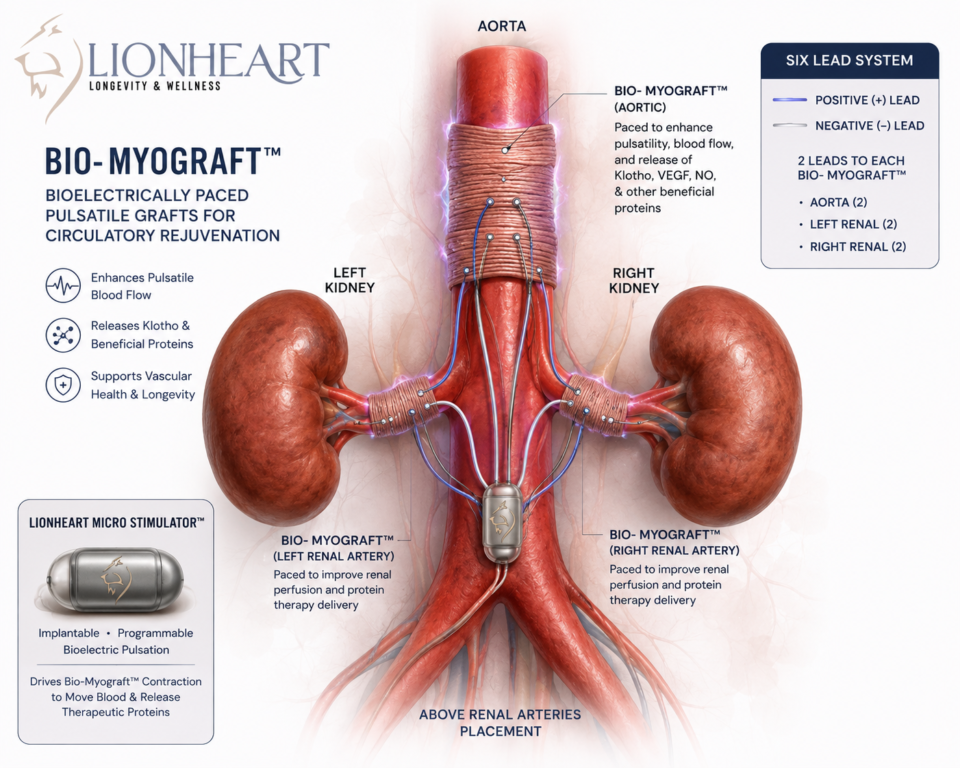
For dialysis patients, a smaller contractile sleeve around an arterio-venous graft could potentially generate intermittent pulsatility and improve local blood movement. AortaCell regenerative components could potentially be evaluated for their ability to support graft healing, endothelial function and long-term vascular access performance. Leonhardt’s published pulsatile-graft patent already identifies hemodialysis grafts, arterio-venous grafts and fistulas as contemplated vascular applications. (Google Patents)
Another possible architecture could combine the contractile myograft and AortaCell regenerative interface with Second Heart Assist technologies. Previous Leonhardt circulatory-assist patent literature describes combining pulsatile aortic support with an aortic impeller pump and synchronizing the technologies to improve hemodynamics while potentially reducing the rotational speed required from an impeller. (USPTO Report)
This creates the possibility of a multimodal system in which a living muscle pump, AortaCell regenerative tissue interface, pulsatile graft and mechanical circulatory-assist device cooperate rather than requiring one component to supply all circulatory work.
Potential AortaCell Aortic and Vascular-Regeneration Application
AortaCell work may also support a distinct application independent of the living muscle pump: the development of biologically active aortic and vascular repair constructs.
In this configuration, AortaCell-derived cells, progenitors, matrices or regenerative factors could potentially be incorporated into or delivered around an aortic graft, stent graft, vascular sleeve or other implant. The objective would be to encourage endothelial coverage, vascular-wall healing, tissue integration, remodeling and long-term biological acceptance of the implant.
A contractile myograft could potentially be added where mechanical assistance is desired. In other cases, the AortaCell component could be used alone as a regenerative vascular interface, with bioelectric stimulation applied to modulate cellular behavior, protein expression or local tissue repair.
Potential research areas include:
- AortaCell-supported endothelialization of vascular grafts and stent grafts.
- Regenerative cellular interfaces between prosthetic grafts and native aortic tissue.
- Bioactive sleeves or matrices surrounding pulsatile grafts.
- Aortic-wall repair and remodeling following endovascular or open vascular intervention.
- Local delivery of regenerative proteins, extracellular vesicles or other biologics.
- Integration of vascular-support cells with engineered contractile muscle.
- Reduction of fibrosis, thrombosis, inflammation or graft-interface failure.
- Sensor-controlled stimulation of regenerative cells and contractile tissue.
These applications remain investigational and would require separate preclinical evaluation.
Potential Healthy-Aging Application
The most far-reaching opportunity may extend beyond cardiovascular support.
The new Nature Aging research indicates that a relatively localized contractile myograft can influence systemic physiology in animal models. The grafts improved muscle and metabolic parameters and were associated with regenerative and anti-degenerative effects in tissues beyond the graft itself. (Nature)
Lionheart therefore intends to study whether precisely paced myografts, supported by AortaCell regenerative biology, could reproduce or amplify some molecular signals normally generated by exercise, particularly for individuals whose age, disability, illness or cardiovascular limitations prevent sufficient physical exercise.
The program could eventually evaluate circulating myokines and regenerative mediators including Klotho, follistatin, VEGF, BDNF, IGF-related pathways and other exercise-responsive proteins, while determining which responses can be safely controlled through pacing frequency, intensity, duty cycle and biological composition of the graft.
AortaCell components could potentially be evaluated for their ability to improve graft maturation, vascular supply, cellular persistence and regenerative signaling. The objective would be to determine whether a biologically integrated and electrically paced tissue construct can provide both local tissue repair and systemic endocrine effects.
Potential Therapeutic-Protein Factory
The Nature Aging investigators additionally demonstrated that myografts genetically modified to express therapeutic proteins could function as sustained in-vivo delivery systems. Their animal experiments included parathyroid hormone and growth hormone expression. (Nature)
Lionheart believes this creates an important additional research direction.
A patient’s own engineered muscle graft, potentially supported by AortaCell cells or matrices, could potentially become a living therapeutic-protein production site, while a bioelectric pacing system controls its contraction and potentially influences aspects of its secretory behavior.
Future research could investigate whether such tissues can be engineered or stimulated to generate beneficial levels of selected regenerative proteins while avoiding supraphysiologic systemic exposure.
Potential protein-expression targets could include Klotho, follistatin, VEGF, BDNF, IGF-related factors and other proteins associated with vascular repair, muscle maintenance, tissue regeneration and healthy aging. AortaCell biology could potentially provide an additional cellular source of regenerative signals or improve the local environment in which engineered protein-producing cells function.
Closed-Loop Bioelectric and AortaCell Control
A central development opportunity is the creation of a closed-loop system that combines biological sensing, electrical stimulation and regenerative-cell behavior.
A future system could potentially include:
- A vascularized contractile myograft or muscle sleeve.
- AortaCell-derived regenerative cells, matrices or biologic factors.
- A pulsatile vascular graft, cuff or conduit.
- An implanted bioelectric stimulator.
- Sensors measuring ECG, pressure, flow, oxygenation, activity or tissue response.
- Software that adjusts contraction timing, amplitude, frequency and duty cycle.
- Bioelectric modulation of local protein expression and regenerative signaling.
Such a system could potentially operate in several modes. It might synchronize with systole to augment forward flow, activate during diastole to support perfusion, provide sequential contraction along a vascular conduit, reduce cardiac workload, support dialysis-access flow or deliver intermittent regenerative stimulation.
The same platform could potentially be programmed differently depending on whether the primary objective is circulatory assistance, vascular healing, tissue regeneration, exercise-mimetic signaling or therapeutic-protein production.
Intellectual-Property Foundation
The development program is expected to draw from a broad Leonhardt and AortaCell intellectual-property history spanning vascular grafts, cardiovascular implants, regenerative-cell delivery, bioelectric stimulation, protein-expression modulation and biologically integrated tissue repair.
Leonhardt is an inventor on early endovascular graft technologies including U.S. Patent 6,334,869 and U.S. Patent 6,767,358, among other vascular-graft patents. (Google Patents)
More recent Leonhardt patent families address bioelectric stimulation and controlled expression of regenerative proteins. U.S. Patent 11,471,686 covers Klotho modulation using bioelectric signaling, while U.S. Patent 10,960,206 addresses a bioelectric stimulator capable of controlling expression of proteins including follistatin. (Google Patents)
The pulsatile vascular-stent-graft family adds a complementary mechanical circulatory component in which sections of an implanted vascular structure are actively actuated to change diameter and generate or augment pulsatile flow. (Google Patents)
AortaCell work adds potential intellectual-property opportunities involving regenerative cells, vascular interfaces, biologically active graft coverings, aortic-wall repair, endothelialization, tissue-engineered conduits, cellular delivery, extracellular-matrix systems and combinations of regenerative biology with bioelectric stimulation.
Lionheart intends to evaluate additional patent filings specifically covering the integration of engineered living muscle + AortaCell regenerative cells or matrices + implantable pacing + physiological synchronization + vascular grafts + regenerative-protein expression + cell and gene therapy.
Potential claim categories may include:
- AortaCell-supported contractile muscle sleeves surrounding aortic or vascular conduits.
- Regenerative cellular interfaces between pulsatile grafts and native vascular tissue.
- Sequentially paced muscle segments positioned along a vascular graft.
- Closed-loop control of muscle contraction using ECG, pressure and flow sensors.
- Bioelectric stimulation of AortaCell populations to modulate vascular repair or protein expression.
- Combined mechanical pumping and regenerative-protein delivery.
- AortaCell-supported dialysis-access grafts with contractile pulsatile cuffs.
- Cardiac-assist muscle wraps incorporating regenerative cells and bioelectric stimulation.
- Wireless powering and telemetry for implanted living-pump systems.
- Modular systems in which the same biological construct can be configured for circulation, vascular repair or systemic regenerative signaling.
A Possible New Category: Bioelectric Living Vascular Implants
“We believe the next generation of regenerative medicine will increasingly combine living tissues, regenerative cells and intelligent electronics,” said Howard J. Leonhardt, Executive Chairman of Lionheart Health, Inc. “The Nature Aging study provides compelling animal evidence that a relatively small contractile muscle graft can influence biology throughout the body. Our opportunity is to investigate whether we can make such a graft programmable, support it with AortaCell regenerative biology, pace it when needed, position it where mechanical contraction has cardiovascular value and combine it with regenerative signaling technologies we have been developing for decades.”
Leonhardt continued:
“Our vision is a living implant that can do three jobs at the same time: pump, signal and regenerate. Around the aorta it could potentially contribute pulsatile circulatory assistance. Around a dialysis graft it could potentially augment local pulsatile flow. At an aortic or vascular repair site, AortaCell technologies could potentially support healing and biological integration. Elsewhere in the body, the same type of construct could potentially serve as an exercise-mimetic endocrine organ. With engineered cells, it may eventually provide controlled delivery of beneficial proteins.”
Development Roadmap
Lionheart anticipates beginning with preclinical feasibility work evaluating myograft viability, AortaCell compatibility, vascularization, endothelialization, tissue integration, stimulation thresholds, fatigue resistance, pacing synchronization, myokine production and hemodynamic effects.
Initial studies could compare:
- Myograft alone.
- AortaCell regenerative components alone.
- Myograft combined with AortaCell cells or matrices.
- Myograft combined with bioelectric stimulation.
- Myograft combined with pulsatile vascular technology.
- The complete integrated platform.
The company expects cardiovascular versions of the concept to require extensive animal testing examining arrhythmia risk, graft remodeling, thrombosis, embolic risk, vascular compression, infection, fibrosis, immune response, cellular persistence, uncontrolled tissue growth, durability and control-system failure modes before human evaluation could be considered.
AortaCell-related studies would also need to evaluate cell fate, biodistribution, vascular remodeling, inflammatory response, ectopic tissue formation, graft-interface stability and the long-term behavior of any engineered or genetically modified cells.
The program is investigational. Lionheart Health has not demonstrated that paced myografts, AortaCell technologies or their combination produce anti-aging, vascular-regenerative or cardiovascular benefits in humans, and no Lionheart myograft or AortaCell product has been cleared or approved by the U.S. Food and Drug Administration for these proposed applications. Findings reported in the August 2026 Nature Aging publication were obtained in mouse models and should not be interpreted as evidence of equivalent effects in humans.
About Lionheart Health
Lionheart Health is developing a multi-modality health-optimization and regenerative-medicine platform combining AortaCell regenerative technologies, bioelectric stimulation, regenerative cells and biologics, muscle stimulation, circulatory-support technologies, vascular repair and protein-expression modulation.
The company’s research programs seek to develop technologies capable of improving tissue function, vascular integration and healthspan through coordinated biological, cellular and bioelectric interventions.
Lionheart Health Inc is majority owned by Leonhardt Ventures LLC that spun out and licensed Second Heart Assist, Inc to pursue aorta based pump applications of its inventions. They will have first option on this technology for that application of use should they wish to have it
Scientific reference:
Liu X, Yao Z, Zhang L, et al. Contractile myografts confer systemic anti-aging benefits. Nature Aging. Published August 26, 2026. DOI: 10.1038/s43587-026-01190-3. (Nature)
Forward-Looking Statement:
This release contains forward-looking statements regarding investigational technologies, planned studies, potential mechanisms and possible future therapeutic applications. These concepts are in various stages of research and development. Preclinical observations may not translate into safe or effective therapies for humans, and no representation is made that the proposed systems will receive regulatory authorization or achieve the anticipated biological or clinical effects.