
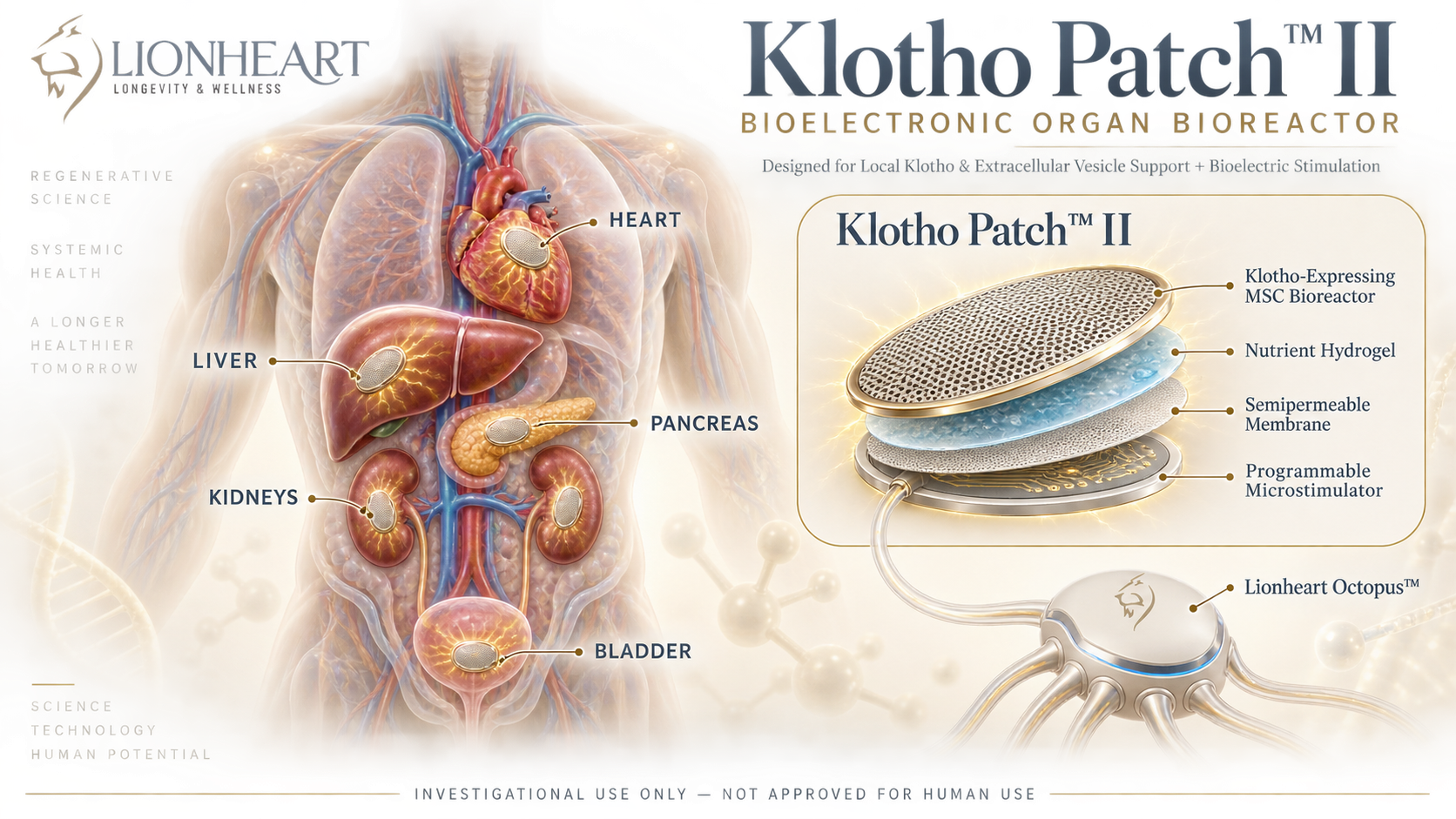
Investigational platform is being designed to combine Klotho-expressing cells, nutrient hydrogel, controlled biologic delivery and programmable bioelectric stimulation for major-organ regeneration research
HUNTINGTON BEACH, Calif. — September 22, 2026 — Lionheart Health, Inc., a biotechnology and bioelectronic medicine company focused on healthspan longevity and regeneration, today announced that it has prepared a provisional patent application covering its new KlothoPatch™ II bioelectronic organ bioreactor platform.
KlothoPatch™ II is being designed as a conformable, organ-surface implant that may combine Klotho-expressing mesenchymal stromal cells, nutrient hydrogel, a semipermeable containment membrane and programmable bioelectric stimulation. The investigational platform is intended for preclinical study in connection with the heart, kidneys, liver, pancreas and bladder.
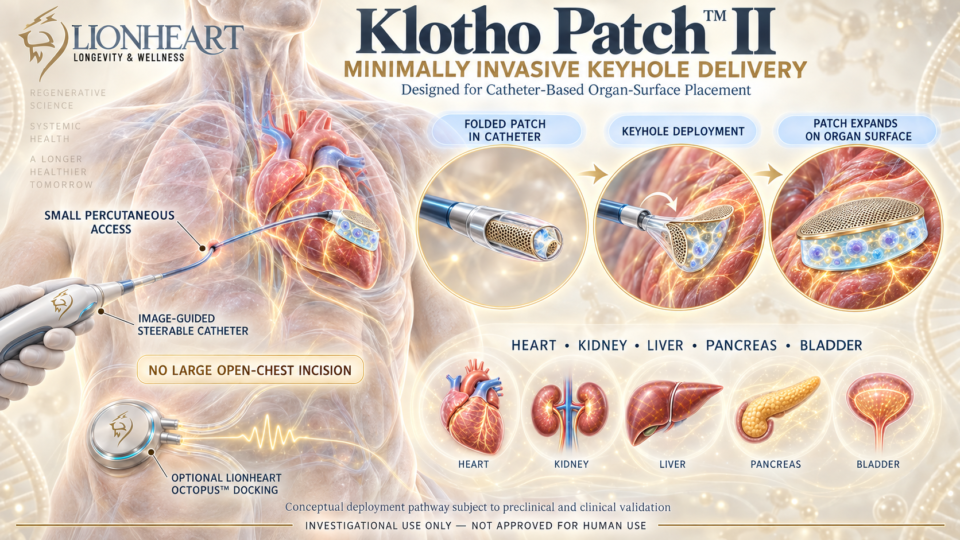
The proposed intellectual-property filing includes alternative systems for replenishing the implanted bioreactor. One configuration incorporates an endovascular catheter system designed to dock with the KlothoPatch™ II chamber. A second configuration utilizes the Lionheart Octopus™ implantable pump positioned beneath the skin. The Octopus reservoir would be designed for periodic percutaneous refilling with a needle and syringe through a self-sealing silicone septum.
Potential refill materials to be evaluated may include sterile physiologic nutrient solution, soluble Klotho protein, defined extracellular vesicles or exosomes, and other investigational regenerative-support formulations. The system is being designed to permit controlled replenishment without repeatedly performing open surgery.
“KlothoPatch II represents our vision of combining regenerative cells, controlled biologic delivery and programmable bioelectric signaling within one potentially retrievable platform,” stated Howard J. Leonhardt, Executive Chairman and Co-CEO of Lionheart Health. “The goal is to develop a localized biologic factory that can be monitored, replenished and electrically stimulated while positioned on or adjacent to a failing organ. Every component will require careful preclinical validation before clinical use.”
Proposed KlothoPatch™ II Components
The provisional patent application is expected to describe multiple potential configurations incorporating:
- Autologous or allogeneic Klotho-expressing mesenchymal stromal cells;
- Viral or nonviral methods of producing Klotho-expressing cells;
- Porous biocompatible nutrient hydrogel;
- Semipermeable membranes designed to retain cells while permitting diffusion of soluble Klotho and extracellular vesicles;
- Programmable microstimulation electrodes;
- Oxygen, temperature, pressure, impedance and biochemical sensing;
- Endovascular catheter docking and replenishment;
- A subcutaneous Lionheart Octopus™ refillable pump;
- A needle-accessible, self-sealing silicone refill septum;
- Replaceable or retrievable cell cartridges;
- Closed-loop control based on Klotho levels and organ-function biomarkers; and
- Organ-specific configurations for the heart, kidneys, liver, pancreas and bladder.
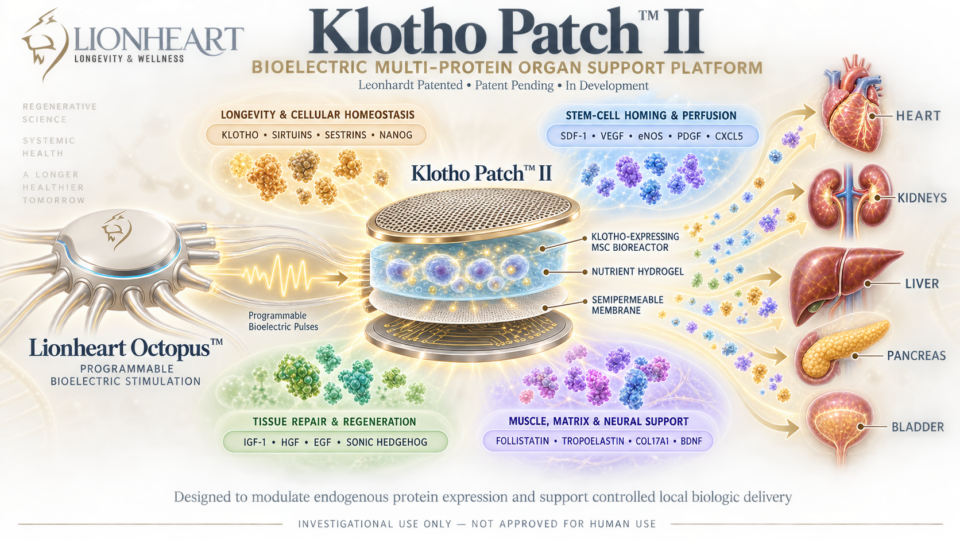
The platform may also be studied to determine whether bioelectric stimulation can modulate the release of soluble Klotho and extracellular vesicles from engineered cells while independently supporting signaling, perfusion or functional activity in adjacent organ tissue.
Rather than continuously discharging fluid directly into a failing organ, certain configurations are expected to circulate or exchange nutrient solution within the contained bioreactor chamber. Secreted Klotho and selected extracellular vesicles could then diffuse across the membrane to surrounding tissue while the engineered cells remain confined inside a potentially retrievable cartridge.
“The refillable design is important because living-cell implants require long-term attention to oxygenation, nutrient exchange, waste removal, cell viability and consistent biologic output,” Leonhardt added. “The Octopus platform is intended to give investigators the ability to adjust, replenish, monitor or discontinue supportive delivery without replacing the entire organ patch.”
Lionheart Health plans to evaluate remote subcutaneous or intramuscular bioreactor placement alongside organ-surface configurations. The company believes that an accessible remote depot may offer safety and retrieval advantages for systemic Klotho delivery, while organ-adjacent patches may provide higher localized exposure and integrated organ-specific bioelectric stimulation.
KlothoPatch™ II is at the very early stage research and development stage. The company has not established that the platform is safe or effective for treating any disease. Planned development activities include engineering verification, catheter and septum durability testing, sterility and refill validation, electrical-safety testing, hydrogel characterization, cell-containment studies, biodistribution, tumorigenicity, immunogenicity, organ-specific toxicology and controlled preclinical efficacy studies.
A provisional patent application establishes an initial filing date but does not itself result in an issued patent. Lionheart Health will use the provisional period to refine the platform, generate supporting data and evaluate subsequent U.S. and international patent filings.
KlothoPatch I TM video >
https://youtu.be/t_YOcU6XGd8?
KlothoImplant TM video >
https://youtu.be/OPmHof646YU?
KlothoPod I video >
https://youtu.be/XZuDYzd2LoQ?
KlothoPod II video >
https://fb.watch/v/7YrJv6XQE/
About Lionheart Health, Inc.
Lionheart Health is developing a portfolio of bioelectric, biologic and regenerative technologies intended to support healthspan longevity and organ-function research. Its development programs combine programmable stimulation, regenerative cells, biologic factors, extracellular vesicles, nutrient matrices, monitoring technologies and implantable or external delivery systems.
The company’s investigational platform technologies include KlothoPatch™, Lionheart Octopus™, KlothoPod™, BodStim™, Brain Band™, KidneyCell™, LiverCell™, PancreaCell™, BladderCell™ and other organ- and tissue-specific regeneration programs.
For additional information, visit www.LionheartLongevity.
Investigational-Use Notice
KlothoPatch™ II and other products mentioned here above including the Lionheart Octopus™ implantable pump and the associated cellular, gene-transfer, protein, extracellular-vesicle and organ-regeneration applications described in this release are investigational. They have not been approved or cleared by the U.S. Food and Drug Administration or other regulatory authorities for the diagnosis, treatment, prevention or cure of any disease. No claims of safety or efficacy are being made. Human use would require all applicable regulatory authorizations, ethical review, informed consent and clinical oversight.
Forward-Looking Statements
This news release contains forward-looking statements concerning research plans, product concepts, intellectual property, preclinical development and potential future applications. Actual results may differ materially due to scientific, engineering, manufacturing, regulatory, clinical, financing and commercial risks. References to planned patent protection do not assure that any patent application will be filed, issued or provide commercially meaningful protection.
Media and Partnership Inquiries
Lionheart Health, Inc.
www.LionheartLongevity.com
howard@lionheartlongevity.com