
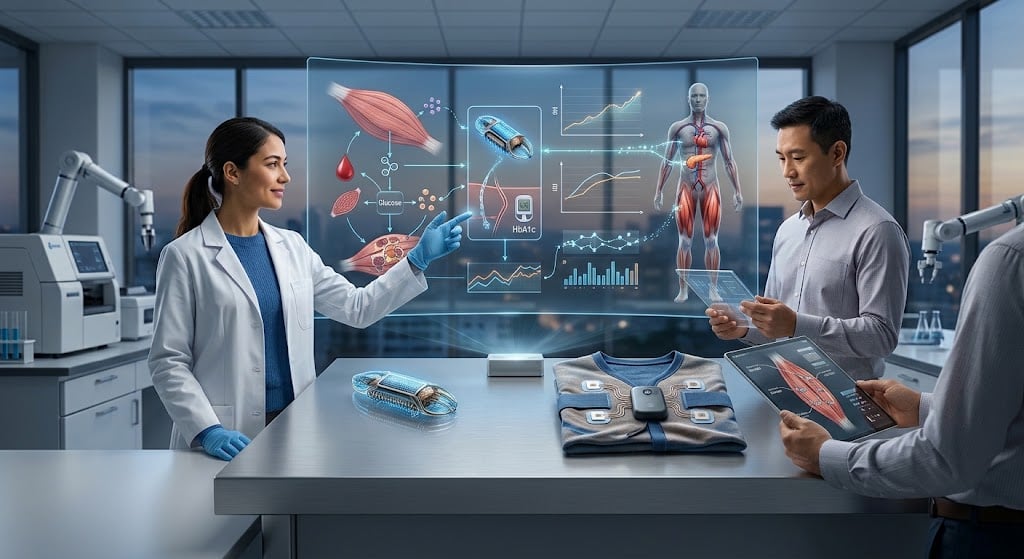
New research from ETH Zurich highlights the potential of electronically controlled implants—and helps frame the questions Lionheart Health has been exploring since it’s founding
Could electricity become another tool for managing type 2 diabetes? An experimental implant developed by researchers at ETH Zurich offers an encouraging early demonstration. For Lionheart Health, the findings reinforce the importance of investigating how implantable bioelectronics and muscle stimulation might contribute to future metabolic care.
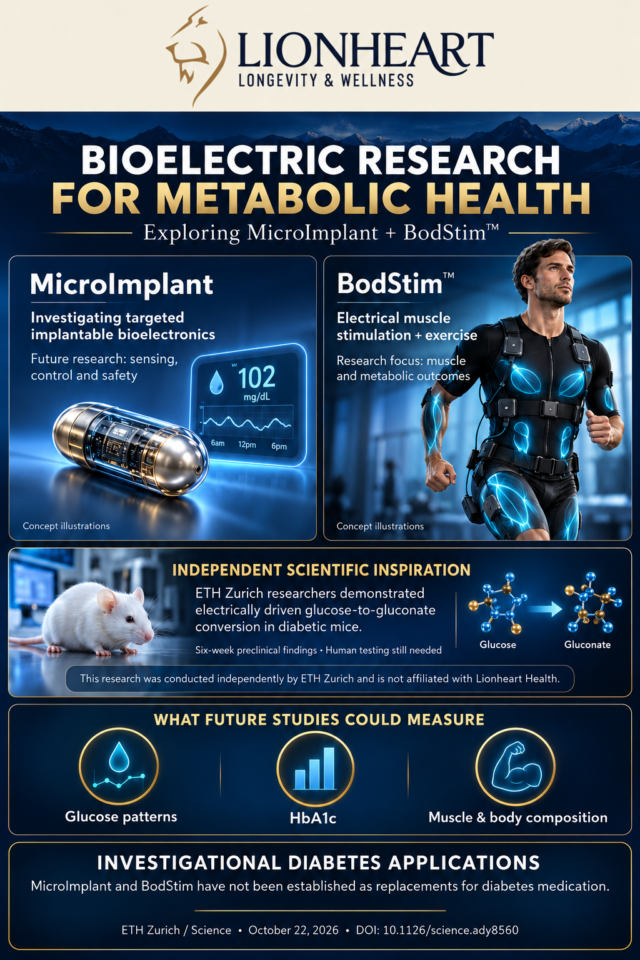
Lionheart Health is pursuing this research direction through its MicroImplant and BodStim™ technologies, exploring two potentially complementary strategies: targeted implantable bioelectric intervention and stimulation of skeletal muscle. The goal is to determine whether these approaches can produce measurable improvements in metabolic health through carefully designed research.
An Experimental Implant Offers a New Direction
In research published in Science on October 22, 2026, a team led by Professor Martin Fussenegger developed a wireless implant that uses an electrically activated catalyst to convert glucose into gluconate. The catalyst incorporates graphite felt, gold nanoclusters and platinum particles.
The system connects glucose monitoring with electronic control, allowing the catalyst to activate when glucose rises and switch off when it reaches a target level. ETH reported glucose regulation, weight loss and reliable operation over six weeks in diabetic mice, with no evidence of electrical or thermal tissue damage in those experiments. Human testing has not yet occurred. (bsse.ethz.ch)
These findings establish an intriguing preclinical foundation. They do not yet establish a safe or effective diabetes treatment for people.
MicroImplant: Exploring Targeted Bioelectric Intervention
For Lionheart Health, the MicroImplant research opportunity is to investigate how a miniature implantable platform might support precisely controlled interventions relevant to metabolic health.
Important development questions include how to deliver and control electrical energy, how to integrate glucose measurements, and how to build safeguards that prevent excessive intervention. Any proposed glucose-conversion capability would require its own engineering development and validation.
The ETH device provides an independent scientific reference point. It does not establish that Lionheart’s MicroImplant contains the same catalyst, performs the same reaction or has demonstrated equivalent results.
Lionheart’s objective is to move from an ambitious concept toward reproducible evidence, with performance, tissue compatibility and long-term reliability evaluated at each stage.
BodStim™: Investigating the Muscle Side of Metabolic Health
BodStim brings a different research approach. Its electrical muscle stimulation technology produces muscle contractions through electrodes incorporated into a wearable garment, supporting muscle training alongside exercise. Lionheart identifies its metabolic applications as investigational; the underlying Wiemspro clearance concerns muscle performance in healthy users rather than diabetes treatment. (lionheartlongevity.com)
A central question for future studies is whether a structured BodStim program can improve glucose-related outcomes alongside muscle strength, physical activity and body composition.
That possibility must be tested directly. Stronger muscles or improved exercise performance alone would not establish a diabetes treatment benefit.
Building Evidence for a Complementary Approach
Lionheart’s broader research vision is to examine whether targeted implantable technology and muscle stimulation could eventually contribute complementary benefits.
A rigorous program would evaluate each technology separately before assessing a combined approach. Relevant outcomes could include continuous glucose-monitoring measures, HbA1c, body composition, strength, treatment tolerability and adverse events. Medication changes would remain under the direction of treating clinicians.
The promise is meaningful: a future in which bioelectronic technologies expand the options available for metabolic care. Achieving that future requires disciplined development, controlled studies and clear reporting of both benefits and limitations.
Lionheart Health’s MicroImplant and BodStim metabolic applications remain investigational. Neither has been established as a replacement for diabetes medication. Patients should continue prescribed care unless their treating clinician advises otherwise.
Research reference: Maity D, Guha Ray P, Buchmann P, Charpin-El-Hamri G, Fussenegger M. “Wireless electrocatalytic closed-loop system for drug-free management of diabesity.” Science. October 22, 2026. doi:10.1126/science.ady8560.
Leonhardt patent connections are Klotho modulation, SIRT6 modulation, bioelectric protein control, and the stimulator–pump platform.
| Patent / publication | Title and status | Potential relevance to MicroImplant / BodStim diabetes research |
| US 12,226,639 B2 | Klotho modulation — issued February 18, 2025 | Describes electrical stimulation to increase Klotho expression, including implantable and external delivery approaches. Relevant to a Klotho-focused metabolic research program; it does not establish diabetes efficacy. |
| US 11,471,686 B2 | Klotho modulation — issued October 18, 2022 | Earlier Klotho patent covering programmed bioelectric signaling for controlled Klotho expression. Relevant to the underlying protein-modulation strategy. |
| US 12,752,107 B2 | Modulation of SIRT — issued October 6, 2026 | Particularly relevant to BodStim’s muscle research: issued claims address specified electrical signals increasing SIRT6 in skeletal muscle, including muscle-atrophy treatment and transcutaneous or implanted-electrode delivery. These are not broad claims to treating diabetes. |
| US 12,109,410 B2 | Bioelectric stimulator — issued October 8, 2024 | Claims address bioelectric control of stem-cell behavior and/or expression of proteins including follistatin, IGF-1, HGF, SDF-1 and VEGF. Potentially relevant to muscle and regenerative components of the program, depending on the implemented signals and methods. |
| US 10,646,644 B2 | Stimulator, pump and composition — issued May 12, 2020 | Relevant platform patent to review for a MicroImplant system combining electrical stimulation with delivery of regenerative compositions. It should not be described as covering every miniature implant. |
| US 11,446,488 B2 | Kidney treatment — issued September 20, 2022 | Describes Klotho-related bioelectric kidney treatment. Potentially relevant to research addressing diabetic kidney complications, rather than direct |