
-
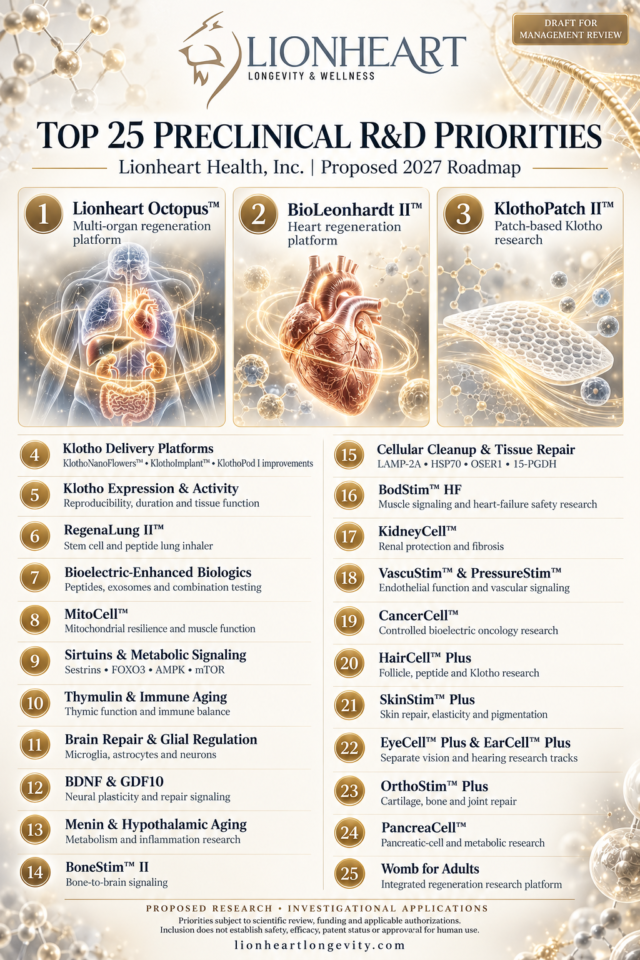
Lionheart Octopus™ Multi-Organ Regeneration Platform (component of BioLeonhardt Whole Body Regeneration System)
Advance an integrated platform combining programmable bioelectric stimulation, targeted delivery, and selected regenerative technologies. Prioritize component reliability, coordinated operation, biocompatibility, and measurable effects in organ-specific laboratory models before integrated preclinical testing. -
BioLeonhardt II™ Heart Regeneration Platform
Develop next-generation combinations of bioelectric signaling, regenerative cells, peptides, hydrogels, scaffolds, and targeted delivery for cardiac-repair research. Evaluate cell survival, tissue integration, contractile performance, vascular support, and arrhythmia risk. -
KlothoPatch II™
Develop and evaluate the proposed patch-based Klotho platform. Characterize its intended payload or expression mechanism, delivery performance, stability, local tissue response, systemic exposure, and biological activity, including comparisons with and without bioelectric stimulation. -
Klotho Delivery Platforms: KlothoNanoFlowers™, KlothoImplant™, and KlothoPod I Improvements
Advance three coordinated development tracks: characterize KlothoNanoFlowers™ formulation, stability, and release; evaluate KlothoImplant™ biocompatibility, delivery duration, and controllability; and improve KlothoPod I performance, monitoring, and reproducibility. Assess each platform independently before combination testing. Includes implantable KlothoBioreactor TM.. -
Klotho Expression and Biological-Activity Validation
Establish reproducible methods for measuring stimulation-associated Klotho expression, release, and activity. Determine tissue specificity, response duration, repeat-treatment effects, and whether molecular changes translate into functional benefits in preclinical models. -
RegenaLung II™ Stem Cell and Peptide Lung Inhaler
Investigate an inhaled-delivery platform for selected stem-cell and peptide candidates, individually and in defined combinations. Establish aerosol characteristics, delivered dose, cell viability after aerosolization, peptide stability, lung deposition, sterility, and pulmonary safety before assessing repair-related effects. Evaluate whether cells and peptides require separate delivery systems. -
Bioelectric-Enhanced Peptides, Exosomes, and Other Biologics
Test whether stimulation changes the production, release, uptake, or activity of characterized biologics. Compare stimulation alone, biologic alone, and their combination to determine whether an added benefit exists. -
MitoCell™ and Muscle Mitochondrial Resilience
Investigate mitochondrial function, cellular energy production, fatigue resistance, and muscle performance. Explore MOTS-c, Humanin, FGF21, GDF15, and related pathways while monitoring context-dependent and adverse effects. -
Sirtuins, Sestrins, and FOXO3–AMPK–mTOR Signaling
Evaluate candidate stimulation sequences targeting cellular maintenance, metabolic regulation, and stress resilience. Require functional evidence alongside changes in molecular markers. -
Thymulin and Thymic Immune-Aging Research
Investigate effects on thymulin expression, thymic-cell function, and relevant immune-cell development. Assess immune balance and potential inappropriate activation. -
Brain Repair and Glial Immune Regulation
Study microglial, astrocyte, and neuronal interactions, including exploratory PD-1/PD-L1 and P2RY12 pathways. Evaluate cellular damage responses, inflammatory injury, and neuronal survival. -
BDNF, GDF10, and Neural Plasticity Programs
Screen stimulation sequences for effects on neurotrophic signaling, neurite growth, neuronal survival, and functional neural networks to support next-generation brain-health research. -
Menin and Hypothalamic Aging Research
Investigate Menin-related pathways in relevant laboratory models, including relationships among hypothalamic function, metabolism, inflammation, and aging-associated changes. -
BoneStim™ II Bone-to-Brain Signaling
Compare electrical stimulation, mechanical loading, and their combination for effects on bone-derived signaling. Measure candidate factors and downstream neural responses without assuming electrical stimulation reproduces mechanical-loading findings. -
Cellular Cleanup, OSER1, and Tissue-Repair Signaling
Establish separate screening tracks for LAMP-2A/HSP70-associated protein maintenance, OSER1-associated stress resilience, and 15-PGDH-related repair pathways. Advance candidates according to reproducible functional effects and safety. -
BodStim™ HF Mechanistic and Safety Research
Investigate skeletal-muscle signaling relevant to heart failure, exercise intolerance, and muscle wasting, including Klotho and follistatin pathways. Evaluate delivered electrical exposure, cardiac-device interactions, and individual protocol components. -
KidneyCell™ Renal Protection and Fibrosis Research
Study Klotho-associated renal signaling, tubular-cell resilience, inflammatory injury, and fibrosis using relevant functional endpoints. -
VascuStim™ and PressureStim™ Vascular Research
Evaluate endothelial function, nitric-oxide signaling, vascular inflammation, and remodeling. Investigate CXCL5 and other targets with attention to tissue-specific effects. -
CancerCell™ Bioelectric Oncology Research
Evaluate selected bioelectric and molecular approaches in controlled tumor models. Compare effects on tumor and healthy cells and assess the possibility of unintended tumor-supporting activity. -
HairCell™ Plus Next-Generation Follicle Research
Study stimulation combined with characterized peptide candidates and Klotho-related approaches. Measure follicle activity, hair-shaft growth, inflammation, and safety. -
SkinStim™ Plus Skin Repair and Pigmentation Research
Investigate collagen organization, tropoelastin, COL17A1, skin-barrier function, and wound repair. Include exploratory pigmentation and hair-graying research where suitable models are available. -
EyeCell™ Plus and EarCell™ Plus Sensory Research
Maintain separate vision and hearing development tracks addressing retinal, optic-nerve, cochlear, and auditory-nerve models. Establish tissue-specific electrical safety and functional endpoints for each program. -
OrthoStim™ Plus Cartilage, Bone, and Joint Repair
Investigate cartilage preservation, inflammatory signaling, bone remodeling, and tissue integration. Compare stimulation alone with selected biologic and scaffold combinations. -
PancreaCell™ and Metabolic Tissue Research
Explore stimulation and targeted-delivery approaches supporting pancreatic-cell survival and function. Evaluate glucose responsiveness, insulin secretion, and risks associated with cells, implants, and delivery systems. -
BioLeonhardt Whole Body Regeneration Chamber “Womb for Adults” Integrated Regeneration Platform
Develop a staged research program involving characterized placental-derived research materials, controlled exchange systems, biological production modules, Klotho, and bioelectric signaling. Validate individual components before integrated adult-tissue studies.
Development Status Notice: This proposed ranking is a working roadmap for management and scientific review. Inclusion does not establish that a program is funded, underway, clinically validated, patented, or authorized for human use. Research configurations, intellectual-property rights, and regulatory pathways require program-specific confirmation.