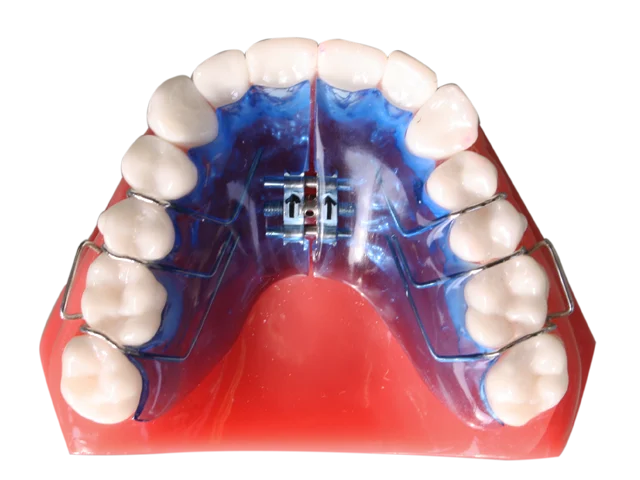
The three most common circumstances that typically indicate the need for maxillary expansion include:
Impacted Teeth
When a tooth is stuck under the gums and blocked by other teeth, it is an impacted tooth. Dentists recommend extractions to reduce the chance of disease and jaw misalignment. Palate expanders can help widen the jaw and allow for the proper eruption of permanent teeth.
Crossbites
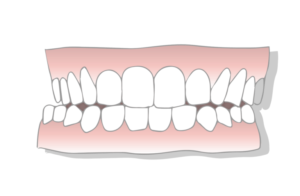
A crossbite is when the upper and lower teeth do not align correctly when biting down. Crossbites occur when some bottom teeth are located outside the upper teeth when the two jaws are closed.
This type of malocclusion can sometimes be corrected with palate expansion treatment.
Crowded Teeth
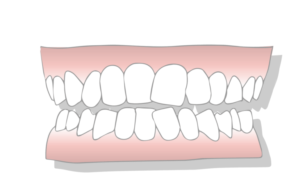
Over-retained teeth refer to baby teeth that have loosened but then tighten back into the gums, preventing the eruption of permanent teeth.
If the primary teeth are not extracted, dental crowding develops, which is a condition that occurs when there is not enough space for teeth to grow in.
Palate expanders eliminate the need for extractions and create space for permanent teeth to grow in.
Before your child’s adult teeth grow in, an orthodontist can check to see how much room is available in his or her mouth. If the jaw seems too narrow, palate expansion may be necessary to prevent dental crowding as the permanent teeth grow in.
Improved Breathing
Maxillary expansion can also improve breathing ability, which helps prevent mouth-breathing and dry mouth (xerostomia). Maxillary expansion also treats Class III orthodontic problems. Class III problems are primarily genetic and may include:
- If the lower teeth and jaw are positioned in front of their upper teeth and jaw (underbite).
- If the lower jaw appears to be unusually large. Although, the lack of upper jaw development is usually the actual cause of this abnormality.
Palate expanders also treat maxillary transverse deficiency. Patients with this condition usually have a narrow palate and posterior crossbite. Other indications of maxillary transverse deficiency include:
- Paranasal Hollowing — when the bones of the upper jaw are underdeveloped, the lower jaw excessively protrudes forward.
- Narrow Nasal Base — instead of having wide nostrils, a person with maxillary transverse deficiency may have unusually narrow or thin nostrils.
- Deepened Nasolabial Folds — indentations that extend from the nose to the outer corners of the mouth. The indentations, or lines, are more noticeable when smiling.
- Hypoplastic Zygoma — a person with hypoplastic zygoma has underdeveloped and flattened cheekbones.
- Narrow Tapering Maxillary Arch — an extremely narrow palate (v-shaped).
Indicators for Palate Expansion
Palate expansion can be completed before the end of an adolescent’s growth spurt. Expansion techniques vary depending on the patient’s age. For example, treatment is different for adolescents in the primary dentition phase (baby teeth), early mixed dentition phase (mix of baby teeth and permanent teeth), and early permanent dentition phase (all permanent teeth).
Young Children
Treatment is most effective when the patient’s jaw is still growing. As baby teeth fall out, permanent teeth start to erupt around the same time (age 6). When the mouth consists of some primary teeth and permanent teeth, it is called the “mixed dentition phase.” If a child has a crossbite or crowded teeth during this phase, palate expansion may be necessary.
Children & Pre-Teens
As a child reaches the late mixed dentition phase, which is when there are more permanent teeth in the dental arch than primary teeth, palatal expansion is more difficult. During this phase, the jaw isn’t growing as quickly. It is typically necessary to wait until the first premolars erupt to begin expansion treatment.
Teenagers and Older
As an adolescent’s growth spurt ends, palatal expansion may not be possible because the jaw is almost fully developed. Implant-supported or surgically assisted palatal expansion is typically the only treatment option at this stage because heavier force is needed to expand the jaw. Expansion is more likely to be successful in young children rather than those who have reached mid or late adolescence.