
New EyeCell™ studies are enrolling to evaluate bioelectric stimulation, photobiomodulation and multimodal regenerative strategies for supporting retinal and visual function
HUNTINGTON BEACH, Calif. — September 17, 2026 — Lionheart Health, Inc., a regenerative health and bioelectric technology company, today highlighted emerging research demonstrating that cells within the mammalian eye can be experimentally reprogrammed to generate new retinal neurons and improve visual responses in animal models. The company believes these advances support continued investigation of its EyeCell™ platform, which is designed to apply noninvasive bioelectric and complementary regenerative signals intended to support retinal, optic-nerve and neurovisual function.
Lionheart Health is now opening enrollment and participant screening for new EyeCell™ clinical research studies. These studies are intended to determine whether carefully selected bioelectric signals—alone or combined with red-light photobiomodulation, structured exercise, nutritional support and other investigational regenerative approaches—can measurably improve or preserve visual function.
“Scientists are increasingly demonstrating that the mammalian retina may be more biologically reprogrammable than previously believed,” said Howard J. Leonhardt, Executive Chairman and Co-CEO of Lionheart Health, Inc. “EyeCell™ was designed around a related central hypothesis: that properly delivered bioelectric and complementary regenerative signals may help activate repair, protection and functional-recovery pathways that are largely dormant in aging or damaged tissues. Our responsibility now is to test that hypothesis carefully in properly designed studies.”
Scientists Reactivate Retinal-Regeneration Pathways
A major focus of retinal-regeneration research involves Müller glia, specialized support cells that help maintain the structure, metabolism and function of the retina.
In zebrafish, Müller glia naturally respond to retinal injury by reverting to a progenitor-like state and producing new retinal neurons. Mammals retain Müller glia but have largely lost this regenerative response.
Researchers have now demonstrated several experimental methods for partially restoring this capacity:
- Manipulating genes, transcription factors and signaling proteins has pushed Müller glia in mice toward retinal progenitor states and the production of new neurons, including rod photoreceptor-like cells.
- In mouse models of severe retinal dysfunction, experimentally generated cells have formed connections within existing retinal circuitry and produced measurable improvements in visual responses.
- A 2025 Nature Communications study identified intercellular transfer of the protein Prox1 as an important barrier to mammalian Müller-glia regeneration. Blocking this transfer enabled Müller glia to reprogram into retinal progenitor cells in injured mouse retinas. A gene-delivered anti-Prox1 approach also promoted retinal-neuron regeneration and delayed vision loss in a mouse model of retinitis pigmentosa.
- Separately, National Eye Institute-supported researchers chemically reprogrammed skin cells into light-sensitive rod photoreceptor-like cells. After transplantation into mice with retinal degeneration, the cells survived and contributed to improved visual function.
These findings remain preclinical. They do not demonstrate that blindness can presently be reversed naturally in humans, but they provide strong evidence that mammalian retinal cells and other adult cells possess greater regenerative plasticity than once believed.
EyeCell™ Designed to Investigate Bioelectric Support of Retinal Repair
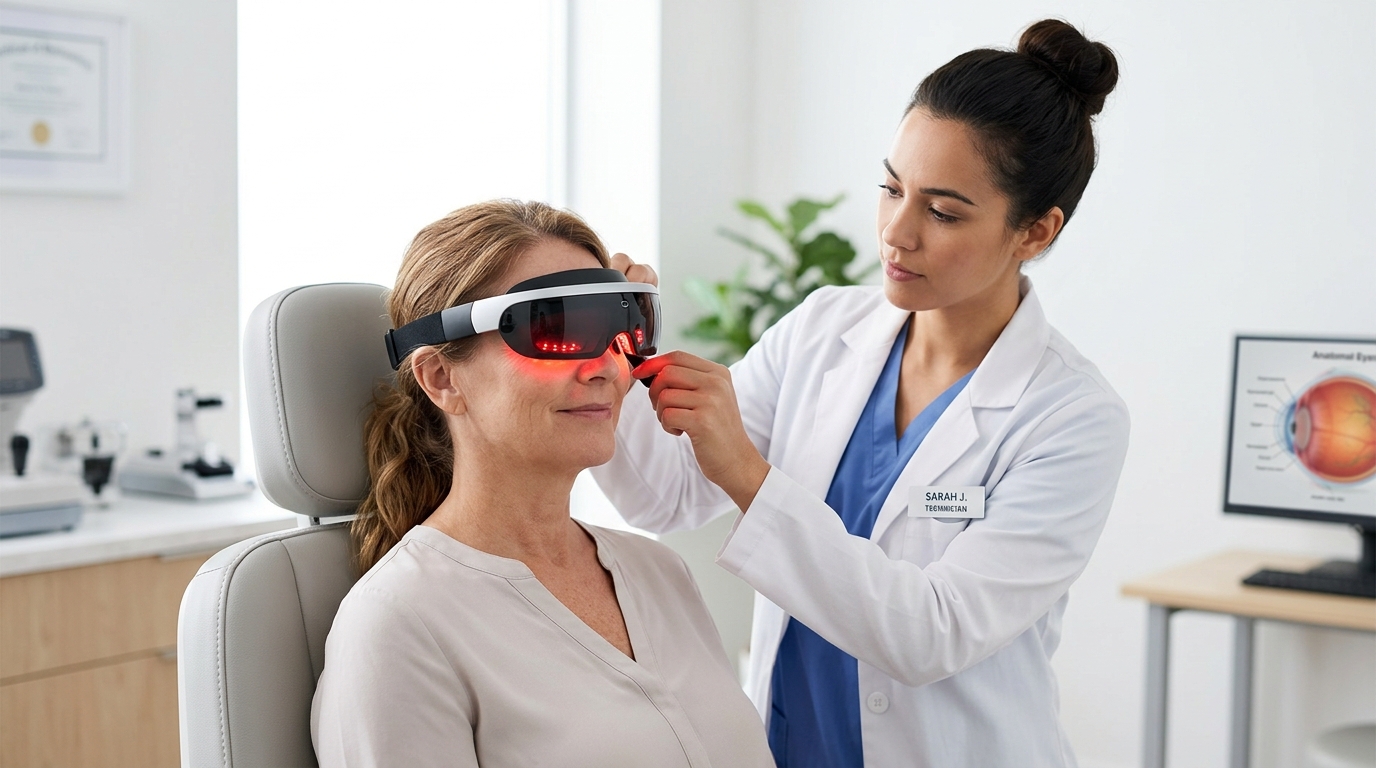
EyeCell™ is Lionheart Health’s investigational vision platform for evaluating noninvasive bioelectric and microcurrent stimulation approaches designed to support retinal, optic-nerve and neurovisual function.
The EyeCell™ research strategy does not assume that electrical stimulation alone has been proven to reprogram Müller glia or regenerate a human retina. Rather, the program is designed to investigate whether precisely selected electrical signals can favorably influence biological processes associated with retinal protection and repair, including:
- Neurotrophic signaling involving factors such as BDNF and CNTF
- Photoreceptor survival and retinal-cell resilience
- Retinal and periocular circulation
- Mitochondrial and cellular-energy support
- Inflammatory and oxidative-stress responses
- Stem-cell migration, cellular communication and tissue-repair signaling
- Functional communication between the retina, optic nerve and brain
Independent animal studies have previously reported that transcorneal electrical stimulation can promote photoreceptor survival, preserve retinal function, protect retinal ganglion cells following optic-nerve injury and reduce light-induced photoreceptor degeneration. These findings provide a scientific rationale for continued clinical investigation but do not establish efficacy in humans.
Earlier EyeCell™ Findings Support Expanded Studies
Lionheart Health previously reported preliminary results from 16 evaluable eyes treated through its Virginia and Utah EyeCell™ pilot programs:
- 11 of 16 eyes improved — 68.8%
- 3 of 16 eyes remained stable — 18.8%
- 14 of 16 eyes improved or remained stable — 87.5%
- 2 of 16 eyes declined — 12.5%
- Selected responding eyes gained several visual-acuity letters, with some gains approaching approximately 10 letters
The pilot incorporated EyeCell™ bioelectric signaling, frequency-specific transpalpebral microcurrent and, in some participants, combinations of these approaches.
Because the pilot involved a small population, mixed treatment exposures, differences between sites and limited control data, the findings are preliminary and hypothesis-generating. They do not establish EyeCell™ as an effective treatment for macular degeneration, blindness or another eye disease.
Chaikin and Kondrot Data Provide Additional Rationale
The EyeCell™ program also builds upon earlier research involving ocular microcurrent and multimodal vision-support protocols.
Chaikin and colleagues evaluated frequency-specific transpalpebral microcurrent in 31 eyes from 17 patients with age-related macular degeneration. Among 25 eyes with dry AMD, 52% showed a positive visual-acuity trend. Five of six eyes with wet AMD improved and one remained unchanged. Because the study lacked a control group, the results require cautious interpretation.
Kondrot reported outcomes involving 152 patients and 290 eyes treated through a three-day multimodality program incorporating microcurrent, nutrition, oxidative therapy and syntonic light. Across the mixed-treatment population, 69% of eyes gained at least five visual-acuity letters and 15% gained at least 10 letters. Because multiple therapies were used together without a control group, the independent contribution of microcurrent could not be determined.
A separate 2023 randomized pilot involving 62 patients with dry AMD reported a favorable difference in ETDRS visual-acuity change between transpalpebral-microcurrent and sham-treatment groups at 30 weeks. Larger confirmatory studies remain necessary.
New EyeCell™ Studies Enrolling
Lionheart Health is enrolling and screening prospective participants for its next-stage EyeCell™ clinical research program. The program is designed to evaluate standardized ophthalmic outcomes, potentially including:
- ETDRS best-corrected visual acuity
- Percentage of eyes gaining at least 5, 10 or 15 letters
- Contrast sensitivity
- Low-luminance visual acuity
- Visual-field testing
- Microperimetry
- OCT retinal imaging
- OCT angiography
- Geographic-atrophy and drusen measurements, when applicable
- Patient-reported functional vision
- Ocular safety and adverse-event monitoring
The planned multimodal study will evaluate EyeCell™ bioelectric stimulation in combination with selected elements that may include red-light photobiomodulation, BodStim™-supported exercise, a structured vision-supportive diet, nutritional supplementation and selected ophthalmic eye-drop approaches.
Future research may also examine investigational signaling strategies related to Müller-glia activation, neurotrophic-factor expression, stem-cell homing and retinal-cell survival. Any advanced regenerative intervention will require separate scientific validation, regulatory review, ethics-committee or IRB oversight and properly documented informed consent.
“Our objective is not to suggest that EyeCell™ has already regenerated a human retina,” Leonhardt added. “Our objective is to determine whether bioelectric signaling can become one component of a rigorously tested regenerative platform capable of protecting threatened cells, improving function and potentially creating a more favorable environment for future cellular-reprogramming therapies.”
EyeCell™ Skaphor™ Available for General Eye Wellness
Separate from Lionheart Health’s investigational clinical program, the EyeCell™ Skaphor™ Model is available through the Lionheart Health eStore as a noninvasive microcurrent and micropulse optical-light platform intended for general eye-wellness applications, including:
- Tired eyes
- Digital eye fatigue
- Eye-area relaxation
- General visual wellness
EyeCell™ Skaphor™ is not marketed as a treatment, cure, mitigation or prevention product for macular degeneration, retinitis pigmentosa, glaucoma, diabetic retinopathy, optic neuropathy, blindness or another eye disease.
Learn more about EyeCell™ Skaphor™ at:
https://lionheartlongevity.
Individuals interested in EyeCell™ clinical-research screening may contact Lionheart Health or request a consultation through:
https://lionheartlongevity.com
Important Research and Medical Notice
Retinal-cell reprogramming and regeneration remain experimental. The referenced Müller-glia, gene-manipulation and chemically reprogrammed-cell findings were obtained in laboratory or animal studies and have not established a therapy capable of naturally reversing blindness in humans.
EyeCell™ has not been cleared or approved by the U.S. Food and Drug Administration to treat macular degeneration, blindness or another eye disease. Disease-focused use is limited to appropriately authorized clinical research with qualified professional supervision, required regulatory and ethics oversight, informed consent and independent safety monitoring where applicable.
Patients with diagnosed or suspected eye disease should remain under the care of a qualified ophthalmologist and should not discontinue, delay or substitute prescribed standard-of-care evaluation or treatment.
About Lionheart Health
Lionheart Health, Inc. is a regenerative health, longevity and bioelectric technology company focused on translating advanced diagnostics, bioelectric stimulation and precision-health protocols into clinically measurable improvements in human function and healthy aging. Its programs span vision, muscle health, brain health, joint health, regenerative aesthetics and major-organ regeneration.
Selected References
- Lee EJ, Kim M, Park S, et al. Restoration of retinal regenerative potential of Müller glia by disrupting intercellular Prox1 transfer. Nature Communications. 2025;16:2928.
Read the study - National Eye Institute. Researchers restore sight in mice by turning skin cells into light-sensing eye cells.
Read the NEI summary - Chaikin L, Kashiwa K, Bennet M, Papastergiou G, Gregory W. Microcurrent stimulation in the treatment of dry and wet macular degeneration. Clinical Ophthalmology. 2015;9:2345–2353. doi:10.2147/OPTH.S92296.
- Parkinson KM, et al. Evaluation of visual acuity in dry AMD patients after microcurrent electrical stimulation. International Journal of Retina and Vitreous. 2023. doi:10.1186/s40942-023-00471-
y. - Lionheart Health. Encouraging EyeCell™ Clinical Data and EyeCell™ Skaphor™ Launch.
Read the earlier EyeCell™ release