
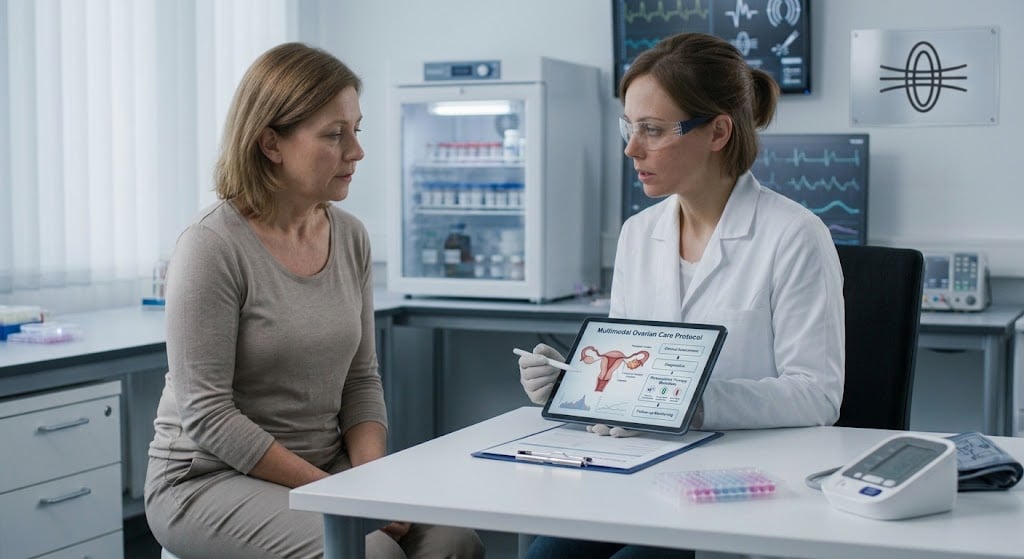
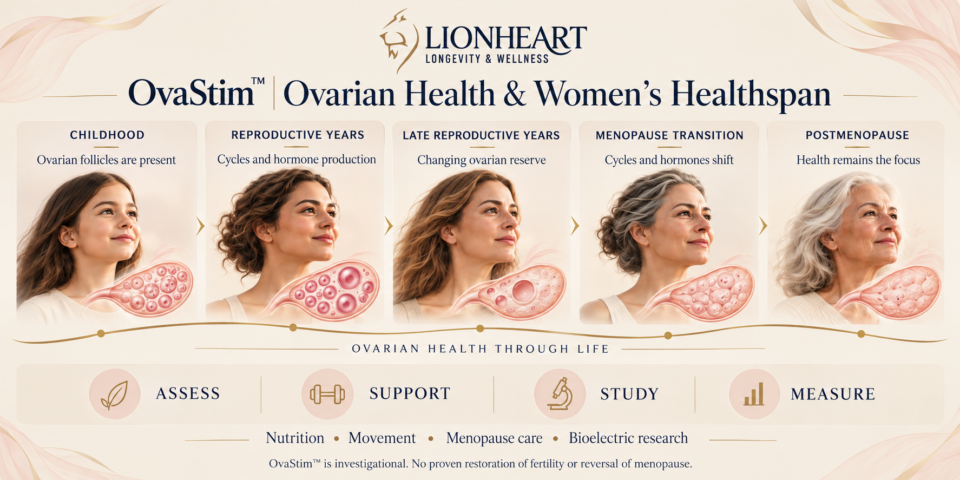
The ovary’s role changes throughout life. During the reproductive years, it supports ovulation and produces hormones. Through the menopause transition, cycles and hormone levels change. After menopause, reproductive function has ended, but the question of how ovarian aging relates to women’s long-term health remains an active area of research. (pubmed.ncbi.nlm.nih.gov, pubmed.ncbi.nlm.nih.gov)
For Lionheart Health, that question calls for a multimodal approach. No single device, supplement, or procedure can address every aspect of ovarian health. The proposed Lionheart Ovarian Health Protocol™ combines clinical evaluation, everyday health practices, appropriate specialist care, and carefully measured research into emerging technologies.
This approach grows from the 44-year history of Lionheart’s parent, Leonhardt Ventures, founded in 1982. Across its work in medical technology and regenerative research, the organization has pursued ways to combine electrical stimulation with other interventions. Ovarian health presents a new area in which to test that approach.
A foundation built around each woman
The protocol begins with a consultation. A clinician reviews symptoms, menstrual or menopause history, medications, medical conditions, and personal goals. Testing then follows the clinical question. Someone exploring fertility preservation needs a different evaluation from someone seeking help with menopausal symptoms or support for health after menopause.
The first layer of care is personal: a nutrient-rich diet, adequate activity and recovery, sleep support, and supplements chosen after reviewing diet, test results, medications, and pregnancy plans. These steps support overall health. They should not be described as proven ways to regenerate ovarian follicles. When fertility preservation matters, timely referral is essential so established options can be considered. (asrm.org, asrm.org)
Combining movement with Lionheart technology
Movement is a central part of Lionheart’s healthspan work. The protocol may pair an individualized exercise plan with BodStim™ electrical muscle stimulation where appropriate, while tracking strength, physical function, and other relevant outcomes.
Lionheart is also interested in Klotho as a research marker. Studies have examined its relationship with reproductive aging, but a change in circulating Klotho would not, by itself, prove improved ovarian function. That distinction matters as Lionheart studies whether its broader healthspan platform has a role in women’s care. (pubmed.ncbi.nlm.nih.gov, pubmed.ncbi.nlm.nih.gov)
Optional wellness and research modalities
Depending on clinical suitability, the protocol may include PEMF, red light therapy, vibrational therapy, hyperbaric oxygen, and sauna. Each has a different purpose and evidence base. Emerging studies provide reasons to investigate some of these approaches, but none has been established as a Lionheart treatment that restores ovarian reserve or reverses menopause. The care team should select them individually and measure outcomes relevant to the person receiving them. (pubmed.ncbi.nlm.nih.gov, pubmed.ncbi.nlm.nih.gov, pubmed.ncbi.nlm.nih.gov)
Lionheart’s proposed OvaStim™ pathway focuses on bioelectric ovarian-health research. Its role is to test a defined stimulation approach with specified settings, safety monitoring, and measurable outcomes. Research using other forms of electrical stimulation cannot establish what OvaStim™ will do; Lionheart must generate evidence for its own application. (pubmed.ncbi.nlm.nih.gov, pubmed.ncbi.nlm.nih.gov)
A separate investigational pathway may examine PRF (platelet-rich fibrin) and bioelectric-enhanced peptides. PRF is distinct from PRP, and results from ovarian PRP studies cannot be assumed to apply to PRF. The phrase “bioelectric-enhanced peptides” describes a combination Lionheart proposes to investigate, not a demonstrated ovarian treatment. (pubmed.ncbi.nlm.nih.gov)
Measure what matters at every life stage
The protocol’s value depends on clear follow-up. For one woman, the meaningful outcome may be relief of menopausal symptoms or better physical function. For another, it may be an informed and timely fertility-preservation decision. Research into ovarian interventions must report its own clinical outcomes and adverse events; changes in a laboratory marker alone cannot stand in for improved fertility, healthspan, or quality of life.
Lionheart’s aim is to bring its multimodal platform to this important area of women’s health and test it carefully. Diet, personalized supplements, movement, established specialist care, and selected wellness services form the patient-centered foundation. OvaStim™, ovarian PRF, and bioelectric-enhanced peptides remain investigational. Their ability to restore ovarian function, reverse menopause, or extend life has not been established.
The Lionheart Ovarian Health Protocol™ is individualized and does not replace gynecologic, menopause, or reproductive-specialist care.