

For decades, serious lung damage caused by pollution, smoking, occupational exposure, infection, and chronic inflammation has often been treated as permanent. Conventional pulmonary care can reduce symptoms, improve airflow, control inflammation, and slow further decline—but it generally does not rebuild the delicate tissue responsible for transferring oxygen into the bloodstream.
The emerging science of lung regeneration is challenging that limitation.
Researchers have identified specialized stem and progenitor-cell niches within the lungs that may remain capable of replacing damaged cells. Under ordinary chronic-disease conditions, however, these repair systems may be inactive, impaired, or overwhelmed. The central scientific question is therefore no longer simply whether the lungs possess regenerative cells, but whether those cells can be safely activated and supported to restore functional tissue.
The investigational RegenaLung™ program is designed around that possibility.
Activating a Dormant Repair System
The alveoli are microscopic air sacs where oxygen enters the bloodstream and carbon dioxide is removed. Damage to their thin cellular lining can severely reduce oxygen-exchange capacity. When the damage becomes extensive, patients may experience shortness of breath, poor exercise tolerance, fatigue, and progressive loss of pulmonary function.
Recent preclinical findings suggest that certain lung stem-cell populations can be stimulated to replace damaged alveolar cells. Appropriate biochemical signals may encourage these cells to re-enter a developmental repair program—restarting biological processes normally most active during growth, healing, and tissue formation.
Rather than merely compensating for lost lung function, this regenerative strategy seeks to address the damaged tissue itself.
The Potential Role of Klotho-Expressing Stem Cells
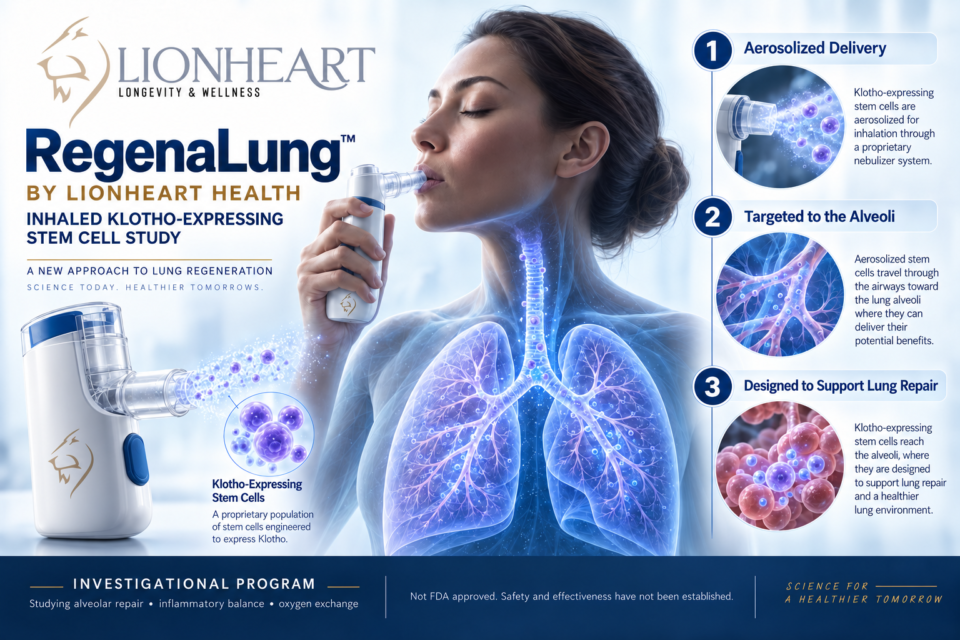
RegenaLung is designed to investigate the use of stem cells engineered or selected to express Klotho, a naturally occurring protein associated with healthy aging, cellular protection, reduced inflammatory signaling, resistance to oxidative stress, and tissue maintenance.
Klotho expression may be particularly relevant to damaged lungs because chronic pulmonary injury often involves several interconnected problems:
- Persistent inflammation
- Oxidative cellular damage
- Premature cellular aging, or senescence
- Loss of healthy microvascular support
- Fibrotic remodeling
- Reduced regenerative signaling
The study is intended to evaluate whether Klotho-expressing stem cells can help create a more favorable environment for lung repair. The therapeutic concept is that the cells may provide both regenerative support and sustained biological signaling, potentially helping protect surviving tissue while encouraging dormant repair mechanisms.
This approach is not simply about delivering stem cells and expecting them to become replacement lung tissue. It is also about studying whether their secreted proteins, extracellular vesicles, growth factors, and Klotho-related signals can influence the surrounding cellular environment.
Supporting the Lung’s Own Biology
RegenaLung represents a shift from replacement-oriented medicine toward biologically guided restoration.
Its investigational strategy is designed to explore whether Klotho-expressing cells can:
- Reduce damaging inflammatory and oxidative conditions.
- Support resident lung stem and progenitor cells.
- Encourage repair of the alveolar lining.
- Improve the local environment needed for healthy tissue development.
- Protect newly repaired cells from recurring injury.
- Ultimately improve measurable pulmonary function and oxygen exchange.
In this model, the therapy does not attempt to overpower the body’s biology. It seeks to supply the signals and cellular support needed for the lungs to reactivate repair pathways that may already exist but are no longer functioning effectively.
Measuring More Than Symptom Relief
A rigorous RegenaLung study should determine whether biological changes translate into meaningful functional improvement. Depending on the approved clinical protocol and stage of development, investigators may evaluate measures such as:
- Oxygen saturation and oxygen-exchange efficiency
- Pulmonary-function testing
- Exercise tolerance and six-minute walking distance
- Patient-reported breathing capacity and quality of life
- Imaging evidence of changes in damaged lung tissue
- Inflammatory, senescence, and regenerative biomarkers
- Treatment safety, tolerability, and durability
These measurements are essential. A reduction in an inflammatory marker alone would not prove that damaged alveoli have regenerated. The most important evidence would be a consistent combination of biological, structural, and functional improvement.
From Managing Decline to Pursuing Recovery
The broader significance of this research reaches beyond a single therapy.
Modern medicine has become increasingly effective at measuring pulmonary decline. Physicians can monitor oxygen levels, airflow, inflammation, fibrosis, and exercise capacity with remarkable precision. But better measurement alone does not repair damaged organs.
The next frontier is therapeutic technology that restores function.
RegenaLung is being developed within this restorative vision: combining cellular therapy, Klotho biology, and regenerative signaling to investigate whether chronically injured lungs can be moved from a state of continued deterioration toward repair.
If successful, this class of therapy could contribute to a fundamental change in pulmonary medicine. Conditions historically managed as chronic and irreversible might eventually become candidates for cellular restoration.
Unlocking the Body’s Hidden Recovery Pathways
The human body contains repair mechanisms that science is only beginning to understand. Some remain active throughout life. Others appear to become dormant, suppressed, or ineffective with age and chronic disease.
The goal of regenerative medicine is to identify those pathways and learn how to reactivate them safely.
RegenaLung is designed to explore whether Klotho-expressing stem cells can help unlock one of those hidden pathways inside the lungs. It is an ambitious investigational strategy: not simply helping patients live with damaged lungs, but studying whether the lungs can be supported in repairing themselves.
That is the promise of restorative medicine—moving beyond reading organ decline and toward developing therapies that may reverse it.
RegenaLung™ is an investigational program. Klotho-expressing stem-cell therapy has not been established as safe or effective for treating chronic lung disease and is not approved by the U.S. Food and Drug Administration for this use. Clinical claims must be supported by appropriately authorized studies.