
Inflammation is essential to healing. When the body detects injury or infection, immune signals help clear damage and begin repair. Trouble arises when that response stays active longer than it should. Persistent inflammation can disrupt tissue function and is one reason researchers are looking for ways to measure and regulate the response with greater precision.
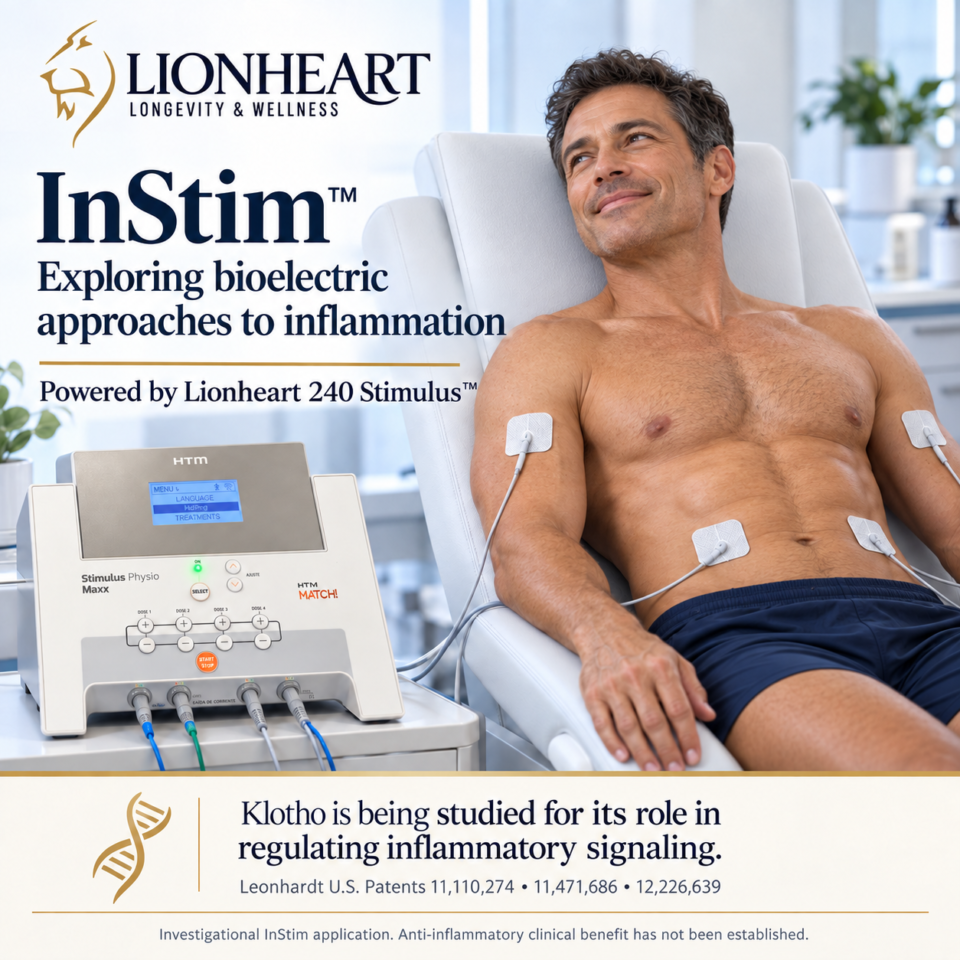
Lionheart Health’s InStim™ research initiative explores whether carefully selected bioelectric signals, delivered through the Lionheart 240 Stimulus™ platform, can influence inflammation-related biology. The goal is to study a measurable question: Can stimulation change relevant biomarkers in people, and do those changes correspond to a meaningful health benefit?
Why Klotho matters
Klotho is a protein studied for its roles in aging, tissue health, and immune regulation. Laboratory research suggests that Klotho can dampen activity in inflammatory pathways including NF-κB and the NLRP3 inflammasome. These findings make Klotho a promising research target, but they do not establish that increasing Klotho through a device will reduce inflammation or improve outcomes in patients. (pmc.ncbi.nlm.nih.gov, pmc.ncbi.nlm.nih.gov)
For InStim, Klotho is one part of a broader hypothesis. Researchers need to determine whether a particular stimulation protocol changes Klotho levels, whether any change is sustained, and whether inflammation markers move in a consistent and clinically useful direction.
The patent foundation
Inventor Howard J. Leonhardt’s issued U.S. Patent 11,110,274, System and Method for Treating Inflammation, describes a bioelectric approach directed at inflammation. Issued U.S. Patents 11,471,686 and 12,226,639, both titled Klotho Modulation, describe approaches to influencing Klotho expression with electrical stimulation. Together, these patents provide a technical foundation for questions the InStim team wants to investigate. A patent describes an invention; clinical studies must establish how well a particular product and protocol work in people. (patents.google.com, patents.google.com, patents.google.com)
From an idea to a testable protocol
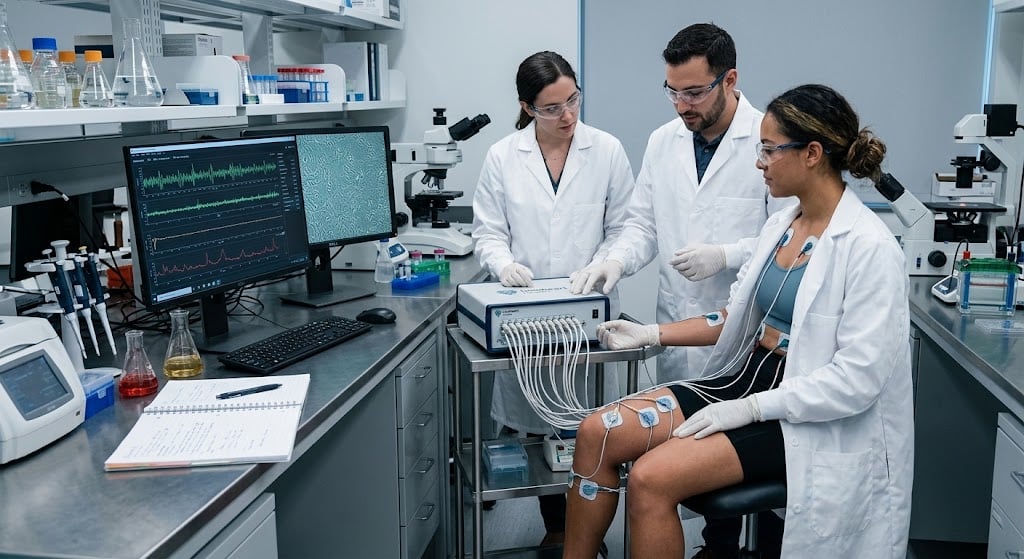
The Lionheart 240 Stimulus™ provides a platform on which InStim stimulation protocols can be studied. A useful research program would document electrode placement, signal settings, treatment frequency, and participant characteristics so that results can be repeated and independently assessed.
It would also measure more than one outcome. Klotho and inflammatory biomarkers such as C-reactive protein and selected cytokines could help show whether the intended biological response occurred. Symptoms and measures of function would address the separate question patients care about most: whether they feel or function better. Comparing results against a suitable control would help distinguish an effect of stimulation from normal variation and other influences.
Electrical stimulation has generated interest as a way to influence inflammatory signaling, but findings across devices, stimulation targets, and patient groups cannot simply be transferred to InStim. Human studies of related approaches have produced mixed results. That is why a carefully defined InStim protocol and its own clinical evidence matter. (pubmed.ncbi.nlm.nih.gov, pubmed.ncbi.nlm.nih.gov)
The next step
The InStim initiative brings together two lines of research: bioelectric control of biological responses and Klotho’s potential role in regulating inflammation. Its promise lies in making that connection testable. Lionheart’s next task is to establish whether its specific signals reliably affect the intended markers, identify who may respond, and determine whether any observed changes translate into meaningful benefits.
Klotho may be one of the body’s most compelling regulators of inflammation. Research shows that it can influence NF-κB and the NLRP3 inflammasome, two signaling pathways that help drive inflammatory responses. In laboratory and animal studies, lower Klotho has been linked to stronger inflammatory activity, while restoring Klotho has reduced certain inflammatory signals. That connection gives Lionheart’s InStim™ initiative a focused question: can precisely delivered bioelectric signals increase Klotho activity and help bring an excessive inflammatory response back toward balance? Establishing that effect—and showing that it improves patient outcomes—requires clinical testing. (pmc.ncbi.nlm.nih.gov, pubmed.ncbi.nlm.nih.gov, pubmed.ncbi.nlm.nih.gov)
InStim™ is an investigational application. Its anti-inflammatory clinical benefit has not been established.
Scientific references
- Prud’homme GJ, Wang Q. “Anti-Inflammatory Role of the Klotho Protein and Relevance to Aging.” Cells. 2024;13(17):1413. doi:10.3390/cells13171413. A review of Klotho’s effects on inflammatory pathways, including NF-κB and NLRP3. (pmc.ncbi.nlm.nih.gov)
- Zhao Y, et al. “Klotho Depletion Contributes to Increased Inflammation in Kidney of the db/db Mouse Model of Diabetes via RelA (Serine)536 Phosphorylation.” Diabetes. 2011;60(7):1907–1916. doi:10.2337/db10-1262. Preclinical evidence linking reduced Klotho with increased inflammatory signaling. (pubmed.ncbi.nlm.nih.gov)
- Maekawa Y, et al. “Klotho Suppresses TNF-α-Induced Expression of Adhesion Molecules in the Endothelium and Attenuates NF-κB Activation.” Endocrine. 2009. doi:10.1007/s12020-009-9181-3
. Laboratory evidence for a potential anti-inflammatory mechanism. (pubmed.ncbi.nlm.nih.gov) - Zhao X, et al. “New Insights into the Role of Klotho in Inflammation and Fibrosis: Molecular and Cellular Mechanisms.” Frontiers in Immunology. 2024. doi:10.3389/fimmu.2024.1454142
. A review of Klotho’s interactions with immune cells and inflammatory pathways. (frontiersin.org) - do Carmo Almeida TC, et al. “Effects of Transcutaneous Electrical Nerve Stimulation on Proinflammatory Cytokines: Systematic Review and Meta-Analysis.” Mediators of Inflammation. 2018;2018:1094352. doi:10.1155/2018/1094352. Evidence concerning inflammatory markers after TENS; it does not test InStim™. (pmc.ncbi.nlm.nih.gov, pmc.ncbi.nlm.nih.gov)
- Schiweck C, et al. “No Consistent Evidence for the Anti-Inflammatory Effect of Vagus Nerve Stimulation in Humans: A Systematic Review and Meta-Analysis.” Brain, Behavior, and Immunity. 2024. doi:10.1016/j.bbi.2023.12.008
. A useful account of the limits and mixed results of human stimulation research; it also does not test InStim™. (pubmed.ncbi.nlm.nih.gov)
These publications support the research rationale. They do not establish that InStim™ raises Klotho or reduces inflammation in patients.