

A widening part, more hair in the shower, or a gradual change in density can raise the same question: what’s causing it? Hereditary thinning and increased shedding can look similar at first, and more than one factor can be involved. A clinician can review when the changes began, examine the scalp, and determine whether further evaluation is needed. That assessment is the starting point for HairCell™ Plus. aad.org
What goes into a HairCell™ Plus plan?
HairCell™ Plus is Lionheart’s clinician-guided approach to hair and scalp care. The consultation helps determine which options fit your scalp findings, health history, and goals. Depending on the assessment, the discussion may include targeted bioelectric scalp stimulation, red light, pulsed electromagnetic fields (PEMF), topical serums or peptides, and guided scalp massage. Lionheart Longevity
The bioelectric research program and topical peptide blend have separate roles. Lionheart’s bioelectric research focuses on signaling targets such as SDF-1, PDGF, COL17A1, tropoelastin, and Klotho. The topical peptide blend is a separate component that a clinician may consider. Studying a signaling target helps frame a research question about the follicle and its surroundings. Clinical studies are needed to determine whether targeting it leads to measurable changes in hair growth. Lionheart Longevity
A clinician may also discuss platelet-rich fibrin (PRF). PRF is prepared from a patient’s own blood and, when included in the plan, administered by injection. Combining PRF with targeted bioelectric stimulation is investigational. The evidence, potential risks, and suitability of each option are part of the consultation. Lionheart Longevity
The HairCell™ 7-Peptide Mix and Klotho
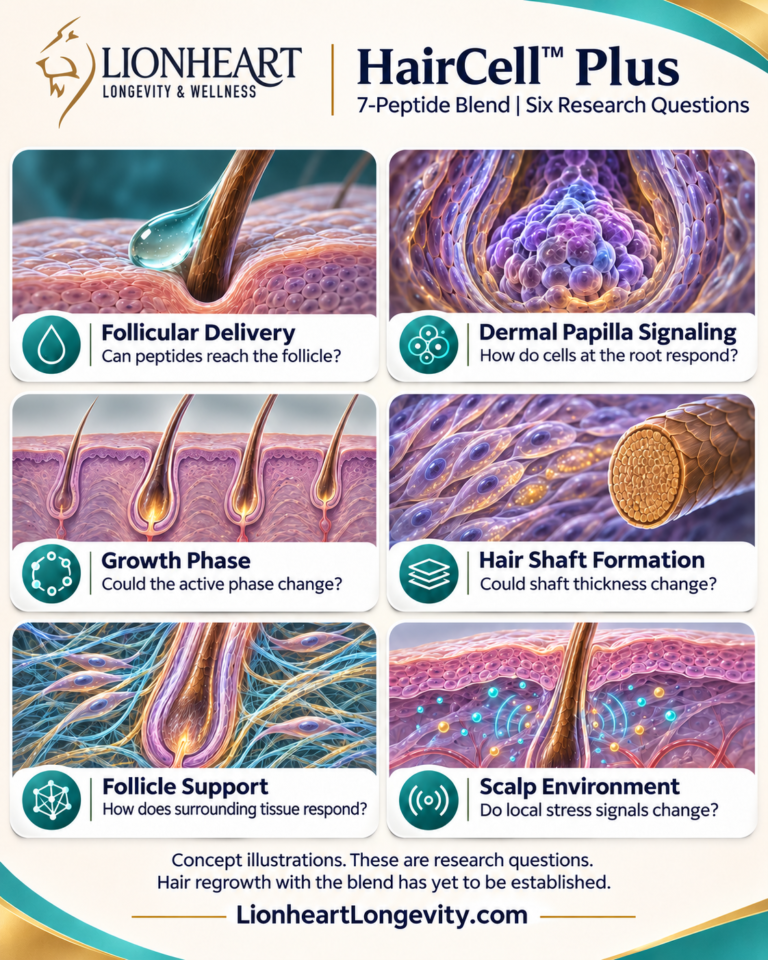
The HairCell™ 7-Peptide Mix is a topical option within the clinician-guided HairCell™ Plus program. The blend includes copper tripeptide-1 (GHK-Cu), acetyl tetrapeptide-3, and five recombinant peptides or polypeptides. The research asks whether the blend can reach the follicle after topical application, influence signaling around the hair root, and produce measurable changes in hair density or shaft thickness.
Klotho is part of our broader bioelectric research. In parallel with the seven-peptide blend, we’re exploring Klotho as a potential eighth component in a future formulation. That raises a specific question: could adding a Klotho-related component change how the scalp or follicle responds compared with the seven-peptide blend alone? The seven-peptide blend and the proposed Klotho combination would each need to be evaluated for their effects on human hair growth.

Why pair peptides with bioelectric stimulation?
A topical formula has to reach the tissue where it’s intended to act. Our bioelectric peptide research asks whether controlled electrical stimulation can change how much peptide reaches that tissue or how the cells respond. For HairCell™ Plus, a direct comparison would test the same topical blend with and without stimulation, then measure whether the combination changes peptide delivery, hair density, or shaft thickness over time.
In December 2025, Lionheart Health announced through Leonhardt Ventures that it had filed a provisional patent application for a broader bioelectric peptide-delivery platform spanning topical, oral, and injectable routes. Lionheart separately announced that it was preparing a provisional application specific to the bioelectric-enhanced seven-peptide hair formulation. Both announcements describe proposed technology. Whether the combination improves delivery to human scalp follicles or produces greater hair growth remains a clinical research question. Hair-specific application announcement
How do you tell whether anything is changing?
Start with a baseline. Scalp photographs taken with consistent lighting, angles, and hair placement make follow-up comparisons more meaningful. Reviewing the same areas over time gives you and your clinician a shared record to discuss alongside changes you notice at home. Hair and scalp changes take time, and individual responses vary. Lionheart Longevity
If you’ve noticed changes in shedding, density, or scalp health, a consultation is a chance to discuss what may be contributing and which options are appropriate for you.
Explore HairCell™ Plus and book a hair wellness consultation
Lionheart Health, Inc. and HairCell TM have partnered with GetHairMD visit www.GetHairMD.com to find a licensed clinic location near you. >
https://www.einpresswire.com/
Scientific References for HairCell™ Plus and Hair Growth
Lionheart Longevity News
The references below distinguish human clinical studies from experiments in isolated human follicles, animal models, and related skin biology. Each study supports the specific intervention or pathway it examined. Clinical outcomes for the complete HairCell™ Plus protocol and its peptide combinations require studies of those formulations and protocols. lionheartlongevity.
Bioelectric and electrical stimulation
- Maddin WS, Bell PW, James JH. The biological effects of a pulsed electrostatic field with specific reference to hair. Electrotrichogenesis. Int J Dermatol. 1990;29(6):446–450. doi:10.1111/j.1365-4362.1990.
tb03837.x. Human clinical study. An early investigation of pulsed electrostatic fields in hair loss. PubMed - Yao G, Jiang D, Li J, et al. Self-activated electrical stimulation for effective hair regeneration via a wearable omnidirectional pulse generator. ACS Nano. 2019;13(11):12345–12356.
Preclinical. Evaluated a wearable electrical stimulation system for hair regeneration in animal models. PubMed
Klotho
- Jin XH, Pi LQ, Lee WS. Expression pattern and role of Klotho in human hair follicles. Ann Dermatol.2019;31(5):511. doi:10.5021/ad.2019.31.5.511.
Human tissue and follicle organ culture. Klotho expression was lower in follicles from older donors. Silencing Klotho in culture promoted premature entry into catagen, the regression phase of the hair cycle. This study examined follicle biology and did not test a topical Klotho peptide in patients. PubMed
Tropoelastin and the follicular extracellular matrix
- Graff Mitzmacher M, Mithieux SM, Weiss AS, Hee CK, Daniels R. Novel recombinant tropoelastin implants restore skin extracellular matrix. J Drugs Dermatol. 2020;19(12):1166–
1172. doi:10.36849/JDD.2020.5375. Re lated skin biology. Studied recombinant tropoelastin and hyaluronic acid in dermal models, with extracellular-matrix outcomes. PubMed - Piccini I, et al. Application of a novel ingredient blend promotes hair growth by modulating Wnt/β-catenin signaling, DP inductivity, and boosting elastin expression in healthy human scalp hair follicles ex vivo. J Cosmet Dermatol. 2026. doi:10.1111/jocd.70995. Isolat
ed human follicles. The study examined a multi-ingredient blend, so the observed changes cannot be attributed to elastin or tropoelastin alone. Wiley Online Library
SDF-1/CXCL12 and PDGF | Cell migration and follicle cycling
- Belmadani A, Jung H, Ren D, Miller RJ. The chemokine SDF-1/CXCL12 regulates the migration of melanocyte progenitors in mouse hair follicles. Differentiation.
2009;77(4):395–411. doi:10.1016/j.diff.2008.10. 015. Mouse follicle biology. Supports a role in the migration of pigment-cell precursors. PubMed - Zheng M, Oh SH, Choi N, Choi YJ, Kim J, Sung JH. CXCL12 inhibits hair growth through CXCR4. Biomed Pharmacother. 2022;150:112996. doi:10.1016/j.biopha.2022.
112996. Preclinical. Found an inhibitory effect in the models studied. The two CXCL12 papers examine different outcomes and show why cell migration and hair growth should be evaluated separately. PubMed - Tomita Y, Akiyama M, Shimizu H. PDGF isoforms induce and maintain anagen phase of murine hair follicles. J Dermatol Sci. 2006;43(2):105–115. doi:10.1016/j.jdermsci.2006.
03.012. Mouse study. Links PDGF signaling to the active growth phase of the follicle. PubMed
COL17A1 | Hair follicle stem cell maintenance
- Matsumura H, Mohri Y, Binh NT, et al. Hair follicle aging is driven by transepidermal elimination of stem cells via COL17A1 proteolysis. Science. 2016;
351(6273):aad4395. doi:10.1126/science.aad4395. M echanistic study with mouse experiments and human observations. Links loss of type XVII collagen to follicle stem cell depletion and age-related miniaturization. PubMed
VEGF and eNOS | Vascular and nitric oxide signaling
- Yano K, Brown LF, Detmar M. Control of hair growth and follicle size by VEGF-mediated angiogenesis. J Clin Invest. 2001;107(4):409–417. doi:10.1172/JCI11317. Mouse study. Demonstrated that VEGF-mediated vascular changes around follicles can influence follicle size and hair growth. jci.org
- Sowden HM, et al. Differential expression of nitric oxide synthases in human scalp epidermal and hair follicle pigmentary units: implications for regulation of melanogenesis. Br J Dermatol. 2005;153(2):301–309. doi:10.1111/j.1365-2133.2005.
06718.x. Human scalp tissue. Mapped eNOS and other nitric oxide synthase isoforms in scalp and follicular pigmentary structures. The endpoint was expression and localization. Wiley Online Library
Pulsed electromagnetic fields (PEMF)
- Gentile P, Lee SI. Photobiostimulation therapy (PBST) and pulsed electromagnetic field therapy (PEMF) in hair loss treatment: multicentric, retrospective, case-control study. Aesthetic Plast Surg. 2025;49(5):1193–1204. doi:10.1007/s00266-024-04569-
y. Retrospective human study. Evaluated a regimen combining photobiostimulation and PEMF. The study design limits what can be attributed to PEMF alone. PubMed
Red light and low-level laser therapy
- Jimenez JJ, Wikramanayake TC, Bergfeld W, et al. Efficacy and safety of a low-level laser device in the treatment of male and female pattern hair loss: a multicenter, randomized, sham device-controlled, double-blind study. Am J Clin Dermatol. 2014;15(2):115–127. doi:10.1007/s40257-013-0060-6.
Human randomized trial.Evaluated a specific low-level laser device against sham for pattern hair loss. PubMed
Other electromagnetic approaches | Radiofrequency
- Fractional CO₂ versus radiofrequency as hair regrowth enhancers for female androgenic alopecia: a randomized controlled trial. PubMed PMID:40919794. Human randomized trial. Compared fractional CO₂ laser and fractional microneedling radiofrequency as adjuncts to topical minoxidil. Microneedling radiofrequency delivers energy through needles and is a distinct intervention from a noninvasive PEMF cap. PubMed
Platelet-rich fibrin (PRF)
- Sharma S, et al. Injectable platelet-rich fibrin for treatment of female pattern hair loss. J Cosmet Laser Ther.2024;26(1–4):17–25. doi:10.1080/14764172.2024.
2374858. Human clinical study. Evaluated injectable PRF in female pattern hair loss. PubMed - Behrangi E, Amiri S, Zeinali R, et al. A systematic review of clinical evidence on the efficacy and safety of conditioned media, platelet-rich fibrin, stromal vascular fraction, extracellular vesicles, and stem cells in androgenetic alopecia. Stem Cell Res Ther. 2026;17:194. doi:10.1186/s13287-026-05016-
2. Systematic review.Summarizes the clinical literature on PRF and other investigational biologic approaches. pubmed.ncbi.nlm. nih.gov
Adipose-derived stromal vascular fraction (SVF)
- Butt G, Hussain I, Ahmad FJ, Choudhery MS. Stromal vascular fraction-enriched platelet-rich plasma therapy reverses the effects of androgenetic alopecia. J Cosmet Dermatol. 2020;19(5):1078–
1085. doi:10.1111/jocd.13149. Human clinical study. Examined SVF-enriched platelet-rich plasma. The combination matters when interpreting the findings, since PRP and PRF are distinct preparations. PubMed
Amniotic fluid
- Tumentemur G, Aygun EG, Yurtsever B, Cakirsoy D, Ovali E. Effect of amniotic fluid on hair follicle growth. J Dermatolog Treat. 2025;36(1):2451389. doi:10.1080/09546634.2025.
2451389. Preclinical. Evaluated processed human amniotic fluid and measured follicle density and tissue changes in an experimental model. The authors called for clinical trials. pubmed.ncbi.nlm.nih. gov
Nutrient hydrogels and follicle-support matrices
- Fernández-Martos S, et al. Sustained human hair follicle growth ex vivo in a glycosaminoglycan hydrogel matrix. Int J Mol Sci. 2019;20(7):1725. Isolated human follicles. A defined hydrogel supported follicle cell survival and proliferation in culture. This provides a rationale for studying scaffold materials and delivery matrices in follicle research. PubMed
Other Lionheart signaling targets and related hair biology
Lionheart’s HairCell materials describe targets including IGF-1, HGF, EGF, activins, follistatin, and RANKL. The company’s broader research portfolio also discusses FOXO3, AMPK, and mTOR. The references below separate the specific targets from related pathways such as FOXN1 and Sonic hedgehog. lionheartlongevity.
- Wnt/β-catenin. Ito M, Yang Z, Andl T, et al. Wnt-dependent de novo hair follicle regeneration in adult mouse skin after wounding. Nature. 2007;447(
7142):316–320. doi:10.1038/nature05766. Mouse study. Demonstrated Wnt-dependent formation of new follicles after wounding. PubMed - FOXO3, AMPK, mTOR, and autophagy. Chai M, Jiang M, Vergnes L, et al. Stimulation of hair growth by small molecules that activate autophagy. Cell Rep. 2019;27(12):3413–3421.e3. doi:10.1016/j.celrep.2019.05.
070. Related preclinical pathway evidence. Supports investigation of autophagy and follicle cycling. The study did not isolate FOXO3 as a hair-growth treatment target. pubmed.ncbi.nlm.nih. gov - FOXN1 and Notch1. Genetic interplays between Msx2 and Foxn1 are required for Notch1 expression and hair shaft differentiation. PubMed PMID:19103190. Mouse genetics. Examined FOXN1’s role in hair shaft differentiation. FOXN1 and FOXO3 are distinct transcription factors. PubMed
- IGF-1. Philpott MP, Sanders DA, Kealey T. Effects of insulin and insulin-like growth factors on cultured human hair follicles: IGF-I at physiologic concentrations is an important regulator of hair follicle growth in vitro. J Invest Dermatol. 1994. PubMed PMID:8006448. Isolated human follicles. Studied IGF-1 as a regulator of follicle growth in culture. PubMed
- HGF. Jindo T, Tsuboi R, Imai R, et al. The effect of hepatocyte growth factor/scatter factor on human hair follicle growth. J Dermatol Sci. 1995;10(3):229–232. doi:10.1016/0923-1811(95)
00429-V. Isolated human follicles.Measured DNA synthesis and shaft elongation in culture. pubmed.ncbi.nlm.nih. gov - EGF. Philpott MP, Kealey T. Effects of EGF on the morphology and patterns of DNA synthesis in isolated human hair follicles. J Invest Dermatol. 1994;102(2):186–191. doi:10.1111/1523-1747.
ep12371760. Isolated human follicles. Examined changes in follicle structure and cell proliferation after EGF exposure. PubMed - Follistatin and activin. Nakamura M, Matzuk MM, Gerstmayer B, et al. Control of pelage hair follicle development and cycling by complex interactions between follistatin and activin. FASEB J. 2003;17(3):497–499. doi:10.1096/fj.02-0247fje. Mou
se study. Examined how the balance between follistatin and activin affects follicle development and cycling. PubMed - RANK/RANKL. Duheron V, Hess E, Duval M, et al. Receptor activator of NF-kappaB (RANK) stimulates the proliferation of epithelial cells of the epidermo-pilosebaceous unit. PubMed PMID:21402940. Preclinical.Con
nects RANK signaling to proliferation in follicular and neighboring epithelial structures. PubMed - BMP signaling. Plikus MV, et al. Cyclic dermal BMP signalling regulates stem cell activation during hair regeneration. Nature. 2008;
451:340–344. Mouse study. Shows that cyclical BMP signals in the dermis help regulate when follicle stem cells activate. pubmed.ncbi.nlm.nih. gov - Sonic hedgehog (SHH). St-Jacques B, Dassule HR, Karavanova I, et al. Sonic hedgehog signaling is essential for hair development. Curr Biol. 1998;8(19):1058–1068. doi:10.1016/S0960-9822(98)
70443-9. Developmental mouse study. Establishes a role for SHH in follicle formation during development. PubMed
Copper peptide research | Relevance to the 7-Peptide Mix
- Pyo HK, Yoo HG, Won CH, et al. The effect of tripeptide-copper complex on human hair growth in vitro. Arch Pharm Res. 2007;30(7):834–839. doi:10.1007/BF02978833. Isolat
ed human follicles and cultured dermal papilla cells. The researchers tested AHK-Cu. Lionheart lists GHK-Cu in the HairCell™ blend, so the paper provides background on a related copper peptide. doi.org