

Leonhardt Ventures Prepares Provisional Patent Application for Bioelectric Bone-to-Brain Signaling, Licensed to Lionheart Health
Lionheart 240 Stimulus BoneStim™ II program builds on earlier BMP9 and OPG patent filings.
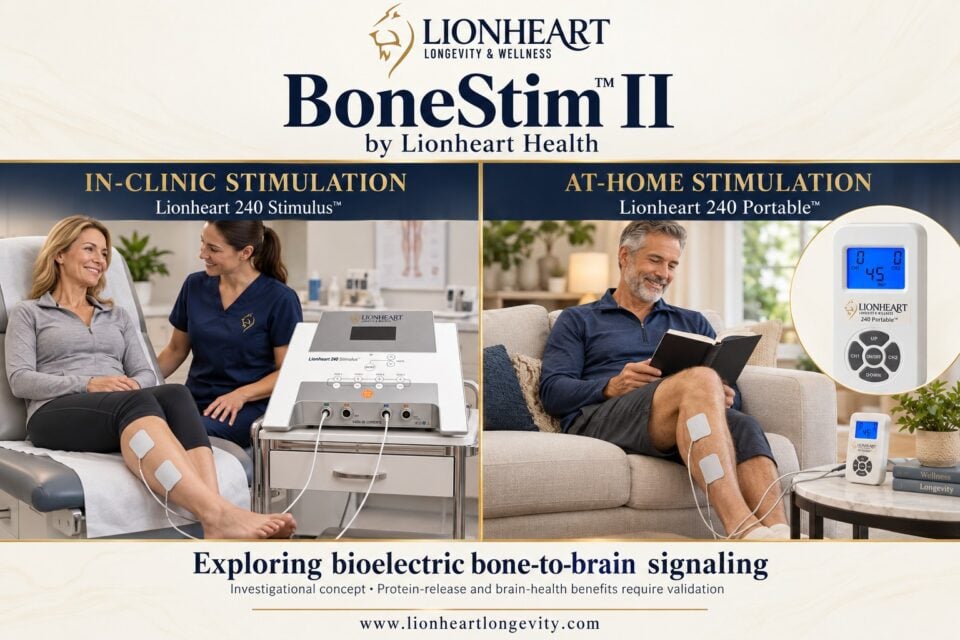
October 6, 2026 — Leonhardt Ventures LLC announces that it has prepared a provisional patent application directed toward bioelectric stimulation of bone to promote the expression and release of protective proteins and related signaling molecules. The technology is licensed to Lionheart Health, Inc. for development through the Lionheart 240 Stimulus BoneStim™ II program.
The proposed approach explores whether programmed electrical signals can engage bone-cell pathways associated with communication between the skeleton and the brain.
New research supports a bone-to-brain connection
A study published September 21, 2026, in Nature Neuroscience reported that controlled, repeated compression of the shinbone improved recovery in animal models of brain injury. The response depended on PIEZO1, a mechanical-force-sensing channel in bone cells called osteocytes.
Researchers identified directly released factors including HSP70, IL-1R2 and APOL11a, together with indirect increases in circulating BDNF, platelet factor 4 (PF4) and dopamine. These signals collectively supported neuroprotection and recovery. Dopamine is a neurotransmitter rather than a protein. The experiments involved mice and pigs; human therapeutic benefit remains unproven. (nature.com)
Introducing the BoneStim™ II research direction
The Lionheart 240 Stimulus BoneStim™ II program is intended to investigate whether selected bioelectric stimulation sequences can influence these protective bone-cell signaling pathways.
Development priorities include measuring protein expression and release, determining whether effects remain local or appear in circulation, and establishing appropriate stimulation parameters and safety. Future research may also examine combinations of bioelectric stimulation and controlled mechanical loading.
The published study tested mechanical compression. Whether electrical stimulation can reproduce its effects is a central question for BoneStim™ II research.
Building on previous BMP9 and OPG filings
The new development direction builds on Leonhardt Ventures’ earlier work in bioelectric control of bone-related proteins.
The “BMP9 Modulation” application, published as US20220370791A1, describes electrical stimulation intended to modulate expression or release of bone morphogenetic protein 9. It claims priority to provisional application 63/189,586, filed May 17, 2021. This is cited as a historical filing; Google Patents currently lists that published application as abandoned. (patents.google.com)
Earlier OPG work includes U.S. Patent 11,691,007, “Bioelectric OPG Treatment of Cancer,” issued July 4, 2023. The patent describes bioelectric upregulation of osteoprotegerin and modulation of the OPG/RANKL/RANK pathway, including bone-related applications. (patents.justia.com)
BoneStim™ II extends this research direction from bone formation and remodeling toward investigating protective signals that may influence other organs, particularly the brain.
Development status: The new provisional patent application has been prepared; filing is not announced here. BoneStim™ II remains investigational. Neither a patent application nor the cited animal study establishes that Lionheart 240 Stimulus releases these factors in humans or treats traumatic brain injury, stroke or brain degeneration.
Learn more at lionheartlongevity.com and leonhardtventures.com.