
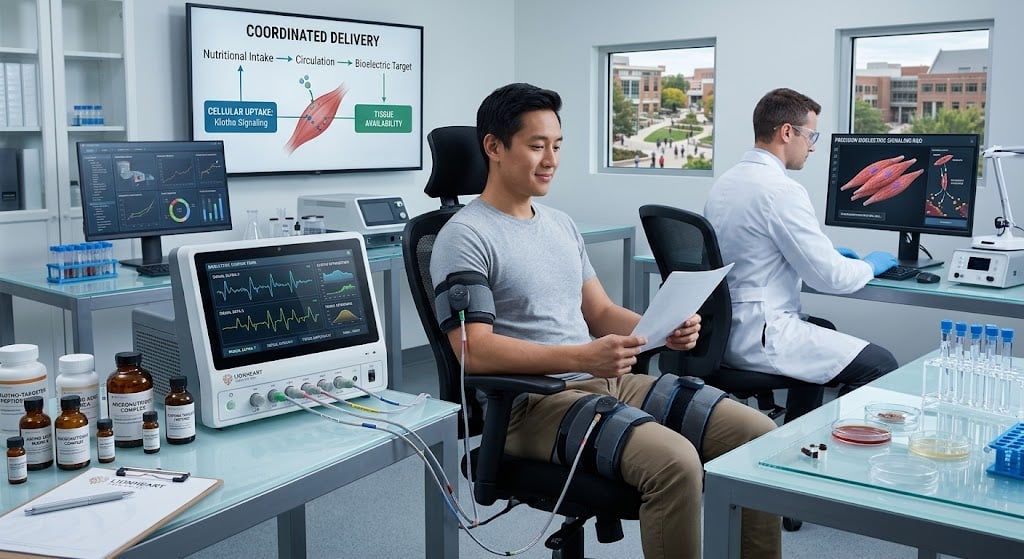
Research concept explores precisely controlled electrical stimulation paired with nutritional support, including Klotho-focused formulations.
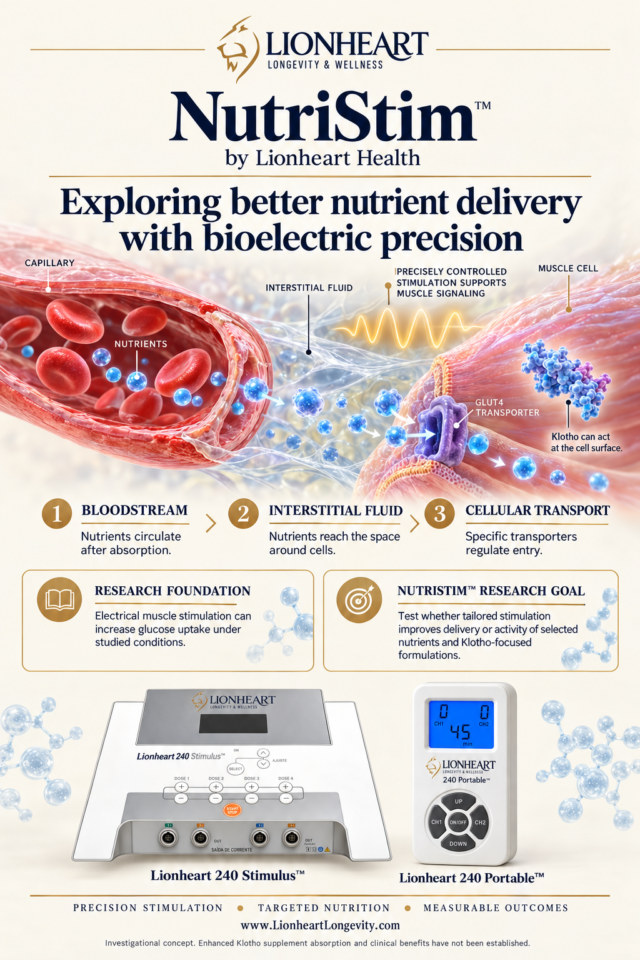
Lionheart Health, Inc., working with Leonhardt Ventures LLC, is preparing a provisional patent application directed toward bioelectric methods intended to improve how selected nutrients and bioactive compounds reach target tissues, interact with cells, and support cellular function.
The proposed approach addresses an essential question: Can the right bioelectric stimulation help the body make better use of what we consume?
Taking a supplement is only the beginning of its journey. Its ingredients must survive digestion, be absorbed, circulate through the bloodstream, reach the fluid surrounding tissues, and interact with the appropriate cells. Cellular entry depends on the compound’s properties and specific transport mechanisms. Some biologically active substances exert their effects at the cell surface without entering the cell.
How bioelectric stimulation may help
Published research provides a foundation for investigating this approach. In human research, electrically induced muscle contractions increased whole-body glucose uptake during stimulation and for a period afterward under controlled experimental conditions. Laboratory studies also show that electrical stimulation can activate signaling pathways that move GLUT4 glucose transporters to the muscle-cell surface, helping glucose enter cells. These findings support a specific mechanism for glucose uptake; they do not establish improved absorption of every nutrient or supplement. (pubmed.ncbi.nlm.nih.gov, pmc.ncbi.nlm.nih.gov)
The proposed patent application would explore coordinating selected nutritional formulations with controlled bioelectric stimulation to investigate:
- Target-tissue delivery: Whether stimulation-associated muscle activity and local circulation changes improve the availability of selected compounds near target cells.
- Cellular transport: Whether particular stimulation patterns activate transport pathways relevant to a specific nutrient.
- Timing: Whether coordinating supplementation with stimulation produces a measurable advantage over either intervention alone.
- Personalization: How waveform, intensity, electrode placement, treatment duration, and formulation influence biological responses.
The central principle is precision. A stimulation pattern that influences glucose transport cannot automatically be assumed to improve amino-acid, vitamin, peptide, or protein delivery. Each combination requires its own testing.
Exploring Klotho-focused supplements and formulations
A particular research interest is combining bioelectric stimulation with Klotho-focused nutritional strategies.
These approaches need to be distinguished carefully: supplements intended to support the body’s own Klotho production, formulations containing Klotho-derived peptides, and experimental preparations containing Klotho protein are different categories with different delivery challenges.
Klotho also illustrates why “getting into cells” is only part of the story. Experimental research shows that soluble Klotho can interact with structures on the cell surface and influence signaling. Its activity does not necessarily require delivery into the cell’s interior. (pubmed.ncbi.nlm.nih.gov)
For Lionheart, the research question is therefore broader: Can a defined bioelectric protocol improve the delivery, availability, or biological activity of a particular Klotho-focused intervention?
Whether stimulation improves the absorption or effectiveness of an orally administered Klotho protein or peptide formulation remains to be established. Evidence for enhanced glucose uptake does not answer that question.
Measuring the proposed benefit
A rigorous development program would compare the selected formulation alone, stimulation alone, the combination, and appropriate controls. Depending on the formulation, measurements could include circulating concentrations, tissue exposure, cellular uptake, Klotho levels, downstream signaling, and functional outcomes.
For Klotho-focused research, testing should distinguish increased production of the body’s own Klotho from delivery of an administered compound.
Demonstrating a higher blood concentration would also need to be distinguished from demonstrating improved tissue function or a meaningful health benefit.
Connecting nutrition with bioelectric precision
The proposed initiative extends Lionheart’s research direction toward coordinated nutrition and bioelectric stimulation—matching a defined biological target with a specific formulation, stimulation protocol, and measurable outcome.
The goal is to determine where bioelectric stimulation can help selected nutrients and bioactive compounds reach their intended targets and work more effectively.
Research-stage announcement. The proposed combinations have not been established to improve Klotho supplement absorption, reverse aging, or treat disease in humans. A provisional patent application, once filed, is not an issued patent and does not establish clinical effectiveness or regulatory authorization.