
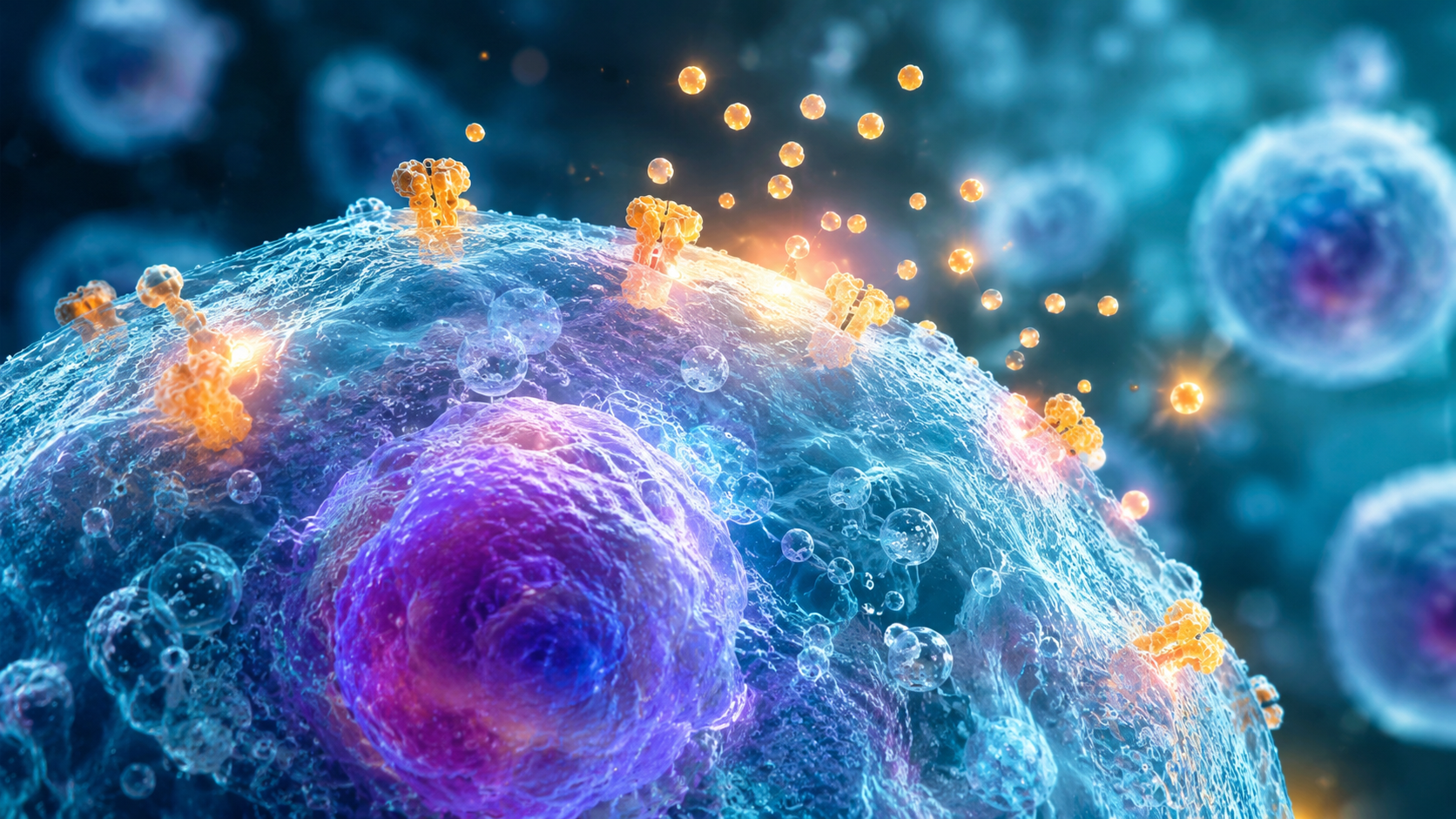
Understanding the connection between cell membrane channels, ionic signaling, DNA, RNA and the body’s protein-making machinery.
Every cell operates within an electrical environment. Charged particles move across cell membranes, creating voltage differences that help cells sense their surroundings and respond. These electrical processes participate in a much larger communication network—one that can ultimately influence which genetic instructions a cell uses.
Lionheart Health’s bioelectric protein-expression research builds on this connection between electrical signals and biological responses. The goal is to develop stimulation sequences that influence the production or release of selected proteins by engaging the cell’s existing regulatory machinery.
Leonhardt Ventures’ Klotho modulation patent describes one example of this approach: applying programmed electrical stimulation intended to increase Klotho expression in tissue. That patent documents an invention; establishing the degree of control and benefit in each clinical application requires experimental and clinical evidence. (patents.google.com)
The communication begins at the cell membrane.
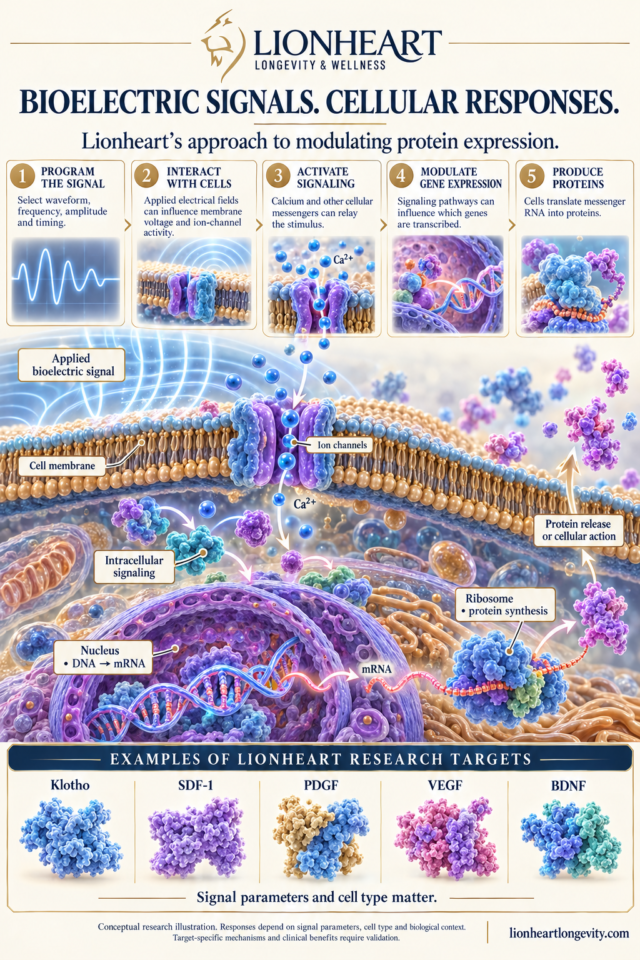
A cell membrane is a selective boundary containing channels, pumps and transporters. These structures regulate the movement of ions, including sodium, potassium, calcium and chloride. Their activity helps establish the voltage difference between the inside and outside of a cell.
Ion channels act as selective gates. Some respond to changes in voltage; others respond to chemical signals or mechanical forces. Pumps use energy to maintain the ion gradients that make electrical signaling possible.
Applied bioelectric stimulation can interact with this system, influencing membrane voltage and downstream signaling. The response depends on the cell, its channels and its physiological state. Different tissues can interpret the same electrical exposure differently. (pmc.ncbi.nlm.nih.gov)
Calcium helps translate electrical activity into biological instructions.
Calcium is particularly important because it serves as an intracellular messenger. A change in membrane activity can, in appropriate cells, promote calcium entry through channels. Calcium can also be released from storage compartments within the cell.
These changes can activate proteins that carry information toward the nucleus, where genes are regulated.
The pattern matters. In foundational experiments, researchers demonstrated that the frequency of intracellular calcium oscillations affected the activation of transcription factors—proteins that help regulate gene expression. Other experiments showed that calcium signal amplitude and duration also influence which transcription factors respond. These findings help explain how cells can extract different instructions from different signaling patterns. They do not establish that an external stimulation frequency maps directly to one particular protein. (nature.com, nature.com)
How does the message reach DNA?
Saying that bioelectric stimulation “instructs DNA to build RNA” is a useful shorthand. More precisely, electrical stimulation can initiate cellular signaling that influences the machinery responsible for reading selected genes.
DNA contains the genetic information. Regulatory proteins help determine which portions are read and how actively they are used. During transcription, an enzyme called RNA polymerase makes an RNA copy from a DNA template. For a protein-coding gene, the resulting messenger RNA, or mRNA, carries information needed for protein production. (genome.gov)
The intended pathway can therefore be understood as:
Bioelectric stimulus → membrane and ionic responses → intracellular signaling → gene regulation → RNA production → protein synthesis.
This process works through the cell’s existing genetic instructions. A key research question is whether a particular stimulation sequence can produce a reproducible change in a desired target, at a useful magnitude and for a useful duration.
RNA carries the instructions to the protein-making machinery.
After processing, messenger RNA can leave the nucleus and reach ribosomes. During translation, ribosomes read the mRNA instructions and assemble amino acids into a protein chain. That chain then undergoes folding and, where needed, further processing before becoming functional. (genome.gov)
Depending on the protein, it may work within the cell, become part of the cell membrane or be released to influence neighboring or distant cells.
This distinction is important when measuring results. Increased mRNA indicates a change in gene expression, but it does not by itself establish a corresponding increase in functional protein or a clinical benefit.
Expression and release are different control points.
Bioelectric research also examines what happens beyond transcription. Cellular signaling can affect how existing proteins function and when stored signaling molecules are released.
A muscle-cell study, for example, investigated how contraction induced by electrical stimulation promoted VEGF secretion through an adenosine-mediated pathway. This illustrates how stimulation can influence protein availability through mechanisms involving cellular activity and release, alongside effects on gene expression. (journals.physiology.org)
For Lionheart’s research, this means asking several separate questions: Did the cell produce more RNA? Did it make more protein? Was that protein released? Did it reach the intended tissue and perform the intended function?
Each question requires its own measurements.
Cells also communicate as networks.
Individual cells are connected to a broader tissue environment. Gap junctions can allow ions and small signaling molecules to pass between neighboring cells, helping coordinate electrical and chemical activity.
Research in developmental bioelectricity describes how membrane voltage, ion transport and intercellular communication can participate in networks that influence gene expression and cell behavior. This provides a scientific basis for studying tissue-level responses, while leaving the effectiveness of each therapeutic application to be demonstrated. (pubmed.ncbi.nlm.nih.gov)
Why the stimulation program matters.
Lionheart’s approach focuses on programmed signal characteristics—including waveform, amplitude, pulse duration, frequency and timing—with the intention of influencing selected biological responses. Its Klotho patent describes electrical stimulation sequences directed toward that protein-expression objective. (patents.google.com)
The broader scientific literature provides evidence that electrical stimulation can alter gene expression under defined conditions. In one muscle-cell study, electrical stimulation increased VEGF mRNA in cultured human muscle cells and increased VEGF and bFGF mRNA in rat muscle cells. Those findings support biological plausibility, while remaining specific to the cells and protocols studied. (pubmed.ncbi.nlm.nih.gov)
The development challenge is to connect the full chain: a defined electrical exposure, a measured cellular response, a verified protein change and a meaningful outcome.
Lionheart’s vision is to use bioelectric signals as a programmable input to the body’s own biological machinery. Turning that vision into dependable therapies requires understanding how cells receive the signal, how they translate it into molecular activity and how that activity affects tissue function.
The opportunity is powerful: learning to communicate with cells through the electrical and ionic systems they already use—and measuring carefully what those conversations achieve.