
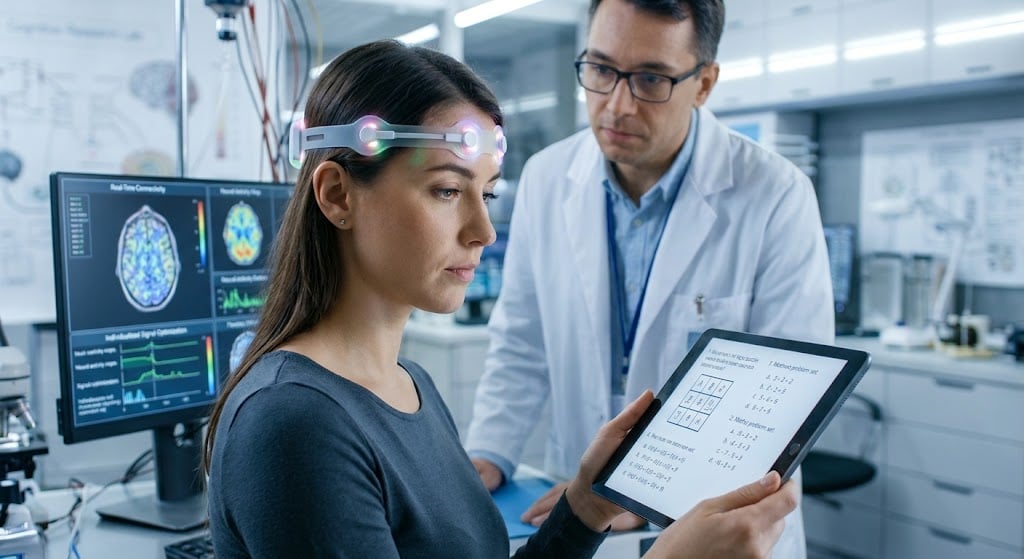
Emerging research offers an exciting direction for Lionheart Health’s brain technology—and shows why matching the signal to the person and the task matters.
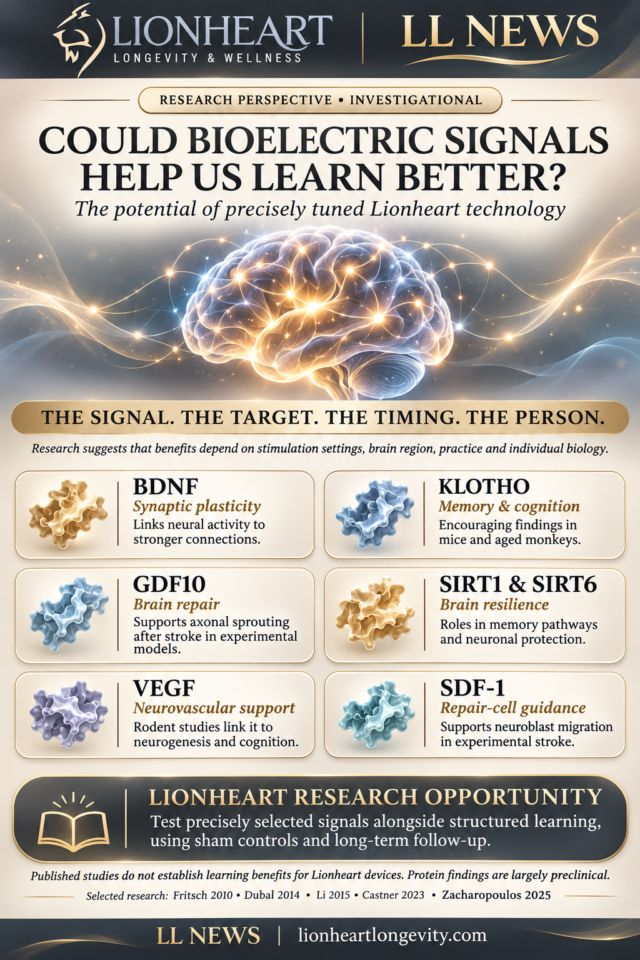
Learning a new skill can change a life. Remembering information more effectively, mastering a challenging subject, or retaining new abilities later in life can expand independence and opportunity.
Could carefully tuned bioelectric stimulation help the brain accomplish these tasks?
Published research suggests that it can improve certain learning and memory outcomes under specific conditions. For Lionheart Health, these findings raise an intriguing research question: could our bioelectric technology, appropriately configured and clinically tested, help people benefit more from learning and practice?
The opportunity deserves serious exploration. It also requires precision about what researchers have demonstrated and what remains a hypothesis for Lionheart.
The brain communicates through electrical and chemical signals. Learning depends on coordinated activity across networks and on plasticity—the ability of connections to change with experience. Researchers are investigating whether gentle electrical stimulation delivered through scalp electrodes can influence these processes during training.
A particularly relevant study appeared in PLOS Biology in July 2025. Researchers studied 72 healthy young adults during five days of mathematical training, comparing transcranial random noise stimulation, or tRNS, over different brain regions with sham stimulation. Prefrontal stimulation enhanced calculation learning in participants with weaker baseline connectivity in a relevant brain network. Responses also depended on changes in connectivity and GABA, an inhibitory neurotransmitter. The findings point toward individualized stimulation: the same intervention may produce different outcomes depending on a person’s starting biology. (journals.plos.org)
Memory research provides another encouraging example. A 2022 Nature Neuroscience study found that four days of targeted transcranial alternating current stimulation, or tACS, improved particular verbal memory measures in older adults, with benefits detectable one month later. Different combinations of brain location and stimulation frequency supported different aspects of memory. (nature.com)
Together, these studies suggest that “tuned right” has a concrete scientific meaning. It involves the electrical waveform, stimulation frequency, electrode placement, timing relative to practice, and characteristics of the individual. It also requires defining the intended outcome: learning a calculation procedure, remembering words, and acquiring a movement skill are different goals.
The broader evidence remains mixed. In one randomized motor-learning trial involving 100 adults, active stimulation did not clearly outperform sham on several outcomes. Improvement after a session can reflect practice, expectations, or stimulation—and a well-designed study must distinguish among them. (pubmed.ncbi.nlm.nih.gov)
For Lionheart Health’s Brain Band and broader bioelectric platform, this creates a potential development pathway. A future learning program could pair a carefully selected stimulation protocol with structured cognitive exercises, then measure whether participants learn faster, retain more, or apply their learning to unfamiliar tasks.
That is a proposed research direction, rather than an established benefit of Lionheart’s technology. Findings from tRNS and tACS studies cannot automatically be transferred to a different device or signal. Lionheart would need to demonstrate benefit using its own specified configuration and protocol.
A useful first study would compare active Lionheart stimulation plus training against sham stimulation plus identical training. Researchers would assess performance before treatment, after the training period, and at later follow-ups. Testing unfamiliar tasks would help answer a particularly meaningful question: does any improvement extend beyond the exercise participants practiced?
The results could guide more personalized development. Some participants might respond to one configuration while others show little benefit. Identifying those differences could be as valuable as finding an average improvement.
This work should begin with appropriate clinical oversight and screening. Published adult findings do not establish suitability for children or people with seizure disorders. (pubmed.ncbi.nlm.nih.gov)
The prospect is compelling: bioelectric technology may eventually help some people gain more from the effort they invest in learning. Lionheart’s opportunity is to investigate that possibility with carefully chosen signals, meaningful measures, and controlled studies.
Could a precisely tuned Lionheart protocol improve learning ability? It is a scientifically plausible question—and one that deserves a rigorous answer.
Research perspective: This article discusses investigational applications. The cited studies did not test Lionheart devices and do not establish that Lionheart technology improves learning, intelligence, or academic performance.
- Zacharopoulos G, Dehghani M, Krause-Sorio B, Near J, Cohen Kadosh R. Functional connectivity and GABAergic signaling modulate the enhancement effect of neurostimulation on mathematical learning. PLOS Biology. 2025;23(7):e3003200.
https://doi.org/10.1371/journal.pbio.3003200
Relevance: In 72 adults undergoing mathematical training, benefits from prefrontal random noise stimulation depended on baseline brain connectivity and neurochemical responses. Supports investigating stimulation tailored to the individual and learning task. - Grover S, Wen W, Viswanathan V, Gill CT, Reinhart RMG. Long-lasting, dissociable improvements in working memory and long-term memory in older adults with repetitive neuromodulation. Nature Neuroscience. 2022;25:1237–1246.
https://doi.org/10.1038/s41593-022-01132-3
Relevance: Four days of targeted alternating current stimulation improved specific verbal memory measures in older adults, with benefits detectable one month later. Different frequencies and brain locations affected different memory functions. - Snowball A, et al. Long-term enhancement of brain function and cognition using cognitive training and brain stimulation. Current Biology. 2013;23(11):987–992.
https://doi.org/10.1016/j.cub.2013.04.045
Relevance: Five days of random noise stimulation paired with arithmetic training improved learning speed. Calculation benefits were observed six months later, including on untrained calculation material. - Reis J, et al. Noninvasive cortical stimulation enhances motor skill acquisition over multiple days through an effect on consolidation. Proceedings of the National Academy of Sciences. 2009;106(5):1590–1595.
https://doi.org/10.1073/pnas.0805413106
Relevance: Direct current stimulation paired with motor practice enhanced skill acquisition, primarily through gains between training sessions. The performance advantage remained at three months, supporting investigation of stimulation-assisted skill consolidation. - Rezaei S, Khanmohammadi R. Comparison of short- and long-term effects of neurofeedback and transcranial electrical stimulation on the motor learning in healthy adults. Behavioural Brain Research. 2025;476:115263.
https://doi.org/10.1016/j.bbr.2024.115263
Relevance: This randomized trial involving 100 adults found that active stimulation did not clearly outperform sham treatment on several learning outcomes. Highlights the importance of controlling for practice and placebo effects. - Chuderski A, Chinta SR. Transcranial alternating current stimulation barely enhances working memory in healthy adults: A meta-analysis. Brain Research. 2024;1839:149022.
https://doi.org/10.1016/j.brainres.2024.149022
Relevance: Across 42 reports involving 1,386 healthy adults, the small overall working-memory benefit disappeared after adjustment for publication bias. Provides important balance: promising individual studies do not establish reliable general cognitive enhancement.
Additional References: Proteins Involved in Learning, Memory, and Brain Health
- Fritsch B, et al. Direct current stimulation promotes BDNF-dependent synaptic plasticity: potential implications for motor learning. Neuron. 2010;66(2):198–204.
https://doi.org/10.1016/j.neuron.2010.03.035
Relevance—BDNF: Provides a mechanistic link between electrical stimulation and BDNF-dependent strengthening of neural connections. Supports investigating whether appropriately configured stimulation can facilitate learning-related plasticity; it does not validate a Lionheart-specific signal. - Li S, et al. GDF10 is a signal for axonal sprouting and functional recovery after stroke. Nature Neuroscience. 2015;18:1737–1745.
https://doi.org/10.1038/nn.4146
Relevance—GDF10: Experimental research identified GDF10 as a driver of new axonal growth and functional recovery after stroke. Supports a brain-repair rationale, rather than demonstrating enhanced learning in healthy people. - Dubal DB, et al. Life extension factor klotho enhances cognition. Cell Reports. 2014;7(4):1065–1076.
https://doi.org/10.1016/j.celrep.2014.03.076
Relevance—Klotho: Combined human genetic associations with mouse experiments. A KLOTHO variant was associated with better cognition in humans, while experimentally elevating Klotho in mice enhanced cognition and synaptic plasticity. Human associations do not establish a treatment effect. - Castner SA, et al. Longevity factor klotho enhances cognition in aged nonhuman primates. Nature Aging. 2023.
https://doi.org/10.1038/s43587-023-00441-x
Relevance—Klotho: A single low-dose administration improved memory performance in aged rhesus macaques, with effects persisting for at least two weeks. Higher doses did not produce the same benefit, emphasizing the importance of dose selection. This was an animal study of administered Klotho, rather than bioelectric stimulation. - Gao J, et al. A novel pathway regulates memory and plasticity via SIRT1 and miR-134. Nature. 2010;466:1105–1109.
https://doi.org/10.1038/nature09271
Relevance—SIRT1: Mouse experiments identified a pathway through which SIRT1 regulates synaptic plasticity and memory, involving miR-134, CREB, and BDNF. Provides a biological rationale for studying sirtuin modulation in cognition. - Kaluski S, et al. Neuroprotective functions for the histone deacetylase SIRT6. Cell Reports. 2017;18(13):3052–3062.
https://doi.org/10.1016/j.celrep.2017.03.008
Relevance—SIRT6: Brain-specific SIRT6 deficiency in mice caused learning impairments, increased DNA damage, and neurodegenerative changes. Establishes the importance of normal SIRT6 function, but does not demonstrate that increasing SIRT6 above normal improves learning. - Cao L, et al. VEGF links hippocampal activity with neurogenesis, learning and memory. Nature Genetics. 2004;36(8):827–835.
https://doi.org/10.1038/ng1395
Relevance—VEGF: Increasing hippocampal VEGF expression in adult rats increased neurogenesis and improved cognition. Supports investigation of VEGF’s role in brain plasticity, without establishing that generalized VEGF elevation improves human learning. - Ohab JJ, Fleming S, Blesch A, Carmichael ST. A neurovascular niche for neurogenesis after stroke. Journal of Neuroscience. 2006;26(50):13007–13016.
https://doi.org/10.1523/JNEUROSCI.4323-06.2006
Relevance—SDF-1/CXCL12: Experimental stroke research showed that SDF-1 and angiopoietin-1 promoted migration of immature neurons and behavioral recovery. Supports research into brain repair and cell recruitment, rather than general learning enhancement. - Trejo JL, Carro E, Torres-Aleman I. Circulating insulin-like growth factor I mediates exercise-induced increases in the number of new neurons in the adult hippocampus. Journal of Neuroscience. 2001;21(5):1628–1634.
https://doi.org/10.1523/JNEUROSCI.21-05-01628.2001
Relevance—IGF-1: Rodent experiments linked circulating IGF-1 to exercise-induced hippocampal neurogenesis. Provides a mechanistic connection between physical activity and brain biology, without demonstrating a learning benefit from a Lionheart device. - Lie DC, et al. Wnt signalling regulates adult hippocampal neurogenesis. Nature. 2005;437:1370–1375.
https://doi.org/10.1038/nature04108
Relevance—Wnt proteins: Experimental research demonstrated that Wnt signaling regulates the generation of neurons from adult hippocampal stem/progenitor cells. Supports a neurogenesis research rationale; it does not establish improved human learning from Wnt modulation.