
Peptides can influence biological processes ranging from metabolism and muscle function to tissue repair. Their effectiveness, however, depends on reaching the right biological target at an appropriate concentration.
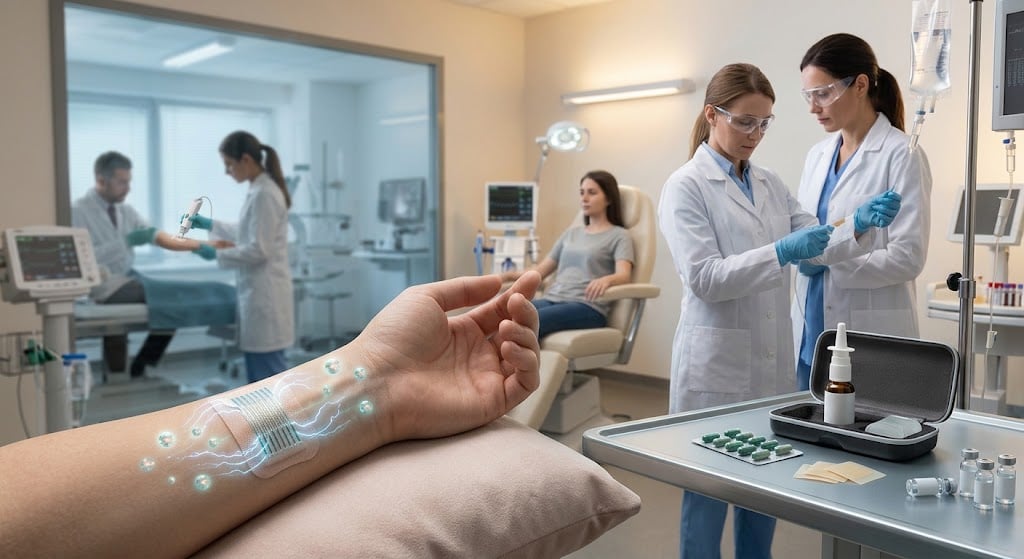
Delivery methods—including intravenous infusion, injections, nasal sprays, oral films, and patches—face different barriers. Electrical delivery technologies offer an additional possibility: helping selected molecules cross skin, oral tissues, or cell membranes.
Published research provides stronger evidence for this general principle than a preliminary laboratory observation alone. Studies of iontophoresis and electroporation have demonstrated increased transport of selected peptides and proteins in tissue models and animals. Human electrochemotherapy research also demonstrates that electrical pulses can improve the effectiveness of a locally administered drug in a specific clinical setting.
These findings justify further research. They do not establish that every peptide, electrical waveform, or delivery route will benefit.
Understanding Delivery Efficiency
Three measurements should be distinguished:
- Systemic bioavailability: The fraction of an administered dose reaching the bloodstream intact.
- Tissue delivery: How much reaches the intended organ or treatment site.
- Cellular uptake: How much enters cells.
An IV infusion provides 100% systemic bioavailability by definition, but it does not guarantee delivery into every tissue or cell.
Many peptides act through receptors on cell surfaces. For these molecules, increased intracellular uptake may not be necessary or beneficial. The appropriate goal is improved exposure or biological activity at the intended target.
Chart 1. Major Peptide Delivery Methods
Numerical examples below apply to specific studied formulations. They are not universal absorption estimates for each route.
| Delivery method | Efficiency and evidence | Principal advantage | Principal limitation |
| Intravenous injection or infusion—IV | 100% systemic bioavailability by definition | Immediate, controlled bloodstream delivery | Vascular access; rapid clearance and tissue barriers can remain |
| Subcutaneous injection—under the skin | Often substantial; subcutaneous teriparatide illustrates approximately 95% absolute bioavailability | Established administration method for many peptide medicines | Injection reactions, local degradation, and formulation-dependent absorption |
| Intramuscular injection—IM | Can provide effective absorption; no universal percentage | Rapid delivery or sustained depot release, depending on formulation | Discomfort and dependence on technique and tissue perfusion |
| Intradermal injection | Places the dose within skin; systemic exposure varies | Direct skin targeting | Limited volume and specialized technique |
| Nasal spray or powder | Highly formulation-dependent; nasal calcitonin illustrates approximately 3–5% bioavailability relative to IM administration | Needle-free and potentially rapid | Nasal clearance, enzymes, irritation, and limited dose volume |
| Sublingual strip or tablet—under the tongue | Variable; studied sublingual desmopressin doses showed approximately 0.25% absolute bioavailability | Convenient; mucosally absorbed drug can bypass digestion | Swallowing, enzymes, contact time, and limited permeability |
| Buccal film or patch—inside cheek | Formulation-specific; no standard peptide absorption percentage | Adhesion can prolong tissue contact | Saliva, swallowing, and mucosal barriers |
| Upper-palate film—roof of mouth | Requires formulation- and placement-specific measurements | Convenient placement may be possible | Hard palate is relatively resistant to penetration |
| Swallowed oral tablet, capsule, or liquid | Usually challenging; studied oral semaglutide formulations illustrate approximately 0.4–1% or 1–2% absolute bioavailability | Familiar and convenient | Digestive degradation and gastrointestinal barriers |
| Pulmonary inhalation | Clinically feasible for selected formulations, including insulin | Large absorption surface and potentially rapid delivery | Device technique and pulmonary safety requirements |
| Passive skin patch | Usually poor systemic delivery of most peptides through intact skin | Convenient application | Strong outer-skin barrier |
| Topical cream, gel, or serum | Local exposure varies; systemic absorption is generally limited | Direct local application | Application does not establish penetration to deeper targets |
| Microneedle patch | Human peptide studies demonstrate meaningful systemic delivery | Bypasses the outer skin barrier | Dose capacity, insertion consistency, and stability |
| Iontophoretic or electroporation-assisted delivery | Published studies demonstrate enhanced transport of selected molecules | Electrically assisted barrier crossing | Requires a specific, validated device–formulation combination |
| Ultrasound- or heat-assisted skin delivery | Experimental and formulation-dependent | Can alter skin permeability | Tissue safety and dose consistency |
| Rectal or vaginal delivery | Variable mucosal absorption; often intended for local effects | Alternative access and local targeting | Tissue variability, enzymes, and acceptability |
| Local injection—joint, wound, or other treatment site | Places the dose near its target | Local tissue exposure | Clearance and procedure-specific risks |
| Intrathecal delivery—into cerebrospinal fluid | Direct access to the cerebrospinal-fluid compartment | Bypasses the blood–brain barrier for selected therapies | Specialist procedure; does not guarantee uniform brain penetration |
| Ocular delivery—drops or injections | Strongly dependent on the approach | Eye-specific targeting | Ocular barriers and procedural risks |
| Implant, depot, or infusion pump | Exposure depends on route and release characteristics | Sustained or programmed dosing | Stability, release control, and device burden |
Sources: references 1–7.
Nanoparticles, liposomes, hydrogels, and absorption enhancers can support several routes. They are formulation technologies rather than separate anatomical delivery methods.
Oral Delivery: Placement and Formulation Matter
Swallowed peptides face digestive enzymes and gastrointestinal absorption barriers. Sublingual and buccal formulations attempt to deliver at least part of the dose through oral tissues.
The mouth is not uniformly permeable. The hard palate is keratinized and generally less permeable than the cheek or floor of the mouth. A film placed on the palate may also release ingredients into saliva, allowing them to reach other surfaces or be swallowed.
Complete dissolution does not mean complete absorption. Reliable claims require measurements of intact peptide in blood or the intended tissue.
A Limited Muscle-Cell Observation
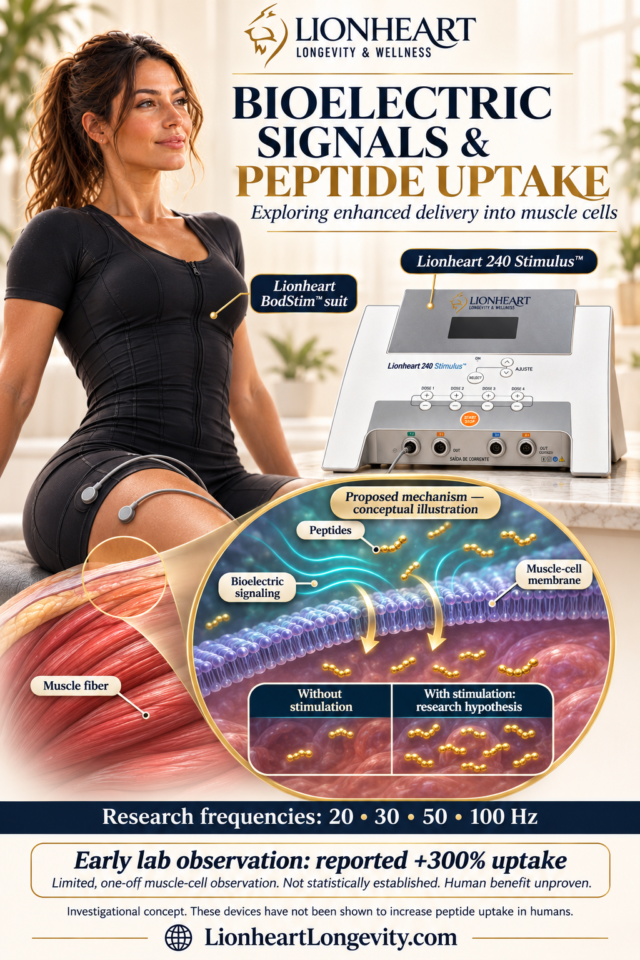
A very limited, one-off laboratory observation in cultured muscle cells reportedly found a 300% increase in peptide uptake under conditions involving 20 Hz, 30 Hz, 50 Hz, and 100 Hz signaling.
This was an exploratory observation, not a statistically significant study. It has not established reproducibility, a reliable effect size, or superiority of any frequency. The underlying protocol and raw data have not been independently reviewed for this article.
The observation is best treated as a hypothesis-generating finding: a reason to conduct controlled experiments.
If the measurement increased by 300%, the final value was four times baseline. That differs from reaching 300% of baseline, which represents a 200% increase. Original measurements should confirm the calculation.
A cell dish also bypasses barriers encountered in people, including skin, oral mucosa, digestion, circulation, and organ clearance. The observation cannot establish a comparable increase in human bioavailability or clinical benefit.
Published Research Provides Stronger Supporting Evidence
The more substantial foundation comes from published electrical-delivery research. Several studies illustrate both the potential and the limits.
Parathyroid Hormone Transport Across Skin
Medi and Singh investigated parathyroid hormone transport across porcine skin using iontophoresis and electroporation.
Both approaches increased transport under tested conditions. Adding iontophoresis after electroporation produced approximately
Parathyroid Hormone Transport Across Skin
Medi and Singh investigated parathyroid hormone transport across porcine skin using iontophoresis and electroporation.
Both approaches increased transport under tested conditions. Adding iontophoresis after electroporation produced approximately fivefold or tenfold greater flux than the corresponding electroporation pulses alone, depending on the condition. Several comparisons were statistically significant.
This is direct evidence that electrical methods can enhance transport of a therapeutic peptide across a skin model. It remains an in vitro tissue study, not proof of equivalent human delivery.
Electrically Controlled Peptide Delivery in Animals
Suzuki and colleagues studied iontophoretic delivery of parathyroid hormone in rats and beagle dogs.
Electrical application produced increases in circulating hormone. In rats, exposure increased with applied dose and current density. Repeated current applications generated repeated blood-concentration pulses.
This strengthens the evidence beyond a tissue dish by showing electrically responsive peptide delivery in living animals. It does not establish human performance.
Insulin Delivery With a Biological Effect
Tokumoto and colleagues evaluated combined electroporation and iontophoresis in rats.
At the tested neutral pH, passive delivery and iontophoresis alone produced almost no insulin permeation. Electroporation increased circulating insulin, and combining it with iontophoresis increased exposure further. Blood glucose fell alongside increased insulin concentrations.
The result demonstrates transport accompanied by a biological effect. It also shows that formulation matters: insulin aggregation and solution conditions substantially influenced delivery.
Enhanced Transport Across Oral Tissue
Patel and colleagues investigated electrically assisted transport through porcine cheek tissue.
Iontophoresis increased transport of selected model macromolecules, with approximately 37-fold higher flux and shorter transport delays than passive delivery. However, the largest tested protein was not detectably transported.
This supports oral electrical-delivery research while demonstrating that success depends on the molecule. It does not establish comparable absorption from an ordinary dissolving strip.
Formulation and Electrical Methods Working Together
Murthy and colleagues studied insulin transport across porcine epidermis using electroporation, a lipid additive, and electroosmosis.
The combined approach produced approximately 18-fold greater insulin transport than electroporation alone.
This supports studying electrical methods together with formulation design. The comparison was against electroporation alone—not injection—and the work did not establish human bioavailability.
Human Evidence From Electrochemotherapy
A randomized, open-label phase II melanoma study compared locally administered bleomycin with and without electroporation.
The investigators reported an objective lesion-response rate of approximately 78% with the combination versus 32% with bleomycin alone, a statistically significant difference.
This provides human clinical evidence that electroporation can improve drug effectiveness in a defined setting. Bleomycin is an anticancer glycopeptide drug; these results do not establish enhanced delivery of regenerative peptides or validate low-frequency muscle stimulation.
What These Studies Establish
Together, the published studies provide stronger support for the general principle of electrically assisted molecular delivery than the limited muscle-cell observation.
However, electroporation, iontophoresis, and low-frequency electrical stimulation are distinct interventions. Evidence for one cannot automatically validate another.
Frequency alone does not define an electrical treatment. Field strength, current density, pulse width, waveform, polarity, electrode placement, exposure duration, and formulation all influence the result.
Chart 2. Hypothetical Bioelectric Enhancement Targets
These are proposed experimental benchmarks—not forecasts, demonstrated outcomes, or recommended treatment settings. The available evidence does not support reliable route-specific human improvement estimates for the reported low-frequency approach.
| Delivery setting | Primary measurement | Initial exploratory benchmark | Stretch benchmark | Interpretation |
| Muscle-cell culture | Intact intracellular peptide per viable cell versus sham | +25% | +100%; separately investigate whether the reported +300% can be replicated | The original observation has no established statistical significance |
| IV plus targeted stimulation | Target-tissue exposure or target engagement | +25% | +100% | IV bioavailability remains 100% |
| Subcutaneous injection plus stimulation | Tissue exposure; measure blood exposure separately | +25% | +100% | Faster absorption is not necessarily greater total exposure |
| Intramuscular injection plus stimulation | Local exposure or target engagement | +25% | +100% | Perfusion and clearance may affect results |
| Sublingual or buccal delivery plus electrical assistance | Intact peptide transport across mucosa | +25% | +100% | Requires formulation-specific testing and mucosal safety assessment |
| Upper-palate film plus electrical assistance | Palatal transport versus identical film with sham stimulation | +25% | +100% | Compare with cheek and under-tongue placement |
| Electrically assisted skin delivery | Intact peptide transport across skin | +25% | +100% | Large relative gains can still leave inadequate absolute delivery |
| Microneedles plus electrical assistance | Delivered dose and tissue or blood exposure | +25% | +100% | Must improve on microneedles alone |
| Local injection, depot, or implant plus stimulation | Prespecified local exposure, retention, or biological response | +25% | +100% | Local improvement does not establish systemic improvement |
| Swallowed oral, nasal, or inhaled delivery plus remote muscle stimulation | First establish an effect on the relevant barrier | No numerical benchmark yet | Set after pilot evidence | Muscle-cell uptake does not establish gut, nasal, or lung absorption |
| Intrathecal or ocular delivery | Site-specific safety and pharmacology | No generic benchmark | Specialist research required | Findings from muscle cells cannot be extrapolated to these sites |
All experimental combinations could produce no improvement, reduced delivery, or unacceptable adverse effects.
A change from 2% to 4% absolute bioavailability is a 100% relative increase but only a two-percentage-point gain. Similarly, greater cellular uptake does not imply an equal improvement in clinical outcomes.
The Next Research Steps
The immediate priority is controlled replication of the muscle-cell observation.
The 20 Hz, 30 Hz, 50 Hz, and 100 Hz conditions should be tested separately before evaluating combinations. Experiments should include peptide-only, stimulation-only, combined-treatment, and sham controls, with independent replication and blinded analysis where feasible.
Measurements should distinguish intact intracellular peptide from surface-bound material or degraded labeling. Cell viability, membrane damage, and useful biological activity should be measured alongside uptake.
The published literature establishes a credible foundation for further work. Carefully designed studies must now determine which peptides, formulations, electrical parameters, and delivery routes offer a reproducible benefit.
References
- FORTEO prescribing information, Section 12.3. Subcutaneous teriparatide pharmacokinetics. Prescribing information.
- Calcitonin salmon nasal solution prescribing information, Section 12.3. Relative bioavailability versus intramuscular administration. Prescribing information.
- NOCDURNA prescribing information, Section 12.3. Studied higher-dose sublingual desmopressin bioavailability. Prescribing information.
- Lesch CA, et al. The Permeability of Human Oral Mucosa and Skin to Water. Journal of Dental Research. 1989. Article.
- RYBELSUS prescribing information, Section 12.3. Formulation-specific oral semaglutide bioavailability. Prescribing information.
- AFREZZA prescribing information. Pulmonary insulin delivery and safety requirements. Prescribing information.
- Parathyroid hormone (1-34)-coated microneedle patch system: clinical pharmacokinetics and pharmacodynamics for treatment of osteoporosis. Human clinical research. PubMed.
- Medi BM, Singh J. Electronically facilitated transdermal delivery of human parathyroid hormone (1-34). International Journal of Pharmaceutics. 2003;263:25–33. PubMed.
- Suzuki Y, et al. Iontophoretic pulsatile transdermal delivery of human parathyroid hormone (1-34). Journal of Pharmacy and Pharmacology. 2001;53:1227–1234. PubMed.
- Tokumoto S, Higo N, Sugibayashi K. Effect of electroporation and pH on the iontophoretic transdermal delivery of human insulin. International Journal of Pharmaceutics. 2006;326:13–19. PubMed.
- Patel MP, et al. Electrically induced transport of macromolecules through oral buccal mucosa. Dental Materials. 2013;29:674–681. PubMed.
- Murthy SN, et al. Lipid and electroosmosis enhanced transdermal delivery of insulin by electroporation. Journal of Pharmaceutical Sciences. 2006;95:2041–2050. PubMed.
- Byrne CM, et al. Treatment of metastatic melanoma using electroporation therapy with bleomycin (electrochemotherapy). Melanoma Research. 2005;15:45–51. PubMed.
- Lionheart exploratory muscle-cell observation. Personal communication from Howard Leonhardt, November 2026. Limited, one-off, unpublished observation; no established statistical significance; protocol and raw data not independently reviewed.
Experimental research targets do not establish clinical safety, efficacy, or dosing equivalence.