

Lionheart News | Building a stronger foundation for healthy aging
What if some of the most valuable steps toward healthier aging also helped support a protein involved in the body’s resilience?
That protein is alpha-Klotho, usually shortened to Klotho. Researchers are studying its connections to kidney function, mineral balance, brain health, physical performance, and aging. Its biology offers a compelling reason to take exercise, nutrition, and metabolic health seriously.
There is one essential distinction: scientists have not established 20 proven ways to raise Klotho in humans. Exercise has some of the strongest intervention evidence. Other approaches have observational support, evidence in specific patient populations, or an indirect biological rationale. This guide brings those approaches together while making their differences clear.
The goal is better health and function. A higher laboratory number alone does not prove that someone is aging more slowly.
Why Klotho Matters
Klotho exists in membrane-bound and soluble forms. The membrane-bound protein helps the hormone FGF23 regulate phosphate and vitamin D metabolism, connecting Klotho closely to kidney and mineral health. These functions are fundamental to maintaining physiological balance.
Interest in longevity grew after researchers demonstrated that increasing Klotho expression extended lifespan in mice. That finding helped establish Klotho as an important research target, but it did not demonstrate that raising Klotho extends human life.
Brain research is also encouraging. Experimental studies have linked Klotho to improved cognition in mice, and administered Klotho improved aspects of memory in aged rhesus monkeys. These findings support further investigation; they do not establish Klotho injections as a proven treatment for human memory loss.
With that perspective, here are 20 practical strategies for increasing Klotho where evidence supports it—and supporting the broader health conditions in which Klotho functions.
1. Make Regular Exercise Your Foundation
Evidence: Human intervention research.
Regular exercise deserves the first position. In the 12-week FIT-AGEING randomized trial involving 74 sedentary middle-aged adults, several exercise programs increased circulating soluble Klotho.
The practical lesson is encouraging: a consistent exercise habit may matter more than finding one supposedly perfect workout. Start at a manageable level and build a routine you can sustain.
2. Include Progressive Strength Training
Evidence: Human intervention research.
Strength training helps preserve the ability to climb stairs, carry groceries, rise from a chair, and remain independent.
It also has direct Klotho evidence. In a post hoc analysis of a randomized trial involving 69 prefrail older adults, 12 weeks of conventional strength training increased soluble alpha-Klotho, while power training did not. Both approaches improved physical performance, illustrating why functional outcomes and biomarkers should be evaluated together.
3. Build Aerobic Activity Into Your Week
Evidence: Human intervention research within structured exercise programs.
Walking briskly, cycling, swimming, and similar activities can form the aerobic component of a sustainable program.
FIT-AGEING found increased Klotho in the group following a program based on standard physical activity recommendations. Because that program included more than one exercise component, the results should not be presented as proof that walking alone produces a particular Klotho increase.
4. Consider Interval Training When Appropriate
Evidence: Human intervention research.
High-intensity interval training alternates harder efforts with recovery periods. It can be an efficient option for appropriately screened individuals.
In FIT-AGEING, interval training increased soluble Klotho. A later analysis also found improvements in certain immediate-memory measures in the interval-training groups. However, the association between Klotho changes and memory changes does not prove that Klotho caused the cognitive improvements.
5. Explore Supervised Electrical Muscle Stimulation as an Exercise Adjunct
Evidence: Human research on combined exercise and stimulation; independent effects remain uncertain.
Whole-body electromyostimulation can activate muscles during supervised exercise, making it relevant to research on muscle function and healthy aging.
FIT-AGEING included an interval-training group using whole-body electrical muscle stimulation. Klotho increased, but the study did not demonstrate a statistically greater Klotho increase from adding stimulation compared with the other exercise programs.
This is a promising research area relevant to Lionheart’s interest in bioelectric technology. It does not establish that every stimulation device, signal, or protocol raises Klotho.
6. Reduce Excess Body Fat Through Sustainable Habits
Evidence: Human intervention-associated findings.
For people carrying excess body fat, gradual weight reduction may support a healthier Klotho profile.
In a 12-month behavioral weight-loss study, changes in Klotho differed between participants losing at least 10% of their body weight and those losing less than 5%. Because participants were not randomly assigned to achieve those weight-loss amounts, the finding supports an association rather than a guaranteed effect.
7. Preserve Muscle While Improving Body Composition
Evidence: Associations within a human exercise trial.
Weight alone tells an incomplete story. Maintaining muscle while reducing excess fat is a more useful objective than simply making the scale fall.
In FIT-AGEING, increases in lean mass index were positively associated with increases in Klotho, while changes in fat measures showed the opposite relationship. This supports combining exercise and sensible nutrition rather than pursuing aggressive weight loss.
8. Adopt a Mediterranean-Style Eating Pattern
Evidence: Human observational research.
Build meals around vegetables, legumes, whole grains, nuts, olive oil, and appropriate sources of protein.
An analysis of 7,906 adults found that greater Mediterranean-diet adherence was associated with higher soluble Klotho. This was an observational study: it cannot prove that changing the diet will raise an individual’s Klotho, but it supports studying overall dietary patterns rather than searching for a single miracle ingredient.
9. Increase Dietary Fiber
Evidence: Human observational research.
Beans, lentils, oats, vegetables, fruit, and whole grains offer practical ways to increase fiber.
In a study of 11,282 adults, those in the highest fiber-intake group had approximately 4.7% higher Klotho than those in the lowest group after statistical adjustment. That is a population association—not a promised treatment response. Increase fiber gradually and adapt intake to your digestive and medical needs.
10. Include Nuts When They Fit Your Diet
Evidence: Limited human observational research.
A modest serving of unsalted nuts can fit well within a Mediterranean-style eating pattern.
Research in sedentary middle-aged adults has examined relationships between food intake and Klotho, including nut consumption. The findings are preliminary, and lean mass was an important determinant. Nuts should be viewed as one useful food choice within a broader pattern, with allergies and individual dietary restrictions respected.
11. Favor a Less Inflammatory Dietary Pattern
Evidence: Human observational research.
Emphasize varied, minimally processed foods and replace nutrient-poor choices with meals that provide fiber, healthy fats, and micronutrients.
Research using the Dietary Inflammatory Index has found associations between more inflammatory dietary patterns and lower Klotho. This overlaps with Mediterranean eating and higher fiber intake; these are complementary habits, not independent effects that can be added together mathematically.
12. Correct Vitamin D Deficiency When Clinically Indicated
Evidence: Human trials in selected populations.
Vitamin D participates in the same mineral-regulating system in which Klotho operates.
A randomized trial in vitamin D-deficient hemodialysis patients found that supplementation increased serum alpha-Klotho relative to placebo. That result should not be generalized to everyone. Test and treat deficiency when appropriate rather than assuming that high-dose vitamin D will increase Klotho or improve longevity.
13. Protect Kidney Health
Evidence: Strong biological rationale; a guaranteed lifestyle-induced Klotho increase is unproven.
Kidney health belongs near the center of any serious discussion about Klotho because of the protein’s role in renal mineral regulation.
Know whether you have kidney disease or risk factors that warrant assessment. Follow an individualized care plan if kidney problems are present. Protecting kidney function is a meaningful health objective even when a measurable Klotho increase cannot be promised.
14. Manage High Blood Pressure With Appropriate Medical Care
Evidence: Klotho findings from selected patient trials.
Some blood-pressure treatments have been studied for effects on Klotho.
In a secondary analysis of a randomized trial involving people with type 2 diabetes, hypertension, and albuminuria, researchers examined changes in soluble Klotho with different antihypertensive regimens. This suggests that treatment choice may influence Klotho in particular disease settings. Medication should be selected for established clinical benefits and individual needs, rather than a Klotho target alone.
15. Address Diabetes-Related Kidney Injury Early
Evidence: Limited human intervention findings in diabetic kidney disease.
If you have diabetes, discuss kidney monitoring and appropriate treatment with your clinician.
In a small randomized crossover study, losartan increased circulating alpha-Klotho, and the increase was associated with reduced albuminuria. This does not mean every diabetes treatment raises Klotho, or that people without a medical indication should take losartan. It highlights the connection between Klotho and treatment of underlying disease.
16. Stop Smoking
Evidence: Human observational research; reversal after quitting remains uncertain.
Smoking cessation is a major health priority regardless of its effect on any individual biomarker.
A large population study found that habitual smoking was associated with lower alpha-Klotho. However, the same analysis did not establish a clear overall increase associated with quitting. The responsible message is that smoking is linked to an unfavorable Klotho profile—not that stopping guarantees a specific rebound.
17. Give Sleep Greater Attention
Evidence: Human observational research with mixed findings.
Keep a reasonably consistent sleep schedule and seek evaluation for persistent sleep problems.
Studies have examined relationships between sleep duration, sleep quality, and Klotho, but the findings are not uniform. Better sleep is a sensible health objective; it is not yet a reliably demonstrated Klotho-raising treatment.
18. Reduce Persistent Psychological Stress
Evidence: Human observational research.
Walking outdoors, counseling, meditation, breathing exercises, and social support may help make chronic stress more manageable.
One study found lower Klotho among women experiencing high chronic stress compared with lower-stress controls. It did not demonstrate that a particular stress-management technique reverses that difference. The finding provides a reason for further research, while supporting attention to psychological well-being.
19. Manage Phosphate Abnormalities if You Have Kidney Disease
Evidence: Established Klotho-related biology; dietary effects on human Klotho remain uncertain.
Klotho, FGF23, phosphate, and vitamin D form an interconnected regulatory system.
People with kidney disease may need individualized advice about phosphate intake and blood levels. Follow that advice rather than adopting an extreme low-phosphate diet on your own. Healthy people should not eliminate nutritious foods simply because those foods contain phosphorus, and phosphate restriction should not be advertised as a proven universal Klotho booster.
20. Participate in Carefully Designed Klotho Research
Evidence: Experimental, depending on the intervention.
For people interested in approaches beyond lifestyle and standard medical care, participation in a legitimate clinical study can help advance the field.
Klotho protein administration, gene-based approaches, and technologies intended to influence Klotho expression require careful evaluation of dose, safety, durability, and meaningful health outcomes. Animal findings are encouraging, but they cannot establish human benefit. In aged primates, higher doses did not simply produce greater cognitive improvement—another reason to avoid assuming that more Klotho is always better.
What This Means for Lionheart’s Approach to Healthy Aging
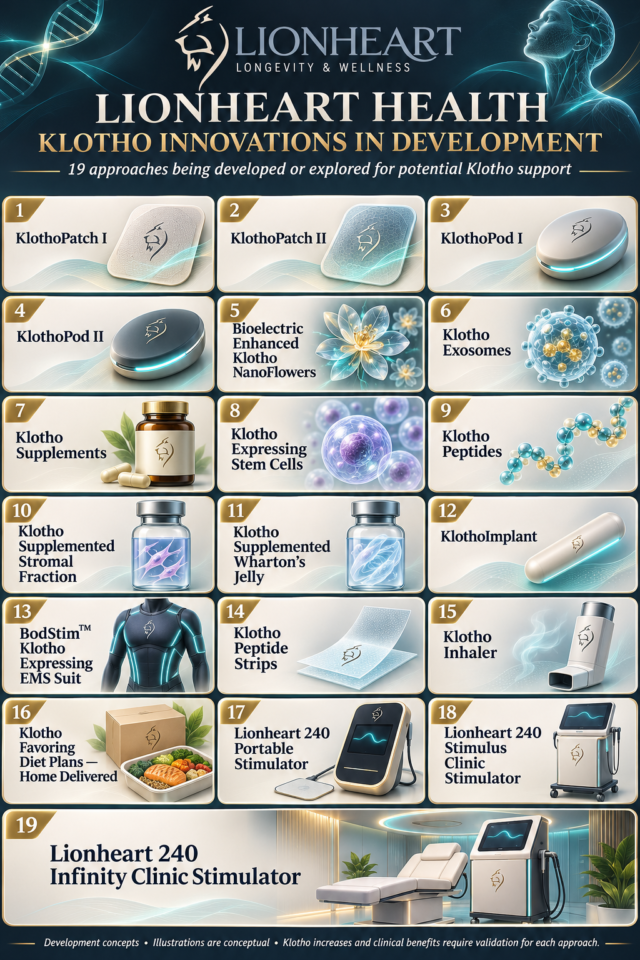
Illustrative AI created graphics. Actual devices and products differ in shape appearance.
Klotho research reinforces the value of combining muscle activity, sound nutrition, and attention to underlying health conditions. It also creates opportunities to investigate whether bioelectric stimulation can contribute additional benefits.
For Lionheart, the scientifically useful question is specific: Can a defined protocol produce a reproducible Klotho change, and does that change accompany meaningful improvements in strength, mobility, cognition, or other health outcomes?
Answering that question requires controlled studies. Research on exercise combined with electrical stimulation provides a starting point, but it cannot substitute for testing Lionheart’s own devices and protocols.
Klotho measurements should also be interpreted alongside function and clinical health. Improving walking ability, preserving muscle, or controlling kidney disease matters even if a Klotho result remains unchanged.
The strongest starting point is accessible: exercise consistently, build strength, eat a fiber-rich dietary pattern, avoid smoking, and address medical conditions that threaten long-term health. Klotho offers an exciting window into aging biology. The purpose of studying it is to help people live and function better.
Educational content. The approaches above differ substantially in evidence strength, and none guarantees a Klotho increase or longer life. Individual exercise, supplement, and medical-treatment decisions should account for personal health conditions.