
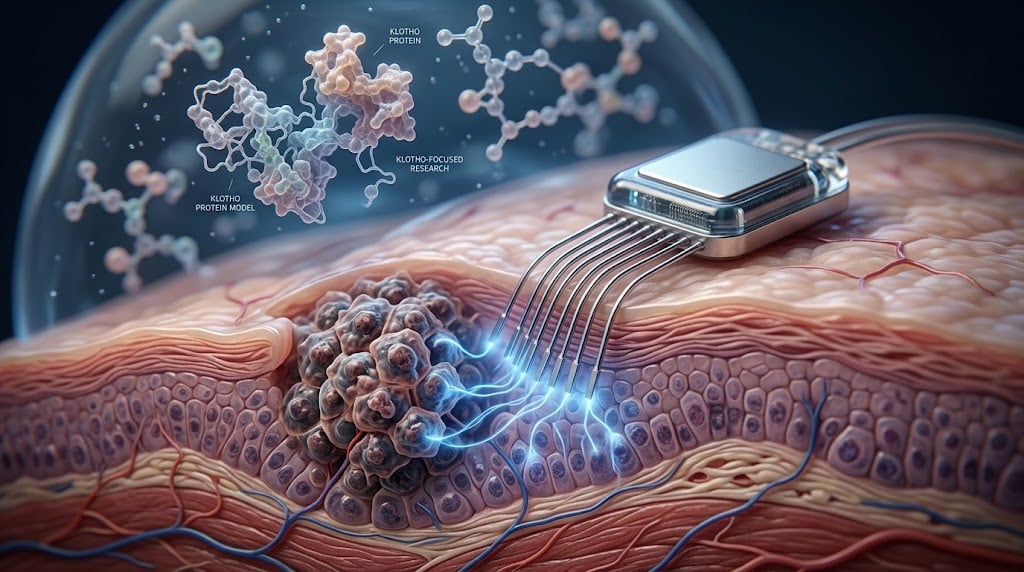
CancerCell MicroImplant™ development initiative aims to combine localized electrical stimulation with research into Klotho and additional biological signals involved in tumor behavior.
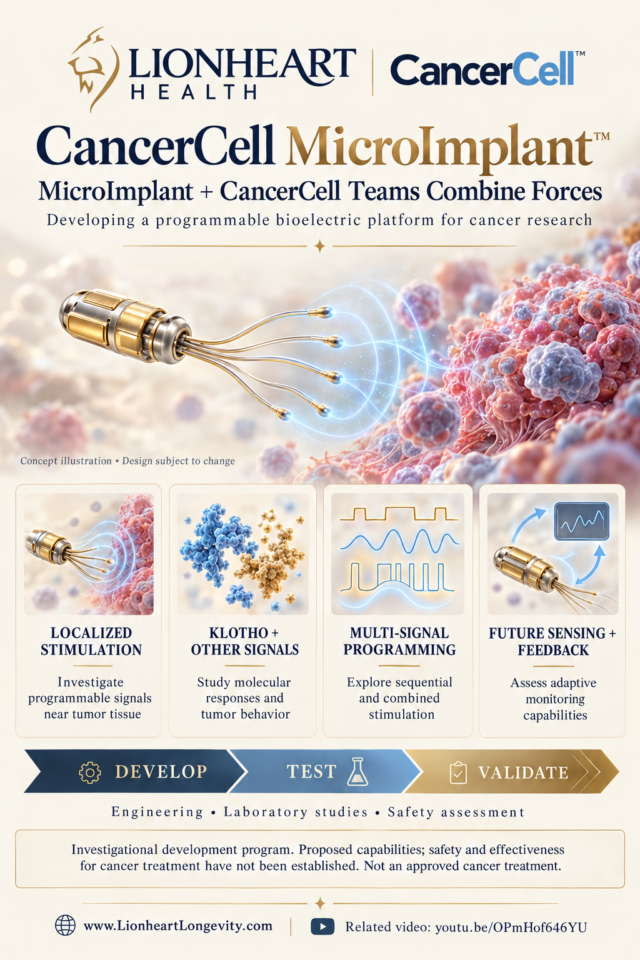
HUNTINGTON BEACH, Calif., October 26, 2026 — Lionheart Health, Inc. announced that its MicroImplant and CancerCell product development teams are combining forces to develop and test CancerCell MicroImplant™, an investigational implantable bioelectric stimulation platform intended to explore new approaches to treating cancer.
The initiative brings together miniature implant engineering and programmable bioelectric signaling research. Its central research question is whether localized electrical stimulation can influence Klotho expression and other selected molecular signals in ways that inhibit tumor growth while preserving surrounding healthy tissue.
The development vision shares features with emerging implantable cancer technologies, including Coherence Neuro’s SOMA platform, while pursuing an additional layer of biological signal modulation. Coherence describes SOMA as an investigational system being developed to sense electrical activity in the tumor microenvironment and deliver stimulation in response. Its earlier CIPHER system has entered short-duration intraoperative human investigation. These milestones do not establish clinical effectiveness for SOMA or Lionheart’s proposed system. (coherenceneuro.com)
Watch the related video:
Explore the implantable cancer technology concept
Expanding the Development Vision
Lionheart’s proposed CancerCell MicroImplant program aims to investigate a broader combination of functions:
- Localized, programmable stimulation: Evaluate electrical signals delivered near a tumor or surgical resection site.
- Klotho-focused modulation: Test whether selected stimulation patterns can reproducibly influence local alpha-Klotho expression and produce measurable anticancer effects.
- Additional biological signals: Screen tumor-specific pathways associated with proliferation, inflammation, immune interactions, and treatment resistance.
- Sequential or combined signaling: Investigate whether different stimulation programs can address multiple biological targets within one platform.
- Future sensing and feedback: Assess the feasibility of integrating measurements that could help researchers adjust stimulation based on observed tissue responses.
These are proposed development capabilities. Their successful integration, safety, and therapeutic value remain to be demonstrated. Lionheart is not claiming established superiority over another device.
Why Investigate Klotho?
Klotho is widely studied for its role in aging biology, but its relevance also extends to cancer research. Foundational laboratory work identified alpha-Klotho as a potential tumor suppressor in breast cancer models, including effects on insulin and IGF-1 signaling. Subsequent structure–function research investigated which portions of the protein contribute to these effects. These findings provide a research rationale, rather than evidence that a Klotho-modulating implant treats cancer in people. (nature.com, aacrjournals.org)
For CancerCell MicroImplant, the challenge is to establish a complete experimental chain: a defined electrical signal, a reproducible molecular response, and a meaningful effect on tumor behavior with acceptable safety.
Klotho biology and other signaling pathways must be evaluated in the context of each tumor type. Increasing a protein associated with beneficial effects in one setting does not establish benefit across all cancers.
A Staged Development and Testing Approach
The combined teams intend to develop a testing framework beginning with device characterization and controlled laboratory studies. Proposed work would evaluate electrical output, electrode performance, local tissue effects, Klotho expression, additional molecular responses, and cancer-cell behavior.
Studies would compare stimulation with appropriate controls and examine both tumor tissue and surrounding healthy tissue. A critical objective would be identifying signals that might unintentionally promote tumor growth, invasion, or other harmful responses.
Progression to animal studies or human investigation would depend on the results, funding, independent scientific review, and applicable regulatory and ethics requirements. No human trial start date is being announced.
Connecting Implant Engineering With Molecular Biology
The CancerCell MicroImplant initiative reflects Lionheart’s broader interest in programmable bioelectric systems that influence biological activity.
By combining the MicroImplant team’s engineering focus with CancerCell’s oncology development focus, the company aims to investigate whether one platform can eventually unite localized stimulation, molecular modulation, and feedback-guided treatment research.
The long-term goal is to develop an additional tool for oncology care. Any future use alongside surgery, radiation, drug therapy, or immunotherapy would require evidence supporting the specific combination.
Learn more: www.LionheartLongevity.com
Development and regulatory notice: CancerCell MicroImplant is a proposed investigational development platform. Safety and effectiveness for cancer treatment have not been established, and it is not being offered as an approved cancer treatment. No claim is made that it increases Klotho in human tumors, shrinks tumors, prevents recurrence, or improves survival. Research involving other devices or Klotho-based approaches does not validate this system. References to Coherence Neuro and the linked video provide industry context and do not imply affiliation, endorsement, or shared technology.
Forward-looking statements: This announcement describes development intentions and potential capabilities that may change or may not be achieved. Outcomes depend on technical feasibility, research results, financing, intellectual property considerations, and regulatory requirements. Preclinical findings may not translate into clinical benefit.