
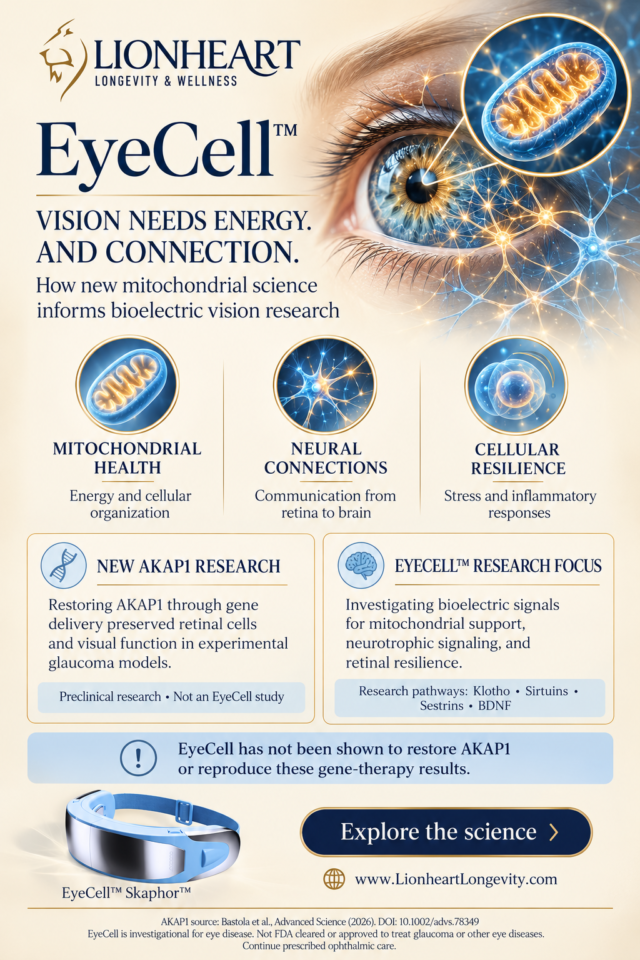
Preserving vision requires more than keeping retinal cells alive. Those cells also need dependable energy, healthy internal structures, and functioning connections that carry visual information to the brain.
New research on a protein called AKAP1 brings these needs into sharper focus—and provides a valuable scientific framework for understanding the questions Lionheart Health is investigating through its EyeCell™ bioelectric vision research program.
What the new research reveals
In a study published in Advanced Science on October 18, 2026, Bastola and colleagues investigated AKAP1, a scaffold protein that helps organize signaling at mitochondria—the structures that supply cellular energy.
The researchers found reduced AKAP1 in glaucomatous retinas. Restoring it through AAV2 gene delivery preserved retinal ganglion cells and visual function in two experimental mouse models of glaucoma. Treatment was accompanied by improvements in mitochondrial organization and energy capacity, preservation of synaptic structures, and lower markers of complement signaling and glial activation.
These results connect three priorities for vision research: mitochondrial health, neuronal communication, and the cellular environment surrounding vulnerable retinal neurons. The study does not establish which changes caused the others, and its findings remain preclinical. (advanced.onlinelibrary.wiley.
Where EyeCell fits
EyeCell approaches retinal protection through a different investigational method: noninvasive bioelectric and microcurrent stimulation.
Lionheart’s published research strategy explores whether selected electrical signals can influence processes associated with retinal and optic-nerve resilience. These include mitochondrial and cellular-energy support, neurotrophic signaling involving BDNF and CNTF, circulation, oxidative stress, inflammatory responses, and communication along the visual pathway. (lionheartlongevity.com)
The connection to the AKAP1 findings is therefore a shared biological research objective: helping vulnerable visual-system cells maintain the energy and signaling needed to function.
EyeCell has not been shown to restore AKAP1, reorganize mitochondrial cristae, or reproduce the results of AAV2-AKAP1 gene therapy. Those are specific questions that would require direct experimental testing.
Looking beyond an energy boost
The AKAP1 findings suggest that future vision therapies may need to address how cellular energy is organized and connected to neuronal activity.
For EyeCell, this creates a useful direction for research. A treatment that changes cellular activity should be evaluated for whether it also helps preserve the structures and connections responsible for useful vision.
Lionheart’s published EyeCell materials identify investigational signaling programs associated with Klotho, sestrins, sirtuins, and neurotrophic factors. The company describes these as potential avenues for studying stress resilience, mitochondrial support, and neuronal protection. Their proposed roles should be distinguished from demonstrated effects in a treated human retina. (lionhearthealthstim.com)
The practical question is whether a defined EyeCell protocol can produce measurable, durable improvements—and which biological changes, if any, explain those improvements.
Measuring what matters
The new mitochondrial research suggests several priorities for future EyeCell investigations:
- Energy and structure: Test mitochondrial function and organization in appropriate laboratory models.
- Neuronal connections: Assess whether stimulation preserves synaptic proteins and retinal signaling.
- Inflammatory responses: Determine whether changes reflect direct pathway effects or reduced tissue injury.
- Useful vision: Measure visual fields, contrast sensitivity, retinal structure, and patient-reported function alongside visual acuity.
- Durability and safety: Use controlled comparisons and follow-up to establish whether any benefits persist.
These are proposed research directions, rather than findings already established for EyeCell. Glaucoma investigations also require disease-specific endpoints; results from macular degeneration cannot establish efficacy in glaucoma.
Encouraging early observations—and the work ahead
Lionheart has reported a preliminary EyeCell dataset involving 16 evaluable treated eyes: 11 improved, three remained stable, and two declined. These company-reported observations justify further investigation, but do not establish treatment efficacy, explain a mechanism, or demonstrate protection against glaucoma progression. (lionheartlongevity.com)
The broader scientific opportunity is compelling: investigate whether bioelectric stimulation can help preserve the cellular conditions that allow the visual system to keep working.
The AKAP1 study offers a more precise framework for that work. For EyeCell, its value lies in helping shape better experiments—connecting mitochondrial measurements, neuronal communication, and meaningful visual outcomes.
EyeCell is investigational for eye-disease applications and has not been FDA cleared or approved to treat glaucoma, macular degeneration, or other eye diseases. Patients should continue prescribed ophthalmic care; participation in research should occur under appropriate professional, regulatory, and ethics oversight. (lionheartlongevity.com)