
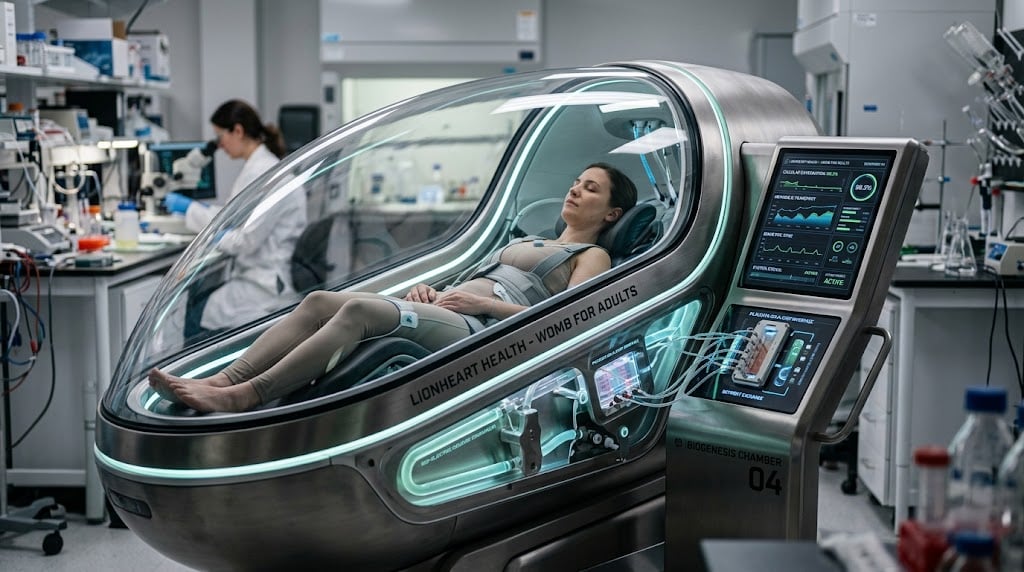
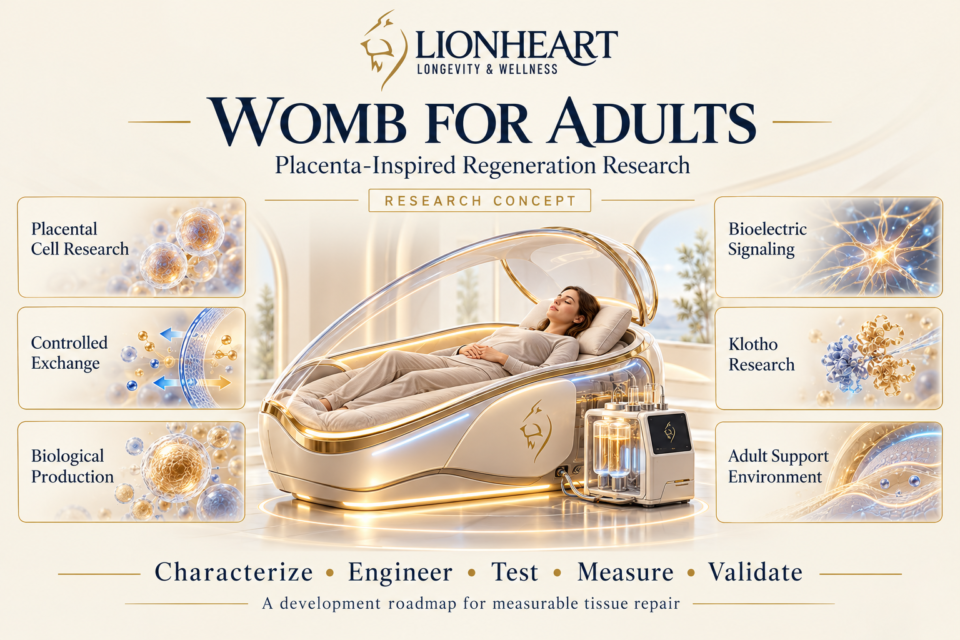
The placenta offers a remarkable blueprint for biological support. During pregnancy, it coordinates nutrient transfer, gas exchange, hormonal signaling, and communication at the maternal–fetal interface. Lionheart Health’s “Womb for Adults” concept translates that inspiration into a defined research and engineering plan: recreate selected placental functions, integrate them with controlled bioelectric signaling, and measure their effects on adult tissue repair.
The development program centers on a modular system. Each component has a specific function, a measurable output, and a defined place in the progression from laboratory discovery to clinical evaluation.
1. Establish the Placental Research Platform
The first phase establishes a research supply of donated placental tissue through consented collection programs and qualified tissue suppliers.
The program separates and characterizes placental cells, amniotic membrane, extracellular matrix, and secreted biological factors. Each material receives its own identity, composition profile, and functional testing.
International sourcing follows the requirements applicable to the material and its intended use. Research specimens and materials intended for therapeutic manufacturing follow separate pathways. (fda.gov)
This phase creates the biological reference library for the entire platform: which cells produce which signals, under what conditions, and with what effects on adult tissue models.
2. Recreate the Placental Interface
The next phase builds a laboratory interface with separate fluid channels and a controlled membrane between them.
Published placenta-on-a-chip research provides the starting architecture. These models reproduce aspects of the placental barrier and allow researchers to measure transport across cellular layers, including glucose transfer. (pubs.rsc.org, pmc.ncbi.nlm.nih.gov)
Lionheart’s development plan adapts this approach to answer precise engineering questions:
- Which substances cross the interface?
- How consistently does transfer occur?
- How do flow, concentration, and cellular activity change the output?
- What response does the receiving adult tissue exhibit?
The result is a testable exchange platform with measured performance.
3. Develop the Biological Production Module
A separate bioreactor houses characterized cells and collects their secreted products.
Trophoblast organoids provide a research tool for this work. Published studies demonstrate that these three-dimensional cultures reproduce important features of placental cell biology and support investigation of maternal–fetal interactions. (nature.com)
The production program identifies useful outputs and establishes repeatable manufacturing conditions. Every candidate receives a defined composition, potency assay, and release specification.
The development sequence moves from complex biological mixtures toward identified active components wherever possible. This makes each component easier to measure, reproduce, and evaluate.
4. Integrate Bioelectric Control
Bioelectric stimulation forms the experimental control layer of the Lionheart platform.
The research program applies defined stimulation patterns to selected cell and tissue models, then measures changes in protein expression, secretion, metabolism, and repair behavior.
Each stimulation program is evaluated against an unstimulated control. The resulting data connect the electrical input to the biological output.
This phase establishes which signals reliably influence the selected cells, how long the response lasts, and whether repeated stimulation maintains consistent activity.
5. Establish a Defined Klotho Module
Klotho receives its own development track within the system.
The program measures Klotho production or delivery, concentration over time, biological activity, and effects in adult tissue models. It then evaluates Klotho alongside other characterized components.
The central experiment compares individual components with their combinations. That approach identifies whether adding Klotho improves the selected outcome and determines the contribution of each part of the system.
Klotho becomes a measured element of the platform, with its role established through direct testing.
6. Engineer the Adult Support Environment
The “Womb for Adults” chamber integrates environmental control, monitoring, and the selected treatment modules.
Temperature, positioning, session duration, and physiological measurements become defined operating parameters. The chamber supports the adult’s existing physiology while the research program evaluates specific interventions.
The exchange module, biological production module, and chamber remain independently testable. Their integration follows demonstrated performance at the component level.
Artificial-womb research provides an engineering precedent for coordinated physiological support. In a landmark study, an external system supported extremely premature fetal lambs for up to four weeks using a fluid environment and an umbilical oxygenation circuit. That work establishes a developmental support model; Lionheart’s program addresses the separate challenge of adult tissue repair. (nature.com)
7. Measure Function and Advance Through Defined Milestones
The validation program begins with adult tissue models and progresses through increasingly integrated systems.
Muscle studies measure contractile performance and recovery. Vascular studies measure barrier function and tissue perfusion. Skin studies measure wound closure and tissue organization. Additional organ models enter the program as reproducible results establish the foundation for expansion.
The milestones are explicit:
- Characterize the biological materials.
- Demonstrate repeatable production and exchange.
- Establish the effects of bioelectric stimulation.
- Determine the contribution of Klotho and other selected factors.
- Demonstrate functional improvement in adult tissue models.
- Complete integrated preclinical evaluation.
- Advance to authorized human studies with defined clinical endpoints.
Clinical evaluation measures outcomes that matter to participants, including strength, mobility, recovery, and the function relevant to the indication under study. Biomarkers support those measurements.
From Placental Biology to an Adult Regeneration Platform
Lionheart’s development plan uses the placenta as a biological reference and organizes its lessons into an engineered system.
Donated tissue supplies the discovery platform. Placental interface models establish controlled exchange. Bioreactors produce characterized signals. Bioelectric stimulation supplies an experimental control mechanism. Klotho receives a defined role through testing. The chamber brings validated components together within a monitored adult support environment.
The plan is clear: identify the useful biology, recreate its functions, control its delivery, and demonstrate measurable adult tissue repair.