

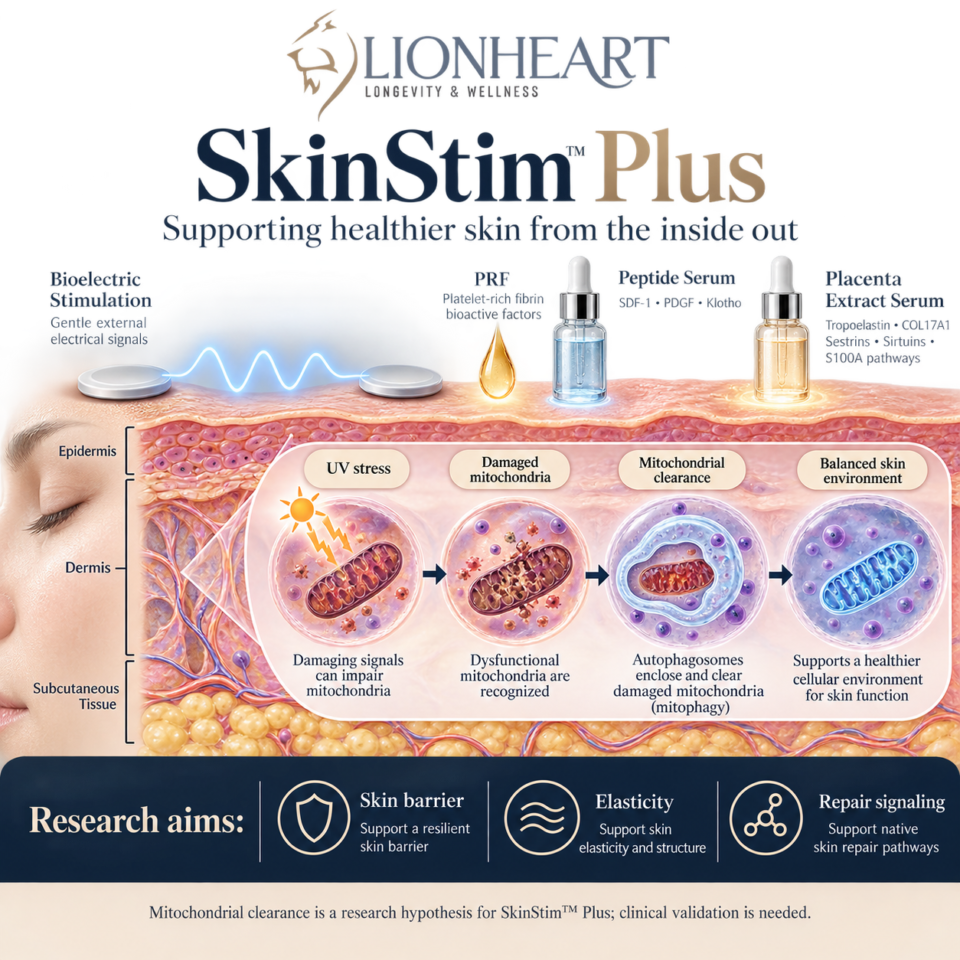
Wrinkles are visible on the surface, but the changes behind them reach deeper. Years of ultraviolet exposure can damage skin cells’ mitochondria, weaken the processes that clear damaged mitochondria, and contribute to persistent inflammation. Collagen and elastic support then deteriorate. The accompanying graphic illustrates this proposed chain of events. Recent experiments in UV-exposed mice and human cells support the role of mitochondrial clearance, or mitophagy, in photoaging; they do not yet prove that a particular treatment reverses that process in people. (pubmed.ncbi.nlm.nih.gov)
Lionheart’s SkinStim™ Plus is designed around a broader goal than smoothing a wrinkle: supporting skin that is resilient, elastic, well nourished, and able to maintain its barrier and repair functions. Its proposed approach combines programmed bioelectric stimulation with selected topical ingredients and, where appropriate, platelet-rich fibrin (PRF).
The bioelectric program targets several pathways involved in skin maintenance. SDF-1 is associated with cell recruitment; PDGF with repair signaling; and tropoelastin with the building blocks of elastic fibers. COL17A1 is relevant to the junction between the epidermis and dermis and to skin stem-cell biology. Lionheart’s published SkinStim materials describe these as target pathways, and its patents describe signal sequences intended to influence them. A patent or a measured change in a laboratory model, however, does not by itself establish a clinical benefit from the complete SkinStim Plus treatment. (skinstim.lionhearthealthstim.
We are also interested in Klotho, sestrins, and sirtuins because of their roles in cellular stress responses and metabolic health. Members of the S100A protein family participate in skin repair and inflammation; a human skin study found changes in several S100A genes after electrical stimulation. These findings give us research questions to pursue. We should measure whether SkinStim Plus changes each target in treated human skin, and whether any such change leads to better skin quality. (PMC)
SkinStim Plus may pair stimulation with a placenta extract serum and bioelectric-enhanced peptides as topical components intended to support the skin’s environment. PRF, prepared from a patient’s own blood, offers another possible source of repair-associated factors. Clinical reviews of PRP and PRF find the strongest facial rejuvenation evidence for improvements in skin thickness and elasticity, while results across studies remain variable. Evidence for PRF cannot simply be transferred to the full SkinStim Plus combination. (PubMed)
The mitochondrial finding in the graphic suggests an especially useful next step. Researchers have reported that a stem-cell-derived secretome improved mitochondrial clearance and reduced inflammatory signaling in experimental photoaging models. Whether SkinStim Plus, its serum, or its peptides produce the same effect has not been established. Testing that question would bring the concept closer to evidence: measure skin appearance and elasticity alongside barrier function, mitochondrial-clearance markers, inflammation, and the specific proteins the program aims to influence. (pubmed.ncbi.nlm.nih.gov)
Healthy skin does more than look youthful. It protects us, senses our surroundings, retains moisture, and repairs everyday damage. SkinStim™ Plus is Lionheart’s proposed way to support those functions while improving appearance. The promise is a more useful definition of skin rejuvenation; the work ahead is to demonstrate, in controlled human studies, which parts of the approach deliver it.