
An integrated strategy for muscle, brain, immunity and regenerative health
Aging touches every part of the body. The 12 biological hallmarks shown in the accompanying image offer a useful framework for understanding why: damage accumulates, repair becomes less efficient, and communication between cells changes. These interconnected hallmarks were described in the 2023 Cell paper, “Hallmarks of Aging: An Expanding Universe.” [1]
Lionheart Health’s approach combines personalized nutrition, physical conditioning, health assessments and research into programmable bioelectric stimulation and regenerative therapies. Its Klotho-Up™ program places particular emphasis on Klotho-associated biology, while BodStim™, Brain Band™ and Second Brain™ connect that strategy to muscle, neurological and gastrointestinal health. [2–4]
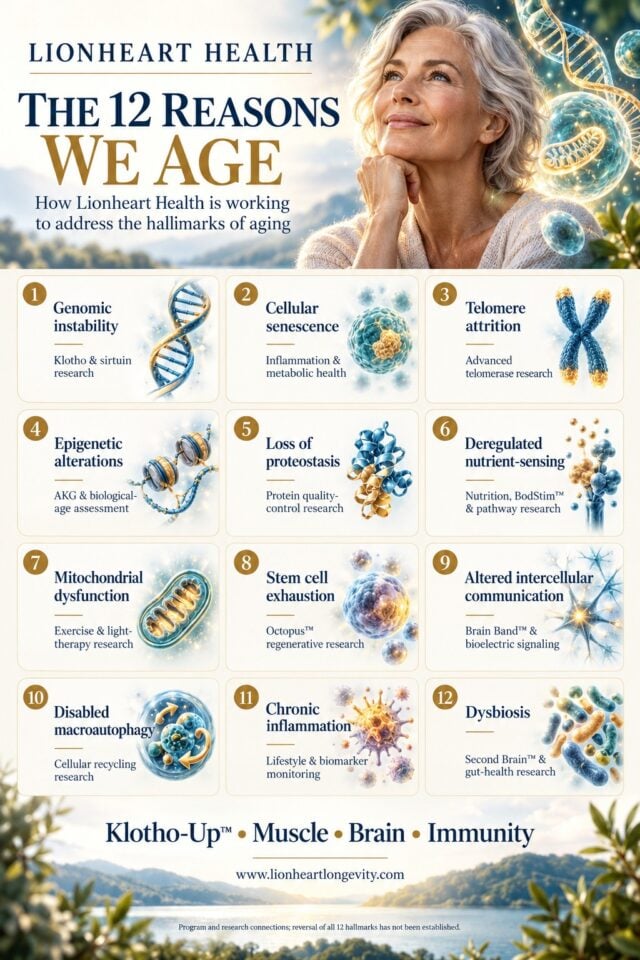
The following is a proposed mapping of Lionheart’s programs and research to the 12 hallmarks. Addressing a relevant pathway does not establish that a product reverses that hallmark in humans. The strongest case for the integrated strategy will come from controlled studies demonstrating meaningful, sustained improvements in function.
1. Genomic instability: Protecting the body’s biological instructions
Genomic instability means accumulating damage to DNA.
Lionheart’s practical starting point is a personalized plan that addresses nutrition, sleep, metabolic risk and avoidable exposures. Its research portfolio also includes Klotho and sirtuin-related signaling, offering pathways to investigate in relation to cellular stress and repair. [3]
The appropriate research question is whether a defined intervention improves validated measures of DNA damage or repair. Lionheart should describe this as an investigational objective; improved energy, higher Klotho or a younger biological-age score alone would not demonstrate repaired DNA.
2. Cellular senescence: Addressing the environment around aging cells
Senescent cells stop dividing and can release disruptive inflammatory signals.
Lionheart’s inflammation-management, exercise and metabolic-health programs provide a practical way to address the broader environment in which these cells accumulate. Klotho-focused and regenerative-signaling research offers additional hypotheses to test.
However, these programs should not be described as proven senolytics—treatments that selectively remove senescent cells. Demonstrating that effect would require direct evidence, rather than an inference from lower inflammation or better physical performance.
3. Telomere attrition: Studying the protective ends of chromosomes
Telomeres are protective chromosome ends that shorten with repeated cell division.
Healthy-lifestyle support fits Lionheart’s overall prevention strategy. More direct telomere interventions belong in its advanced research discussion: any hTERT or telomerase-based approach would require an appropriately authorized study, careful selection of participants and long-term safety monitoring.
The goal should be healthy tissue function. Telomere length by itself cannot establish rejuvenation, and Lionheart’s routine stimulation programs should not be presented as proven to lengthen telomeres.
4. Epigenetic alterations: Investigating changes in cellular programming
Epigenetic alterations change how genes are regulated without changing their sequence.
Lionheart’s Klotho-Up™ collection includes Rejuvant® calcium alpha-ketoglutarate and biological-age testing. [2] These tools can support a research program asking whether a personalized intervention changes selected aging-associated measurements.
A rigorous study would use a consistent testing method, a comparison group and functional outcomes. A change in an epigenetic clock is interesting, but it does not independently establish longer life or reversal of aging across the body.
5. Loss of proteostasis: Supporting protein quality control
Proteostasis is the cell’s ability to maintain properly functioning proteins.
This hallmark offers an important distinction for Lionheart’s protein-expression research: producing a beneficial signaling protein and improving cellular protein quality control are different achievements. A program targeting Klotho, BDNF or other proteins must still establish what happens downstream.
Lionheart can investigate whether its interventions improve protein maintenance, while its existing health programs focus on measurable tissue function. Claims of removing harmful protein aggregates would require separate, indication-specific evidence.
6. Deregulated nutrient-sensing: Improving the balance between growth and maintenance
Nutrient-sensing pathways help cells respond to food and energy availability.
Lionheart addresses this area through personalized nutrition, muscle conditioning and metabolic monitoring. BodStim™ provides the muscle-focused component, while the company has described investigational modulation of the FOXO3–AMPK–mTOR network. [3]
This creates a useful development objective: support strength and metabolic health while studying the timing of cellular growth and maintenance signals. Proposed assessments include glucose control, body composition, strength and exercise capacity. Pathway modulation must be demonstrated, not assumed from the use of a device.
7. Mitochondrial dysfunction: Focusing on energy and physical capacity
Mitochondrial dysfunction impairs the cells’ energy-producing machinery.
Lionheart’s approach brings together exercise, BodStim™ muscle activation and optional photobiomodulation within broader physician-guided programs. Its published brain-health materials describe cellular-energy pathways as a research rationale for light-based adjuncts. [3]
The practical question is whether participants achieve better endurance, mobility and recovery. More direct claims about mitochondrial restoration require appropriate biological measurements. A favorable result from one modality cannot automatically be attributed to every component of a combined protocol.
8. Stem cell exhaustion: Developing regenerative support
Stem cell exhaustion reduces the capacity for tissue renewal.
Lionheart’s investigational Octopus™ platform combines bioelectric signaling with regenerative biologics, stem-cell science and delivery concepts. Its Klotho Nanoflowers™ research proposes sustained local presentation of Klotho-associated signaling. [5]
This portfolio seeks to improve the conditions for tissue repair. Cell-based, gene-based and advanced delivery approaches remain distinct from routine wellness services and require their own clinical and regulatory evaluation. Demonstrating safe, durable tissue improvement is more meaningful than simply reporting a change in a circulating protein.
9. Altered intercellular communication: Investigating the body’s signaling network
Aging changes the signals exchanged between cells and organs.
This hallmark closely matches Lionheart’s bioelectric research strategy. Brain Band™ investigates neurological signaling, BodStim™ connects muscle activity with systemic effects, and Second Brain™ explores the gut–brain relationship. [3]
The proposed opportunity is to study these systems together. Trials should determine whether stimulation changes the intended signals, whether those changes produce meaningful benefits, and whether a combined program adds value beyond its individual components.
10. Disabled macroautophagy: Studying cellular recycling
Macroautophagy clears and recycles damaged cellular material.
Lionheart’s research into FOXO3, AMPK and mTOR provides a conceptual connection to this hallmark. [3] Its nutrition and exercise programs offer a practical foundation for studies of maintenance and recovery.
Autophagy is difficult to assess in people. A patent, a signaling hypothesis or a change in a general blood biomarker does not establish increased autophagic activity. This area should be presented as a research priority requiring direct, tissue-appropriate evidence.
11. Chronic inflammation: Measuring a central healthspan concern
Chronic inflammation is persistent activation of inflammatory processes.
Lionheart’s integrated strategy includes nutrition, muscle conditioning, sleep support, metabolic assessment and gut-health investigation. Its gut protocol explicitly identifies inflammation profiling and longitudinal monitoring as components of care and research. [4]
A proposed evaluation can track clinician-selected inflammatory markers alongside symptoms, physical function and conventional medical risks. The objective is to identify and address relevant drivers, with stimulation-based anti-inflammatory claims tested separately. Lower inflammation alone would not prove that every other hallmark has improved.
12. Dysbiosis: Connecting gut health with whole-body health
Dysbiosis is an unfavorable change in the microbial ecosystem.
Lionheart’s Second Brain™ research and investigational Gut Health Protocol combine gastrointestinal assessment, personalized nutrition and study of gut-directed stimulation. The broader protocol includes bioelectric, light and electromagnetic modalities whose incremental benefits require evaluation. [3,4]
Viome Gut Intelligence testing, offered in the Klotho-Up collection, can contribute exploratory nutrition insights. [2] Proposed follow-up should also consider digestive symptoms, bowel patterns and clinician-selected tests. A commercial microbiome score is one piece of information; it cannot by itself diagnose immune dysfunction or prove restored gut health.
Turning a biological framework into measurable healthspan
Lionheart’s opportunity is to connect these 12 hallmarks with outcomes people value: maintaining strength, thinking clearly, moving independently and remaining resilient.
A well-designed evaluation would establish baseline function and repeat standardized assessments of muscle performance, cognition, metabolic health, inflammation and gastrointestinal symptoms. Exploratory measures—including Klotho, microbiome profiles and biological-age estimates—can help generate hypotheses, while controlled comparisons determine whether the program delivers meaningful benefit.
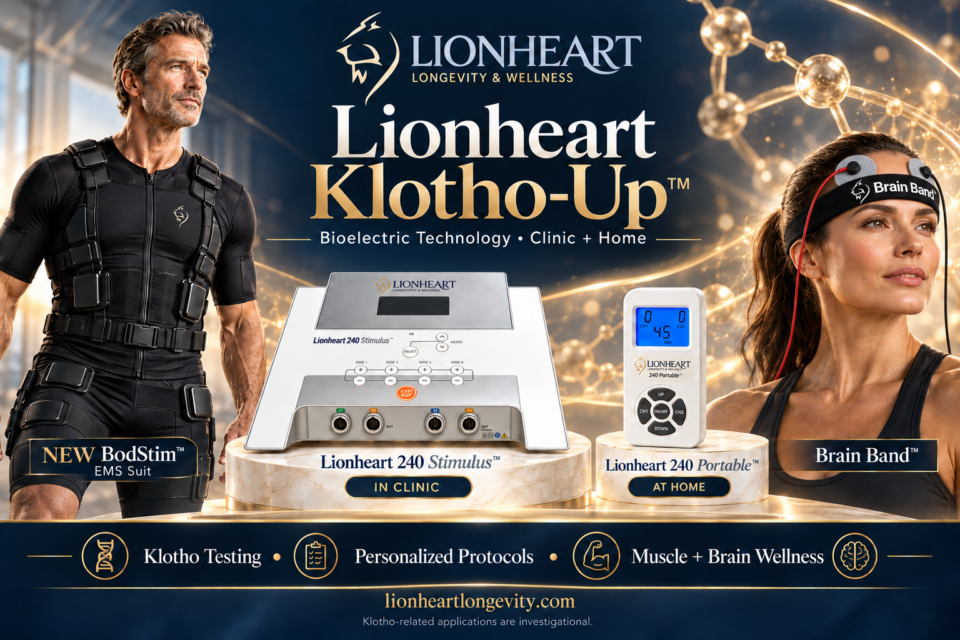
Lionheart’s public materials describe a personalized approach incorporating nutrition, daily movement, BodStim™-supported muscle conditioning, sleep, social connection and reassessment. [6] Its advanced regenerative research expands the questions the company can investigate.
The promise is an integrated, measurable approach to healthspan. Earning that promise requires showing which interventions work, for whom, at what dose and with what durability.
Research and regulatory note: This essay describes current program components and investigational development objectives. Lionheart’s integrated protocol has not been established to reverse all 12 hallmarks or extend human lifespan. Evidence and regulatory status vary by product and indication. Device clearance for a specific use does not establish clearance for aging reversal, protein-expression claims or advanced regenerative combinations.
Sources
- López-Otín C, et al. Hallmarks of aging: An expanding universe. Cell. 2023. https://pubmed.ncbi.nlm.nih.gov/36599349/
- Lionheart Klotho-Up Protocol collection. https://lionheartlongevity.com/collections/lionheart-klotho-up-protocol/
- Lionheart Health Announces Clinical Results Supporting Brain Band™ and BodStim™ Programs for Brain Health and Healthy Aging. Company publication. https://lionheartlongevity.com/lionheart-health-announces-clinical-results-supporting-brain-band-and-bodstim-programs-for-brain-health-and-healthy-aging/
- Lionheart Gut Health Protocol. https://lionheartlongevity.com/treatment/gut-health-protocol/
- Lionheart Octopus™ System: A Multi-Modal Strategy to Address the Biological Barriers Identified in New Longevity Research. Company publication. https://lionheartlongevity.com/lionheart-octopus-system-a-multi-modal-strategy-to-address-the-biological-barriers-identified-in-new-longevity-research/
- Japan Centenarian Protocol announcement. https://lionheartlongevity.com/lionheart-longevity-announces-japan-centenarian-protocol-as-new-membership-pathway/