When people think about longevity, they usually focus on the heart, muscles, metabolism, hormones and cognitive performance. Vision is often treated as a separate specialty—something addressed only when reading becomes difficult, night driving feels unsafe or an eye disease is diagnosed.
That separation may be a serious mistake.
The eyes are not merely cameras attached to the brain. The retina and optic nerve are extensions of the central nervous system. Every moment we are awake, the eyes deliver an enormous stream of sensory information that helps the brain interpret the environment, maintain balance, regulate movement, recognize faces, form memories and synchronize the body’s internal clock.
Protecting vision may therefore be one of the most practical and overlooked strategies for protecting brain function, independence and healthspan.
The Retina Is a Window Into the Brain
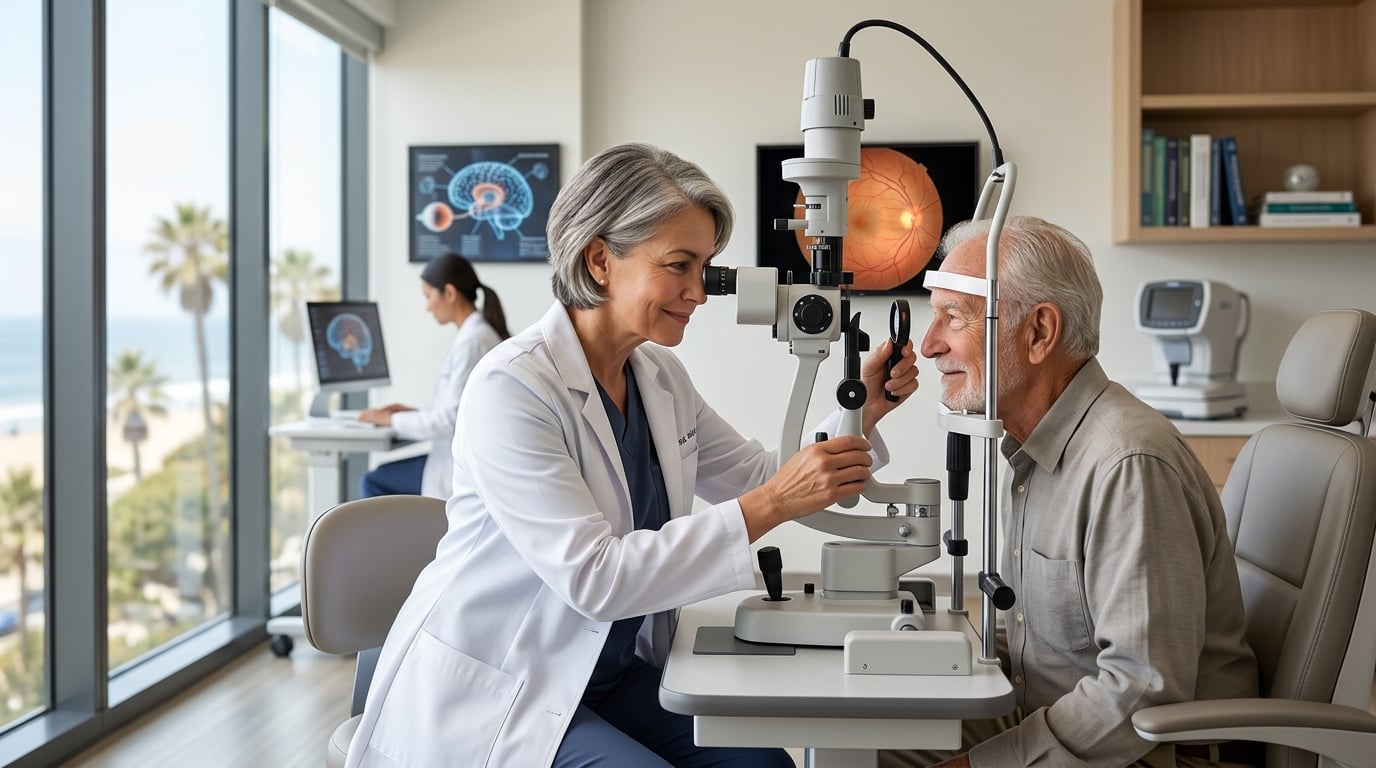
The retina contains specialized neurons, blood vessels and supporting cells that share important characteristics with brain tissue. Unlike the brain, however, the retina can be examined rapidly and noninvasively.
Modern retinal photography, optical coherence tomography and vascular imaging can measure features such as:
- Retinal nerve-fiber thickness
- Optic-nerve health
- Small-vessel structure and circulation
- Macular integrity
- Signs of inflammation or degeneration
- Changes associated with diabetes and hypertension
Researchers are investigating whether combinations of these measurements could help identify early changes associated with neurological and vascular disease. Retinal imaging is not currently a stand-alone diagnostic test for Alzheimer’s disease, but the eye’s accessibility makes it an increasingly important research platform for studying brain aging. The scientific literature describes the retina as an extension of the central nervous system and a potential window into processes associated with dementia. National Institutes of Health review
Vision Loss Is Now Recognized as a Dementia Risk Factor
The 2024 Lancet Commission on dementia prevention added untreated vision loss in later life to its list of potentially modifiable dementia risk factors. Together, the Commission’s 14 identified factors were estimated to be associated with approximately 45% of dementia cases, although eliminating a risk factor cannot guarantee that dementia will be prevented. The Lancet Commission
The connection may operate through several overlapping pathways.
Reduced sensory stimulation
Clear vision continually activates networks involved in attention, spatial processing, learning and memory. When visual input becomes degraded, the brain must devote more effort to interpreting incomplete information. Over time, reduced sensory stimulation may also contribute to changes in the brain’s structure and function.
Less physical activity
Poor vision can make walking, driving and exercising more difficult. People may become less active because they are concerned about falling or navigating unfamiliar environments. That matters because physical activity supports circulation, metabolic health, muscle preservation and cognitive performance.
Social isolation
Difficulty recognizing faces, reading messages or traveling independently can gradually reduce social participation. Social isolation itself is one of the potentially modifiable risk factors identified in dementia research.
Falls and loss of independence
Healthy vision supports balance, depth perception and safe movement. Vision impairment can increase the risk of falls, injuries and reduced mobility—all of which can accelerate frailty and shorten independent healthspan.
Shared vascular and metabolic risks
Hypertension, diabetes, smoking, chronic inflammation and abnormal lipids can harm both the small vessels of the retina and the vascular system supplying the brain. Changes found in the eye may sometimes reflect a broader systemic problem rather than an isolated eye condition.
Association does not always prove causation. Vision impairment can contribute to cognitive decline, but neurological disease can also affect visual processing. In other cases, both conditions may arise from common vascular, metabolic or inflammatory pathways.
The Eyes Also Help Control Sleep and Circadian Health
The eye–brain connection extends beyond sight.
Specialized retinal cells detect environmental light and communicate with brain centers that regulate circadian rhythms. These signals help determine when the body should be alert and when it should prepare for sleep.
Healthy light exposure—especially bright natural light earlier in the day—supports the timing of melatonin release, sleep-wake cycles and daytime alertness. Conversely, insufficient daytime light and excessive bright light at night can disrupt circadian timing.
Sleep is itself a major component of brain health. Poor sleep can impair attention, memory, mood, glucose control and cardiovascular recovery. A comprehensive longevity strategy should therefore consider not only visual acuity, but also how light exposure and eye health influence sleep and daily biological rhythms.
Vision Is a Functional Healthspan Metric
Lifespan measures how long we live. Healthspan measures how long we remain capable, active and independent.
Vision affects nearly every dimension of healthspan:
| Healthspan domain | Contribution of healthy vision |
| Brain health | Supports attention, memory, learning and environmental awareness |
| Mobility | Improves navigation, balance and confidence during movement |
| Exercise | Helps people remain active and participate safely |
| Independence | Supports driving, reading, medication management and daily tasks |
| Social connection | Helps with face recognition and participation in social activities |
| Sleep | Provides light signals involved in circadian regulation |
| Safety | Reduces navigation errors and may lower fall risk |
| Emotional health | Helps preserve autonomy, engagement and quality of life |
For these reasons, correcting a person’s vision may produce benefits far beyond a sharper eye chart. It can restore access to movement, social engagement, mental stimulation and independent living.
A Better Longevity Eye–Brain Evaluation
An integrated longevity program should connect eye care with neurological, cardiovascular and metabolic assessment.
A practical evaluation may include:
- Comprehensive eye examination
Visual acuity alone is insufficient. Depending on age and risk, evaluation may include dilation, eye-pressure measurement, retinal assessment and visual-field testing. The National Eye Institute notes that dilation helps clinicians detect common problems including glaucoma, diabetic retinopathy and age-related macular degeneration. National Eye Institute - Cardiometabolic review
Blood pressure, glucose control, lipids, smoking exposure and inflammation can affect both retinal and cerebral health. - Cognitive baseline
Memory, attention, processing speed and executive function should be tracked over time rather than assessed only after a major decline becomes obvious. - Balance, gait and fall-risk testing
Vision works together with the vestibular system, sensory nerves and musculoskeletal system. A problem in one area can increase demands on the others. - Sleep and circadian assessment
Sleep quality, nighttime light exposure and daily outdoor-light exposure deserve attention in any eye–brain health plan. - Correction of treatable problems
Updated eyeglasses, cataract evaluation, treatment of retinal disease, glaucoma management and low-vision rehabilitation may preserve function and independence. No experimental technology should delay established medical or surgical care.
Moving From Disease Care to Eye–Brain Optimization
Traditional care often waits for a diagnosis. Longevity medicine asks a different question:
How can we identify declining function earlier and preserve it for longer?
The next generation of eye–brain health may combine clinical eye examinations with retinal imaging, cognitive testing, metabolic biomarkers, sleep assessment and individualized interventions. Researchers are also evaluating artificial intelligence, advanced imaging, photobiomodulation, neuromodulation and regenerative approaches, but many of these technologies remain investigational for specific neurological or ophthalmic uses.
At Lionheart Health, our long-term vision is an integrated model in which eye health, brain performance and whole-body longevity are evaluated together. Programs under development—including the EyeCell™ and Brain Band™ platforms—are intended to explore how multimodal approaches may support vision and neurological health. Any investigational application should be evaluated through properly designed studies, and these programs should not be represented as proven treatments for Alzheimer’s disease, glaucoma, macular degeneration or other diagnosed conditions unless supported by appropriate clinical evidence and regulatory authorization.
The Longevity Takeaway
The eyes do much more than allow us to see. They provide the brain with essential stimulation, help regulate sleep, guide movement, support social connection and offer clinicians a rare opportunity to observe neural and vascular tissue noninvasively.
A modern longevity program should therefore treat vision as a central component of brain health—not an isolated service reserved for the moment something goes wrong.
The most valuable eye–brain upgrade may begin with surprisingly familiar actions: obtain comprehensive eye examinations, correct treatable vision problems, manage blood pressure and glucose, remain physically and socially active, protect sleep and investigate unexplained visual changes promptly.
If we want to extend healthspan, we must protect the systems that allow people to engage fully with life. Vision is one of the most important of those systems—and one of the easiest to overlook.
Medical disclaimer: This article is for educational purposes only and does not provide medical advice, diagnosis or treatment. Sudden vision loss, flashes, new floaters, eye pain or acute neurological symptoms require prompt professional evaluation.
EyeCell Skaphor
https://lionheartlongevity.com/product/eyecell-skaphor-tm-model/
https://lionheartlongevity.com/collections/eye/
https://lionheartlongevity.com/treatment/vision-health-protocol/
By Howard J. Leonhardt