
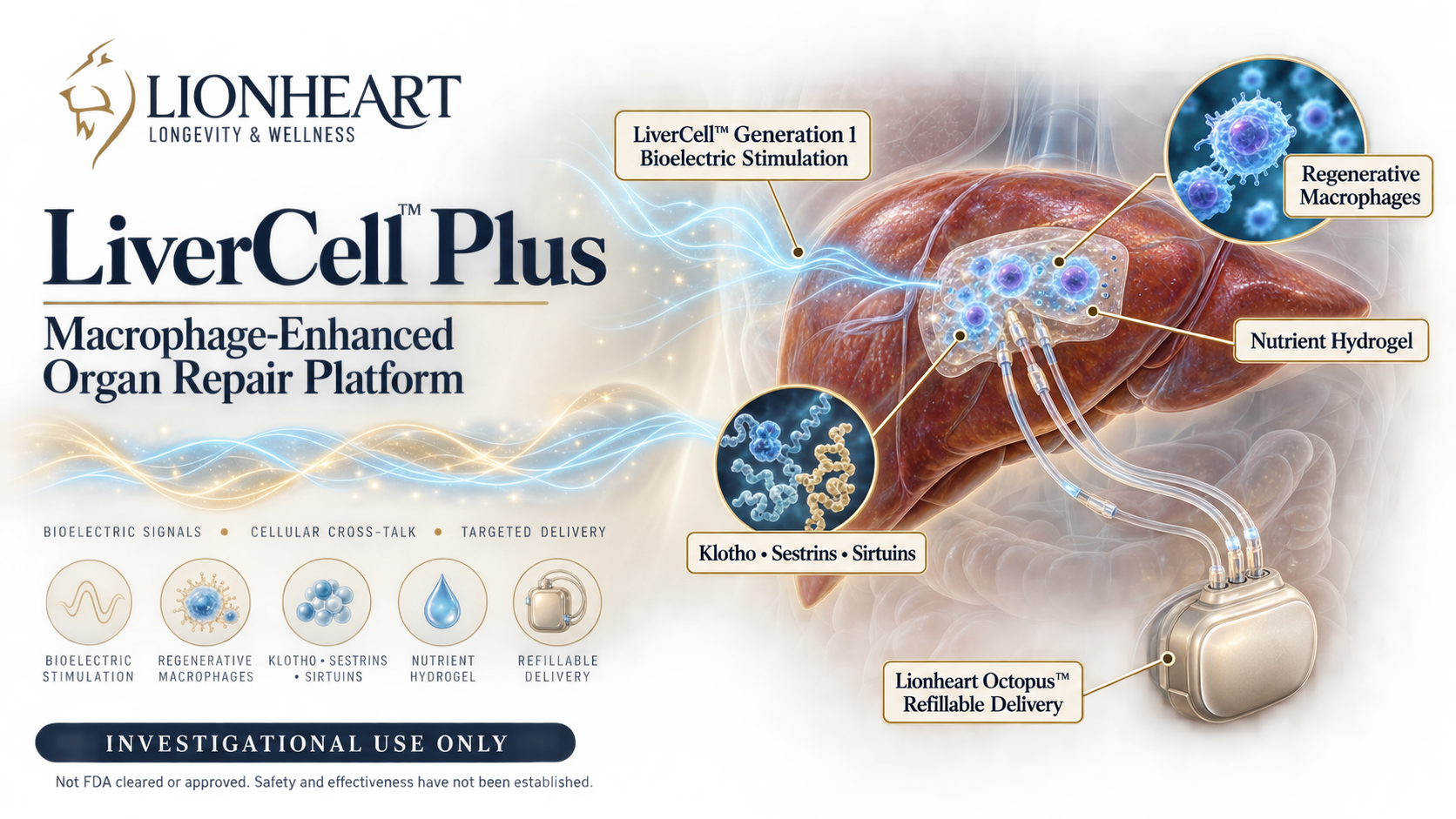
Scientific program will investigate regenerative macrophages together with programmable bioelectric stimulation, Klotho, Sestrins, sirtuins, nutrient hydrogel and the refillable Lionheart Octopus™ delivery platform
HUNTINGTON BEACH, Calif. — September 22, 2026 — Lionheart Health, Inc. today announced plans to develop an investigational regenerative macrophage therapy to complement its LiverCell™ Generation 1 bioelectric-stimulation platform and support development of its next-generation LiverCell™ Plus system.
The LiverCell™ program is being designed to investigate whether bioelectric stimulation, regenerative macrophages, selected protein-expression pathways, cell-supporting nutrient hydrogel and localized biologic delivery can be coordinated to improve the repair environment surrounding damaged liver tissue.
The planned macrophage program will focus on cells selected, conditioned or engineered to exhibit anti-inflammatory, fibrosis-resolving and tissue-repair activities. Lionheart Health intends to study these macrophages independently and in combination with its proprietary bioelectric signaling technology.
The program remains in development. Lionheart Health has not established that its proprietary LiverCell™ waveforms alter macrophage activity or improve liver function in humans.
Building Upon LiverCell™ Generation 1
LiverCell™ Generation 1 is Lionheart Health’s noninvasive bioelectric-stimulation platform. It is being developed to deliver programmable electrical signals through externally positioned electrodes and to investigate biological pathways associated with circulation, cellular survival, inflammation regulation and tissue repair.
Published research provides scientific support for studying electrical stimulation as a potential regulator of macrophage behavior.
In a 2024 laboratory study, direct-current electrical stimulation of human THP-1-derived macrophages increased expression of the repair-associated genes IL10, CD163 and PPARG. The researchers also reported reduced expression of the inflammatory macrophage marker CD86 and decreased secretion of selected pro-inflammatory interleukins. (pubmed.ncbi.nlm.nih.gov, pmc.ncbi.nlm.nih.gov)
Other laboratory studies have similarly reported that electrical stimulation can influence macrophage polarization and may act together with cytokine signals that control inflammatory and tissue-repair responses. (pubmed.ncbi.nlm.nih.gov, pubmed.ncbi.nlm.nih.gov)
These findings support further investigation, but they do not establish that all forms of electrical stimulation produce the same response. Macrophage effects can vary according to waveform, current density, polarity, frequency, treatment duration, cell state and surrounding tissue environment. Lionheart Health therefore plans to test each proposed LiverCell™ signal under defined laboratory and preclinical conditions before making clinical claims.
Developing a Complementary Macrophage Therapy
Macrophages are highly adaptable immune cells involved in the removal of damaged tissue, control of inflammation, coordination of repair and regulation of fibrosis. Liver-resident macrophages, known as Kupffer cells, and macrophages recruited from circulating monocytes can play different roles during liver injury and recovery.
Although macrophages are frequently described as inflammatory “M1” or repair-associated “M2” cells, modern research shows that their actual biological states exist across a broader and changing spectrum. A regenerative liver therapy must therefore control macrophage identity, potency, timing and tissue environment rather than simply attempting to maximize one macrophage category.
Lionheart Health plans to investigate whether regenerative macrophages can complement LiverCell™ Generation 1 by:
- Clearing damaged cells and cellular debris.
- Reducing excessive inflammatory signaling.
- Supporting resolution of inflammation.
- Influencing fibrosis-related pathways.
- Coordinating vascular and tissue-remodeling responses.
- Supporting hepatocyte survival and recovery.
- Producing locally active regenerative factors.
- Interacting with Lionheart’s programmable bioelectric signals.
Klotho and Macrophage Regulation
Klotho is one of the principal protein-expression pathways Lionheart Health plans to investigate within the LiverCell™ program.
Experimental research has found that Klotho overexpression promoted repair-associated macrophage polarization and reduced NF-κB inflammatory signaling in mouse models of kidney and cardiac injury. (pubmed.ncbi.nlm.nih.gov, pmc.ncbi.nlm.nih.gov)
Additional research in macrophages found that Klotho interacted with the NF-κB regulatory pathway and reduced inflammatory activation. Other studies reported that Klotho suppressed monocyte inflammatory-factor release and reduced activation of the NLRP3 inflammasome, a protein complex involved in inflammatory cytokine production. (pubmed.ncbi.nlm.nih.gov, pubmed.ncbi.nlm.nih.gov, pubmed.ncbi.nlm.nih.gov)
Klotho also has potential relevance to liver fibrosis. A recent preclinical study found that genetic Klotho deficiency was associated with spontaneous hepatic fibrosis in mice. In experimental liver-injury models, a Klotho-derived peptide reduced TGF-β signaling, hepatic stellate-cell activation, collagen deposition and other fibrosis-related measurements. (pubmed.ncbi.nlm.nih.gov, pmc.ncbi.nlm.nih.gov)
These studies support investigating Klotho as a potential component of the environment surrounding regenerative macrophages. They do not prove that electrically induced Klotho expression will enhance macrophage therapy or reverse human liver disease.
Sestrin-2 and Macrophage Stress Response
Lionheart Health also plans to investigate bioelectric signals associated with Sestrin-2, a stress-responsive protein involved in oxidative stress, inflammation, autophagy and AMPK–mTOR metabolic signaling.
An experimental study reported that Sestrin-2 suppressed classically activated inflammatory macrophages and reduced macrophage-mediated cardiac inflammation following myocardial infarction. (pubmed.ncbi.nlm.nih.gov)
Separate research found that Sestrin-2 regulates monocyte activation through the AMPK–mTOR signaling network. This pathway helps govern cellular metabolism, stress responses and immune-cell behavior. (pubmed.ncbi.nlm.nih.gov)
Studies involving microglia—the macrophage-like immune cells of the central nervous system—have also found that Sestrin-2 can suppress inflammatory polarization and promote repair-associated states. Although microglia are not liver macrophages, these findings add mechanistic support for studying Sestrin-2 as an immunometabolic regulator. (pubmed.ncbi.nlm.nih.gov)
The LiverCell™ research program will evaluate whether modulating Sestrin-related pathways can improve macrophage viability, stress resistance, metabolic fitness or anti-inflammatory activity in a liver-injury environment.
Sirtuins and Macrophage Metabolism
Sirtuins are NAD+-dependent enzymes that regulate metabolism, mitochondrial function, cellular stress responses and inflammation. Lionheart Health plans to investigate SIRT1, SIRT3 and SIRT6 as potential signaling targets within its combined LiverCell™ macrophage program.
SIRT1
Published research found that activation of the SIRT1–AMPK pathway promoted a less-inflammatory macrophage phenotype. In contrast, macrophage-specific loss of SIRT1 increased inflammatory molecules and reduced repair-associated markers in an animal model. (pubmed.ncbi.nlm.nih.gov, pubmed.ncbi.nlm.nih.gov)
SIRT1 is particularly relevant to the planned LiverCell™ program because experimental research in cholestatic liver disease found that SIRT1–mTOR signaling regulated macrophage inflammasome activity, autophagy and metabolic programming. (pubmed.ncbi.nlm.nih.gov)
SIRT3
SIRT3 regulates mitochondrial metabolism and may help determine whether macrophages adopt inflammatory or repair-associated functions.
Experimental studies found that SIRT3 signaling supported α-ketoglutarate production during M2-associated macrophage polarization. Macrophage-specific SIRT3 deficiency caused mitochondrial dysfunction and promoted a pro-inflammatory macrophage state in obese mice. (pubmed.ncbi.nlm.nih.gov, pubmed.ncbi.nlm.nih.gov)
Additional research found that SIRT3 inhibition increased inflammatory macrophage polarization and worsened tissue injury in an experimental sepsis-induced lung-injury model. (pubmed.ncbi.nlm.nih.gov)
SIRT6
SIRT6 may connect macrophage regulation with control of liver inflammation and fibrosis.
In experimental models, deletion of SIRT6 in myeloid-derived immune cells was sufficient to induce liver inflammation and fibrosis. Macrophages deficient in SIRT6 exhibited increased inflammatory signaling, including activation of c-JUN-related pathways. (pubmed.ncbi.nlm.nih.gov, pmc.ncbi.nlm.nih.gov)
Separate studies found that SIRT6 reduced liver-fibrosis signaling through effects on hepatic stellate cells and the TGF-β/SMAD pathway. (pubmed.ncbi.nlm.nih.gov, pubmed.ncbi.nlm.nih.gov)
Collectively, these findings support studying sirtuins as potential regulators of macrophage metabolism and the fibrotic liver environment. They do not establish that Lionheart’s bioelectric signals can reproducibly increase sirtuin activity or improve macrophage therapy in patients.
LiverCell™ Plus and the Lionheart Octopus™ Platform
LiverCell™ Plus is being designed to build upon the external stimulation used in LiverCell™ Generation 1 by adding localized cellular and biologic delivery.
The planned system may combine:
- Regenerative macrophages.
- Klotho-expressing or other qualified regenerative cells.
- A biocompatible nutrient hydrogel intended to support cell survival and retention.
- Programmable bioelectric stimulation.
- Controlled delivery of selected proteins, peptides, extracellular vesicles or secretomes.
- The refillable Lionheart Octopus™ implanted delivery system.
- Small catheters extending from the pump to the targeted liver region.
- Minimally invasive refill and maintenance procedures.
The Lionheart Octopus™ is envisioned as a subcutaneously implanted pump and docking system with multiple delivery channels. For LiverCell™ Plus, the system is being designed to deliver measured quantities of investigational materials directly to or near the liver over an extended period.
The reservoir could potentially be replenished by passing a needle through the skin into a self-sealing silicone septum or through an image-guided catheter docking system. This design is intended to reduce the need for a new surgical implantation every time additional therapeutic material is required.
Planned Scientific Questions
Lionheart Health intends to evaluate whether its combined platform can:
- Influence macrophage inflammatory and repair-associated functions.
- Improve macrophage survival and retention near damaged liver tissue.
- Coordinate macrophage treatment with Klotho, Sestrin and sirtuin pathways.
- Reduce excessive NF-κB, NLRP3 and TGF-β-related signaling.
- Support resolution of inflammation without creating harmful immune suppression.
- Reduce hepatic stellate-cell activation and pathologic collagen deposition.
- Improve vascularization and tissue-remodeling signals.
- Provide repeated or sustained localized support through a refillable system.
- Produce measurable improvements in validated liver-function and fibrosis endpoints.
“Published research supports the scientific rationale that electrical stimulation and the modulation of Klotho, Sestrin and sirtuin pathways may influence macrophage inflammatory, metabolic and tissue-repair functions,” said Howard J. Leonhardt, Executive Chairman and Co-CEO of Lionheart Health. “Our objective is to determine whether these elements can be brought together in a carefully controlled LiverCell™ research platform.”
Leonhardt continued: “LiverCell™ Generation 1 provides the planned noninvasive bioelectric foundation. The macrophage program adds a potentially complementary cellular component. LiverCell™ Plus and the Lionheart Octopus™ are intended to advance the platform toward localized, refillable and programmable regenerative support. Each step must be validated through rigorous laboratory testing, preclinical studies and properly authorized clinical trials.”
Planned Development Path
Lionheart Health’s anticipated development program includes:
- Selection and characterization of macrophage sources and processing methods.
- Development of identity, purity, viability and potency assays.
- Evaluation of LiverCell™ waveforms in human macrophage cultures.
- Measurement of inflammatory cytokines and repair-associated markers.
- Testing of Klotho, Sestrin and sirtuin expression before and after stimulation.
- Assessment of macrophage metabolism, phagocytosis and fibrosis-related signaling.
- Development of compatible nutrient-hydrogel formulations.
- Engineering validation of the Lionheart Octopus™ reservoir, septum, pump and catheters.
- Preclinical evaluation of safety, biodistribution, cell retention and liver-function endpoints.
- Submission to applicable regulatory authorities before commencing human studies.
Important Investigational-Use Statement
LiverCell™, LiverCell™ Plus, Lionheart Octopus™ and Lionheart Health’s planned macrophage therapy are investigational technologies in development. They have not been cleared or approved by the U.S. Food and Drug Administration to diagnose, treat, cure, reverse or prevent liver failure, cirrhosis, hepatic fibrosis or any other disease.
Published research cited in this announcement was conducted by independent investigators using experimental systems, waveforms, proteins or treatment conditions that may differ materially from Lionheart Health’s technology. Those findings do not establish the safety or effectiveness of LiverCell™, LiverCell™ Plus, Lionheart Octopus™ or any Lionheart macrophage product.
Any human use would require applicable regulatory authorization, institutional review board approval, controlled manufacturing, qualified clinical oversight and informed patient consent.
Selected Scientific References
- Bianconi S, et al. “Direct Current Electrical Stimulation Shifts THP-1-Derived Macrophages Toward a Pro-Repair Phenotype.” 2024. PubMed PMID: 39000377. (pubmed.ncbi.nlm.nih.gov)
- Gu J, et al. “Effects of Electrical Stimulation on Cytokine-Induced Macrophage Polarization.” 2022. PubMed PMID: 35225425. (pubmed.ncbi.nlm.nih.gov)
- Lv S, et al. “Klotho Alleviates Indoxyl Sulfate-Induced Heart Failure and Kidney Damage by Promoting M2 Macrophage Polarization.” Aging. 2020. PubMed PMID: 32464602. (pubmed.ncbi.nlm.nih.gov)
- Li L, et al. “Klotho Reduction in Alveolar Macrophages Contributes to Cigarette Smoke Extract-Induced Inflammation in Chronic Obstructive Pulmonary Disease.” 2015. PubMed PMID: 26385922. (pubmed.ncbi.nlm.nih.gov)
- “Klotho-Derived Peptide 1 Ameliorates Hepatic Fibrosis Induced by