

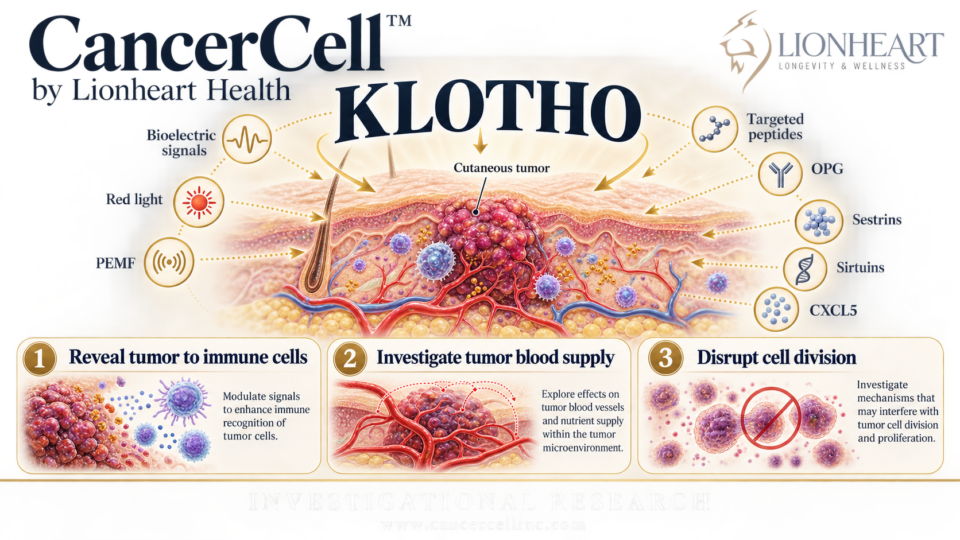
CancerCell by Lionheart Health licenses, Leonhardt bioelectric patents, Klotho research and a BodStim™ supportive-care protocol form a proposed path for laboratory and clinical investigation
HUNTINGTON BEACH, Calif., September 26, 2026 — Lionheart Health, Inc. today outlined a cancer research strategy built around its licensed CancerCell patent portfolio, cancer-related inventions of Howard J. Leonhardt and collaborators, and proposed studies of Klotho biology and muscle support during cancer care.
Lionheart states that it has licensed the Eleanor Schuler cancer patents identified on its published list of issued CancerCell patents. These patents describe approaches to recording and processing cancer-associated electrical signals and applying encoded signals, including proposed methods involving calcium and tumor-cell death. Additional Schuler patents involving responsive neurocode systems may offer a future option path if Lionheart secures the necessary rights. lionheartlongevity.com
The strategy also draws on US 11,185,691, which describes individualized bioelectric tumor therapy; US 11,691,007, which describes bioelectric modulation of osteoprotegerin; and US 12,226,639, which describes bioelectric modulation of Klotho expression. These patents establish disclosed inventions. Whether a particular device, signal or combination improves outcomes for patients with cancer must be determined experimentally and, where appropriate, in regulated clinical studies. lionheartlongevity.
“Lionheart’s cancer research strategy draws on 13 issued U.S. patents: nine licensed Schuler CancerCell patents and four Leonhardt-led grants covering adaptive tumor stimulation, osteoprotegerin signaling and two Klotho modulation inventions. Our broader research portfolio also includes issued patents relevant to inflammation and GDF10, along with published applications involving Sestrins, Sirtuins and other bioelectric protein-expression targets. The strength of this platform lies in the range of precise questions we can test—identifying which signal, target and combination may benefit a particular cancer, and proving the answer through rigorous studies.” — Howard J. Leonhardt, Executive Chairman and Co-CEO, Lionheart Health, Inc.
Lionheart’s publicly posted CancerCell protocol, proposes a randomized, blinded, sham-controlled study in a mouse glioma model. It calls for measuring tumor growth using bioluminescence imaging and calipers. The document is a study plan, not a report of successful treatment results. It includes placeholder stimulation parameters that would need to be specified in a current research protocol. Read the protocol.
Lionheart is separately developing a BodStim™ cancer protocol to investigate whether neuromuscular stimulation can help preserve muscle and physical function during cancer care. Its proposed outcomes should include strength, body composition, function, patient experience and safety. A muscle-support study would not, by itself, demonstrate an anticancer effect.
Independent research provides a rationale for some of these investigations.
Experimental studies have reported tumor-suppressive effects from Klotho manipulation in breast and pancreatic cancer models. In a lymphoma study, Klotho overexpression using a vector or administration of recombinant Klotho restrained tumor growth in mice. These findings support preclinical investigation of Klotho delivery, including gene-delivery approaches; they do not establish a Klotho gene therapy for patients with cancer. pubmed.ncbi.nlm.nih.
There is also clinical precedent for a specific, distinct electric-field modality in oncology: in a randomized glioblastoma trial, tumor treating fields added to maintenance temozolomide increased median overall survival from 16.0 to 20.9 months. Its field parameters, equipment and clinical evidence cannot be transferred to CancerCell or other bioelectric systems without testing those systems directly. jamanetwork.com
“Lionheart’s aim is to turn the concepts described across these patents into clearly defined research questions,” said Howard J. Leonhardt, executive chairman and co-CEO of Lionheart Health. “We want to measure what each signal does, whether a biological target changes, and whether any observed effect translates into meaningful outcomes.”
Future studies may examine bioelectric treatment alone and carefully specified combinations with light, pulsed electromagnetic fields or selected peptides. The combined regimen has not been shown to treat cancer in people.Research would need to establish delivery settings, interactions, tumor-specific response and safety before therapeutic claims could be supported.
Cancer-related Top IP Assets (not all) and Research Map
|
Platform layer
|
Representative patents or work
|
Relationship to Lionheart
|
Proposed research role
|
|---|---|---|---|
|
Tumor signal recording and processing
|
Schuler patents US 8,315,712; 8,656,930; 9,032,964
|
Licensed, per Lionheart’s clarification
|
Investigate whether tumor-associated electrical signals can be measured, processed and used to guide treatment.
|
|
Tumor apoptosis and calcium-based approaches
|
Schuler patents US 8,831,738; 9,295,835; 9,440,083; 9,492,478; 9,636,507; 9,707,403
|
Licensed, per Lionheart’s clarification
|
Test the encoded-signal, calcium and cell-death approaches described in these patent families. Several grants concern related inventions and should not be counted as separate proven treatments.
|
|
Adaptive, individualized tumor stimulation
|
Leonhardt and Genovese US 11,185,691
|
Leonhardt Ventures LLC is listed as assignee
|
Describes reading tumor signals and adapting proposed bioelectric treatment in response.
|
|
Osteoprotegerin signaling
|
Leonhardt and Genovese US 11,691,007
|
Leonhardt Ventures LLC is listed as assignee
|
Investigate bioelectric modulation of the OPG/RANKL/RANK pathway, including questions involving the tumor and bone environment.
|
|
Klotho modulation
|
Leonhardt US 12,226,639
|
Leonhardt Ventures LLC is listed as assignee
|
Investigate whether a defined electrical signal changes Klotho expression and whether that change has a useful effect in a specified cancer model.
|
|
Inflammation and additional biological targets
|
Leonhardt US 11,110,274, plus other grants and applications
|
Rights and relevance vary by record
|
Explore carefully selected pathways as supporting research questions. Mention of cancer in a patent does not establish an effective cancer indication.
|
|
Responsive neurocode systems
|
Schuler-related US 11,154,238; 11,950,923, and published application US 2024/0335164
|
Potential option path, not part of the licensed list identified above
|
Evaluate whether monitoring and responsive delivery systems could extend future research, if rights are secured.
|
|
CancerCell study
|
Lionheart research plan
|
Proposed randomized, blinded, sham-controlled mousestudy measuring glioma-model tumor growth by imaging and calipers. The posted protocol does not contain results.
|
|
|
BodStim™ cancer protocol
|
Protocol in development
|
Lionheart research concept
|
Study muscle mass, strength, function and tolerability during cancer care. Tumor control would require separate evidence.
|
About Lionheart Health, Inc. Lionheart Health develops bioelectric and regenerative-health technologies and research programs. Learn more at lionheartlongevity.com.