
Research direction brings together Klotho-producing cells, programmable bioelectric stimulation and precision extracellular-vesicle characterization
HUNTINGTON BEACH, California — Lionheart Health, Inc. is sharing an update on its research direction in bioelectric-enhanced Klotho exosomes, exploring whether programmable electrical stimulation can help living cells produce extracellular vesicles with more useful Klotho-associated cargo and reproducible biological activity.
The direction connects two longstanding areas of interest for Lionheart and Leonhardt Ventures: bioelectric modulation of regenerative signaling and the development of Klotho-expressing mesenchymal stromal cells. It also builds on Lionheart’s previously announced Bioelectrically Enhanced Exosomes™ research program.
The central research question is straightforward: Can carefully controlled bioelectric signals improve how cells produce and package Klotho-associated biological messages?
Why Klotho and extracellular vesicles belong in the same conversation
Klotho is a protein studied for its roles in aging-related biology and tissue protection. Extracellular vesicles, or EVs, are tiny membrane-bound particles released by cells that carry proteins, lipids and genetic material involved in communication between cells. Exosomes are one category of EV.
Combining these areas offers an intriguing research opportunity: using producer cells to generate vesicles enriched with Klotho, then evaluating whether those vesicles deliver meaningful biological activity.
Independent research provides support for investigating this approach. A September 2026 study reported Klotho-enriched EVs from Klotho-overexpressing human umbilical-cord mesenchymal stromal cells and evaluated their anti-aging activity in laboratory cell models. A separate 2025 study investigated Klotho-delivering MSC-derived small EVs in a mouse model of acute kidney injury. These findings provide preclinical rationale rather than evidence of effectiveness in people. (pubmed.ncbi.nlm.nih.gov, pmc.ncbi.nlm.nih.gov)
Applying bioelectric stimulation at the source
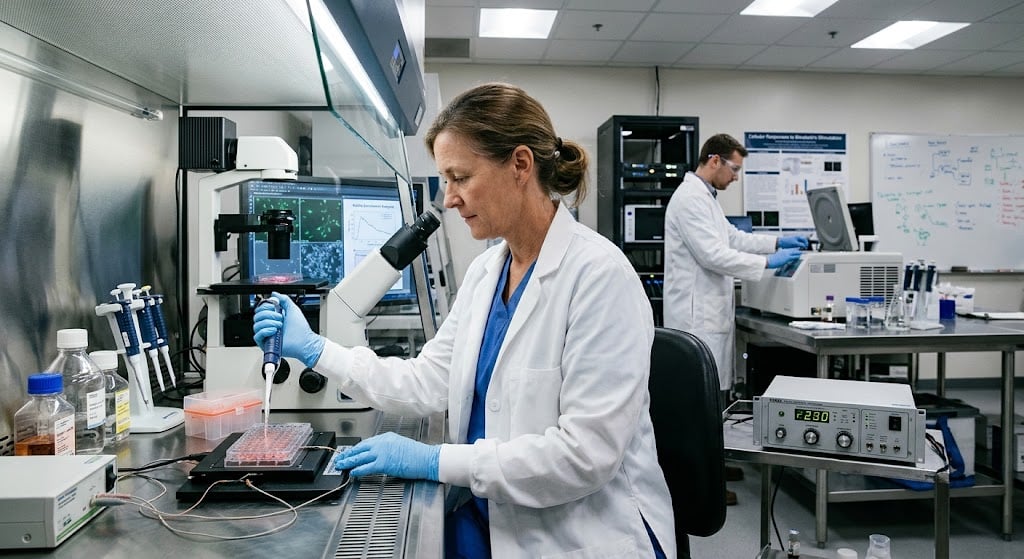
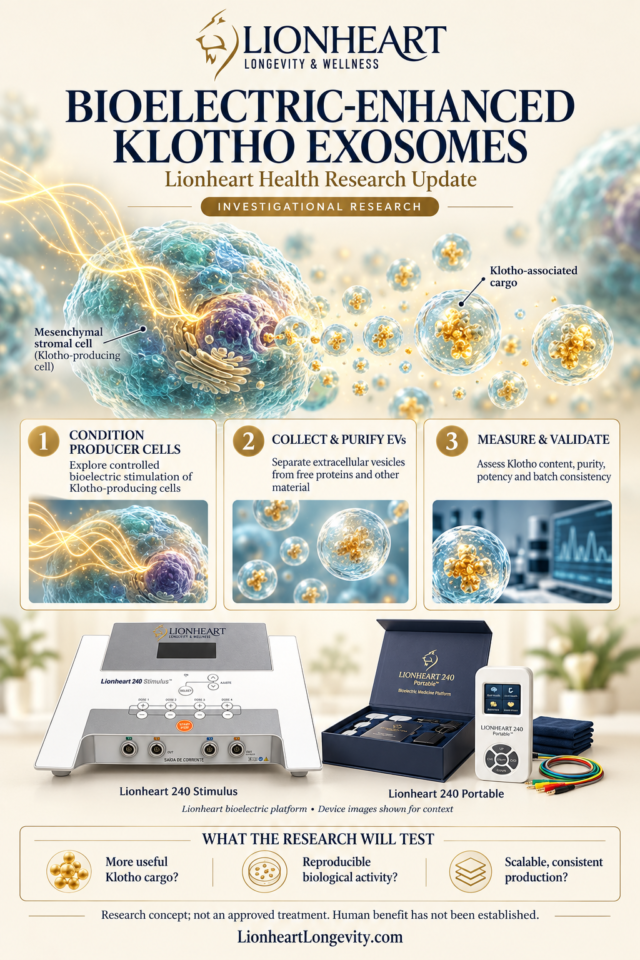
A practical approach under consideration is to apply controlled electrical stimulation to living producer cells during culture, before collecting and purifying their released vesicles.
This makes the producer cell a central part of the process. Researchers can then examine whether stimulation changes vesicle output, Klotho content, other molecular cargo or functional activity.
Published research has shown that electrical stimulation can increase EV secretion and associated cardioprotective activity in mouse cardiac MSC experiments. Whether a particular stimulation protocol can improve Klotho-enriched EV production from human MSCs remains a question requiring direct testing. (pmc.ncbi.nlm.nih.gov)
Measuring what “enhanced” actually means
For this research direction, a larger particle count would be only one measurement. The more consequential questions concern what the vesicles contain, how consistently they can be produced and what they do in a relevant biological assay.
A proposed comparative framework would evaluate ordinary MSCs and Klotho-overexpressing MSCs, each with and without bioelectric stimulation. This would help distinguish the contribution of the producer cells from the contribution of the electrical conditioning.
Key objectives would include measuring Klotho content relative to vesicle number, confirming whether Klotho is associated with purified vesicles, assessing producer-cell health and testing biological activity across independent batches.
Purification is particularly important. Free Klotho protein remaining in a preparation must be distinguished from Klotho carried within or associated with vesicles. International EV research guidance emphasizes careful separation, characterization and functional controls to support reliable conclusions. (isev.org)
Building toward a reproducible production platform
The longer-term opportunity is a manufacturing approach in which cell selection, bioelectric conditioning, purification and potency testing work together.
Early feasibility studies would help determine whether stimulation alone can achieve useful enrichment or whether Klotho-overexpressing producer cells provide a stronger foundation. Process development would then need to address consistency, recovery, storage stability and cost per unit of biological activity.
For Lionheart, this direction extends its broader interest in using programmable bioelectric signals to influence regenerative biology. Progress would be measured through reproducible laboratory evidence, followed by indication-specific preclinical development where justified.
The goal is to establish whether bioelectric conditioning can produce a better-characterized, biologically active Klotho-associated EV preparation—and define the evidence needed to develop it responsibly.
Learn more at LionheartLongevity.com.
Research status: This update describes an investigational research direction, not completed validation of a Lionheart Klotho-exosome product. No human benefit from this proposed combination has been established. FDA states that there are no FDA-approved exosome products; therapeutic clinical development in the United States requires appropriate FDA oversight, including an IND where applicable. (fda.gov)