
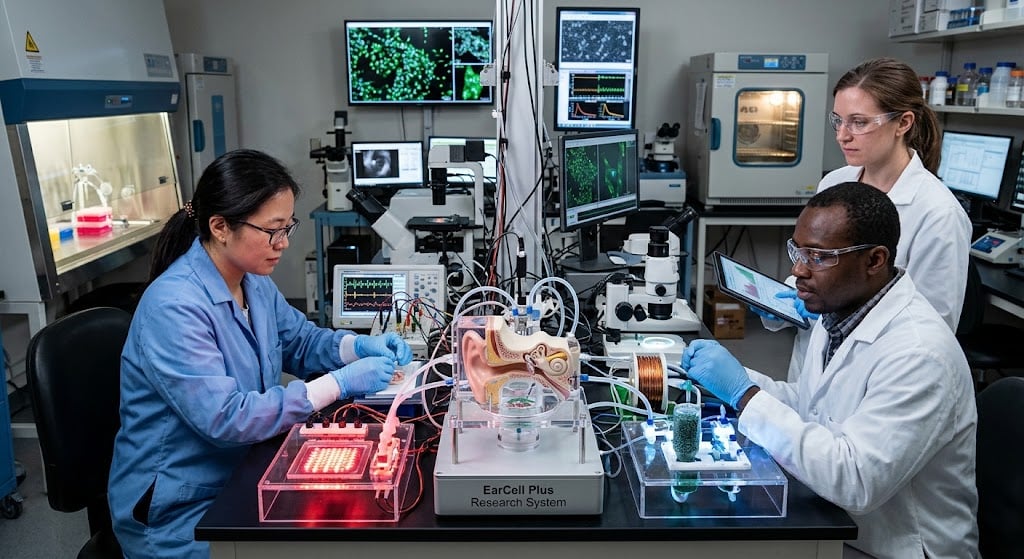
Exploring Klotho-expressing stem cells in nutrient hydrogel alongside bioelectric signaling, light therapy, and pulsed electromagnetic fields.
Hearing depends on a remarkable biological partnership: sensory cells detect sound, neural connections transmit it, and the brain gives it meaning. Developing regenerative treatments requires understanding which parts of that system are damaged—and which interventions might safely help.
Lionheart Health’s EarCell™ Plus research direction brings together several investigational approaches within a multimodal platform. At its center is a proposed strategy using Klotho-expressing stem cells in a supportive nutrient hydrogel, complemented by research into targeted bioelectric signaling, photobiomodulation, and pulsed electromagnetic fields.
The objective is to investigate whether these components, individually or together, can support the biological processes involved in auditory tissue protection and repair. Their combined clinical benefit has not been established.
Building on EarCell’s Regenerative Foundation
EarCell’s published development vision includes localized bioelectric signals, stem cells, growth factors, and nutrient hydrogels for hearing regeneration research. EarCell Plus expands that concept into a framework for evaluating complementary modalities and selected molecular targets. (lionheartlongevity.com)
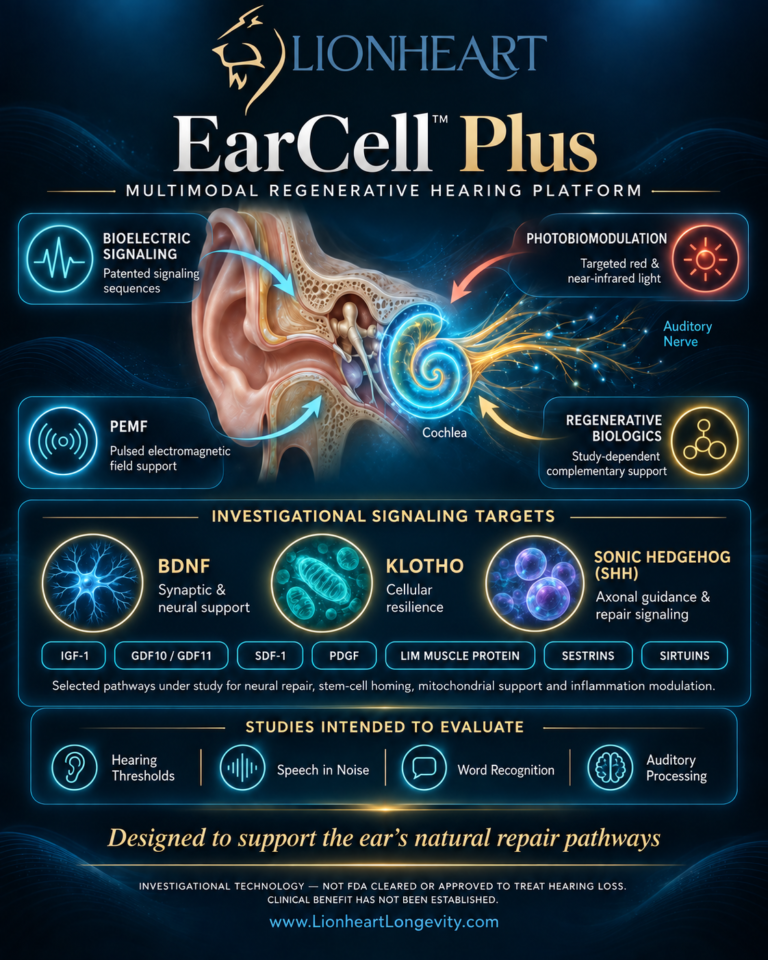
The infographic captures this direction through four components:
- Bioelectric signaling: Investigating selected stimulation sequences and their effects on relevant biological pathways.
- Photobiomodulation: Evaluating targeted red and near-infrared light, including whether sufficient light reaches the intended tissue safely.
- PEMF: Studying pulsed electromagnetic fields as a potential complementary modality.
- Regenerative biologics: Exploring study-specific cell and biological approaches, including the proposed Klotho cell and hydrogel formulation.
These components represent research candidates. Combining them does not automatically produce a stronger treatment; comparative studies must determine what each contributes.
Klotho-Expressing Cells: A Proposed Source of Biological Support
Klotho is of interest because researchers have identified it in the inner ear, and animal studies have associated Klotho deficiency with impaired hearing. Human observational research has also identified associations between circulating Klotho and hearing measures. These findings provide a rationale for investigation, without proving that Klotho administration restores hearing. (pubmed.ncbi.nlm.nih.gov, pubmed.ncbi.nlm.nih.gov, pubmed.ncbi.nlm.nih.gov)
The proposed EarCell Plus strategy would investigate whether appropriately characterized stem cells expressing Klotho can provide useful local biological support. Important questions include how much active Klotho the cells release, how long expression persists, and whether the released protein reaches the intended auditory tissues.
A crucial distinction is that supporting existing auditory cells and replacing lost auditory neurons are different objectives. Klotho-expressing stem cells cannot be assumed to become hearing neurons or reconstruct functional connections to the brain.
Nutrient Hydrogel: Supporting the Cells and Their Delivery
The proposed hydrogel would provide a three-dimensional carrier intended to support cell survival and retention near a selected delivery site.
Its performance would need to be demonstrated experimentally. Researchers would have to evaluate nutrient exchange, cell viability, release of secreted factors, degradation, and compatibility with surrounding tissues.
Placement is particularly important in the ear. A formulation must avoid harmful pressure, swelling, inflammation, or interference with the structures responsible for hearing and balance. The appropriate delivery route remains a development question requiring dedicated testing.
Investigating Signals Relevant to Auditory Repair
The EarCell Plus infographic identifies BDNF, Klotho, and Sonic Hedgehog (SHH) as prominent investigational targets. It also includes IGF-1, GDF10/GDF11, SDF-1, PDGF, LIM muscle protein, Sestrins, and Sirtuins.
These labels define a proposed research agenda spanning neural support, cellular resilience, cell recruitment, and repair signaling. They should not be interpreted as evidence that EarCell Plus has already controlled each target in the human inner ear.
For bioelectric stimulation, the essential task is to establish a measurable chain of evidence: a defined signal produces a reproducible biological response, that response reaches the relevant tissue, and it leads to a meaningful functional outcome without unacceptable harm. EarCell’s existing platform describes the broader ambition of using bioelectric stimulation to influence selected regenerative proteins. (leonhardtventures.com)
How This Relates to Emerging Hearing Cell Therapies
Independent programs are advancing the broader field. Rinri Therapeutics’ Rincell-1 program is preparing a first-in-human trial of specialized otic neural progenitor cells delivered alongside cochlear implantation. Its official research page currently describes the study as not yet recruiting. (rinri-therapeutics.com)
EarCell Plus shares the ambition of addressing biological damage associated with hearing loss. However, its proposed Klotho-expressing cells, hydrogel, and complementary modalities constitute a separate strategy requiring its own evidence.
Measuring What Matters to Patients
The infographic appropriately emphasizes functional outcomes: hearing thresholds, speech understanding in noise, word recognition, and auditory processing.
Future studies would need to select validated measures suited to the participants’ type of hearing loss. Laboratory biomarkers could help explain a response, but meaningful progress would require evidence that participants hear or understand sound better.
Safety monitoring would also need to assess remaining hearing, balance, inflammation, abnormal tissue growth, and the long-term behavior of delivered cells.
EarCell Plus presents an ambitious research direction: investigate the cells, their supporting environment, and the signals that influence auditory biology within one carefully evaluated framework. The goal is to determine whether that combination can eventually translate into measurable hearing benefits.
Learn more: Lionheart Health EarCell | Leonhardt Ventures EarCell
EarCell Plus is investigational technology and is not FDA cleared or approved to treat hearing loss. Clinical benefit has not been established. The Klotho-expressing stem cell and nutrient hydrogel combination described here is a proposed research approach.