
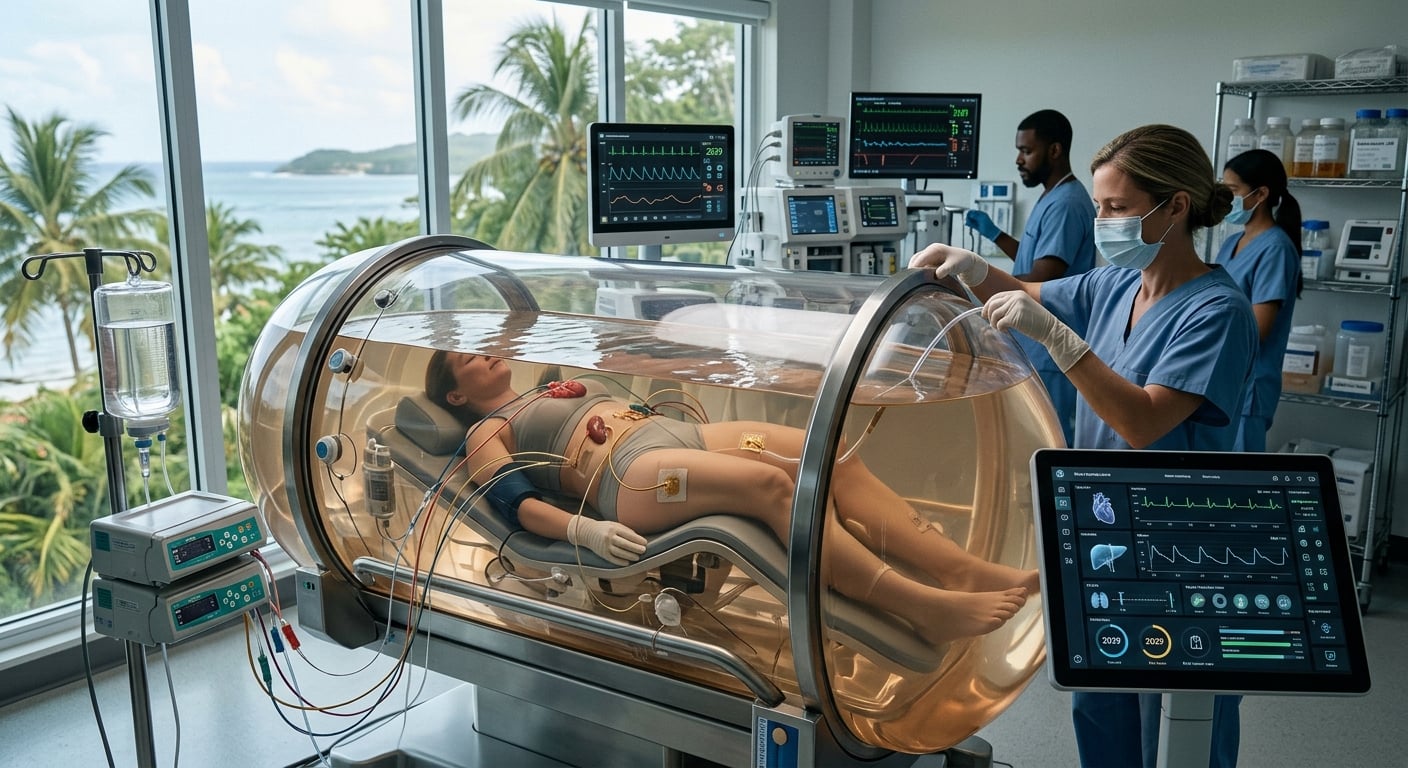
The investigational program centers on the Lionheart Octopus™ refillable delivery system, implantable bioelectric microstimulators, and a monitored, fluid-filled chamber. Lionheart is targeting late 2029 for the first possible investigational treatment.
Planned first treatment site locations include Roatan, Honduras, Costa Rica, Dubai, Mexico and Lithuania
HUNTINGTON BEACH, Calif. — Lionheart Health, Inc. announced a public waitlist for its Whole Body Regeneration System, known as Womb for Adults. Adults who join can receive research updates and early notice if applications open for an initial study. The program will explore whether a monitored environment, targeted delivery of investigational biologic materials, and programmable bioelectric stimulation can help researchers preserve or restore measurable organ function.
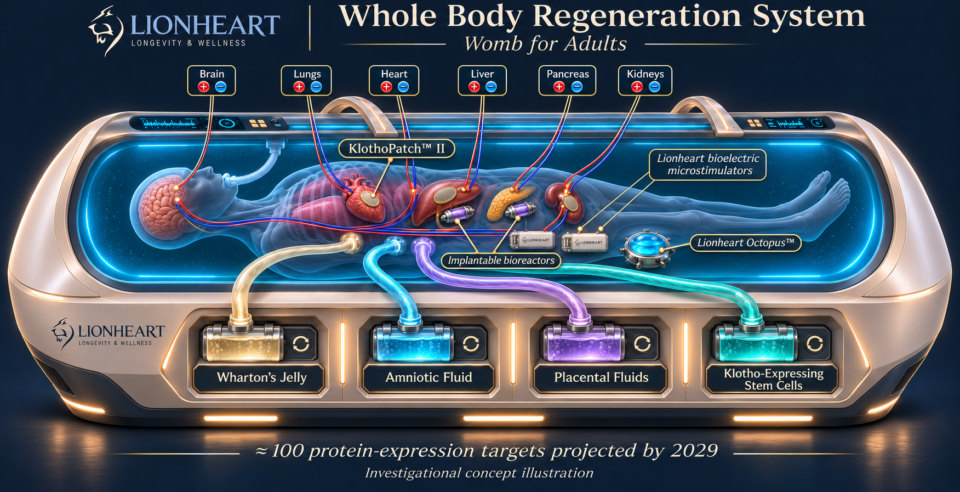
The Lionheart Octopus™ is at the center of the design
The Lionheart Octopus™ is a proposed implantable microinfusion system designed to sit beneath the skin in the lower-left abdomen. Its refillable reservoir and self-sealing access port are intended to allow replenishment while the device remains implanted. Organ-directed catheters would give researchers a way to study localized delivery or replenish a contained, organ-adjacent bioreactor such as KlothoPatch™ II. Lionheart’s IP foundation includes U.S. Patent 10,646,644, Stimulator, pump and composition, alongside newer development work on refillable reservoirs, organ-directed delivery, and bioreactor replenishment.
The chamber concept also includes four separate refillable compartments built into the housing for Wharton’s jelly, amniotic fluid, placental fluids, and Klotho-expressing stromal cells. In the concept illustration, each compartment has its own umbilical-style catheter extending toward the body. The separate compartments would allow researchers to evaluate individual materials and delivery approaches before studying combinations. The illustration depicts a proposed configuration for future research.
Implantable microstimulators would provide local bioelectric signals
The design pairs the Octopus delivery system with Lionheart implantable bioelectric microstimulators. The concept depicts paired positive and negative leads for six organ groups: the heart, lungs, liver, kidneys, pancreas, and brain. The microstimulators would give researchers a way to study local electrical stimulation separately from biologic delivery and test whether combining them changes tissue response. Proposed monitoring would track organ function alongside exploratory biomarkers.
Lionheart’s October 2026 IP inventory lists 63 patent and application entries and 518 issued claims across its core, licensed, and optioned portfolios. The portfolio spans programmable bioelectric stimulation, regenerative cells and biologics, targeted delivery, organ-function research, regenerative aesthetics, and investigational oncology. The bioelectric program includes targets such as Klotho, Sestrins, Sirtuins, BDNF, NANOG, GDF10, SDF‑1, PDGF, and VEGF. At its current research pace, Lionheart projects that its program could encompass approximately 100 protein-expression targets by 2029. That figure is a research projection.
The team brings decades of catheter and bioelectric research
Lionheart’s work builds on the Leonhardt team’s experience in cardiovascular catheter engineering, endovascular stent grafts, catheter-based cell delivery, and bioelectric stimulation. Leonhardt Ventures reports that technologies and derivative product families associated with its team have contributed to the treatment of more than one million patients worldwide. The team reports receiving two Utah Science Technology and Research (USTAR) grants and four University of California, Irvine (UCI) Capstone grants. Lionheart also received the AbbVie Allergan ULP Innovation Award and was selected as an XPRIZE Healthspan Top 40 Milestone 1 award winner and semifinalist in a global competition that XPRIZE says drew more than 600 registered teams from 58 countries. The core Leonhardt led team used bioelectric stimulation for limb salvage patients in England in 1987, regenerated their first mammal heart with muscle derived cells in 1988, implanted first biological pacemakers in large mammals in 1990, first animal implants of a percutaneous heart valve 1991, first animal implants of intravascular lung in 1991, first stem cell delivery catheter system tested 1993 ProCell, completed first human repair of an aortic aneurysm without surgery in Australia in 1995, first human heart regenerated with muscle derived cells in The Netherlands in 2001.
A staged research program and a late-2029 target
Lionheart’s research roadmap describes a possible first study focused on selected noninvasive components, including BodStim™ wearable muscle stimulation. Investigators could track strength and mobility alongside exploratory biomarkers. The Octopus implant, organ-directed catheters, implanted stimulators, and biologic components would require separate evaluation before any study of the integrated system. Its safety and effectiveness have yet to be established.
Lionheart is targeting late 2029 for the first possible investigational treatment, subject to research progress, site readiness, and applicable regulatory and ethics approvals. Locations under consideration include Roatán, Honduras, as well as sites in Costa Rica, Lithuania, Mexico, and Dubai, United Arab Emirates. The site and start date are pending.
Join the waitlist
The waitlist is free and provides research updates and early notice if study applications open. Any future study will have its own eligibility, screening, and consent process. Study participation and access to treatment depend on those requirements. Learn more about the Womb for Adults research program.
Lionheart Health’s proposed BioLeonhardt Whole Body Regeneration Chamber, also called the Adaptive Regeneration Womb™ or “Womb for Adults,” takes its inspiration from the idea of controlling the environment around living tissue. The goals differ by age. An artificial womb would support fetal development after extreme preterm birth. For older children and adults, the research question is whether temporary support can preserve or improve the function of an injured or failing organ. Lionheart’s chamber, refillable delivery architecture, and combined regenerative uses are investigational.
Inside the Lionheart Octopus™ refillable delivery system
The Octopus concept starts with a reservoir placed beneath the skin. A self-sealing access port would allow a clinician to replenish the reservoir while it remains implanted. A microinfusion pump would control delivery through a catheter directed toward a selected organ or a contained bioreactor. A coordinated controller would manage the bioelectric component, with electrodes providing local stimulation. Delivery and stimulation could then be evaluated independently before researchers study them together. U.S. Patent 10,646,644, Stimulator, pump and composition, describes combinations of stimulation, infusion, and regenerative compositions. Lionheart has also reported Octopus development work through a UCI Capstone program.
Lionheart’s September KlothoPatch™ II announcement describes two ways to replenish an organ-adjacent bioreactor. One uses the implanted Octopus reservoir. The other uses an endovascular catheter designed to dock with the patch. The proposed patch combines a nutrient hydrogel, a semipermeable membrane, a potentially retrievable cell cartridge, and local electrodes. In a contained configuration, the membrane would retain cells while allowing selected secreted factors to reach surrounding tissue. Candidate materials under separate study include soluble Klotho, Klotho-expressing stromal cells, platelet-rich fibrin-derived materials, selected growth factors, and extracellular vesicles. Proposed sensors would track oxygen, temperature, pressure, electrical impedance, and biochemical markers.
The pump handles local delivery. Blood circulation and gas exchange would require dedicated equipment. An early experiment could use an established donor-organ perfusion platform to measure what local stimulation or controlled delivery adds. Lionheart’s proposed LiverCell™
The proteins and pathways Lionheart is studying
Bioelectric stimulation and catheter delivery address different questions. Stimulation asks whether an electrical signal can alter what the tissue produces or releases. Delivery asks whether placing a defined material near that tissue changes its response. Lionheart’s broader portfolio spans proteins, protein families, peptides, and signaling pathways. Its July CerebraCell™ announcement alone describes a proposed program involving more than 60 regenerative proteins. Each target still needs to be evaluated in the relevant tissue, including whether its activity should increase or decrease and whether the change improves organ function.
|
Research area
|
Targets named in Lionheart’s public disclosures
|
|---|---|
|
Cellular resilience and energy metabolism
|
Klotho, Sestrins including SESN2, Sirtuins including SIRT1, SIRT3, and SIRT6, plus OSER1, FOXO3, AMPK, mTOR, and NRF2.
|
|
Brain, nerves, and cell identity
|
BDNF, GDF10, GDF11, Menin, Sonic Hedgehog, Apelin, and NANOG. NANOG is a cell-identity research target whose effects would require careful evaluation in each tissue.
|
|
Circulation and tissue repair
|
SDF‑1/CXCL12, PDGF, VEGF, eNOS, HIF‑1α, HGF, EGF, IGF‑1, and CXCL5. U.S. Patent 12,109,410 covers specified bioelectric stimulation methods involving several of these targets.
|
|
Heart, muscle, and tissue structure
|
TBX20, PITX2/PITX2c, MEIS1, and NPPA/pro‑ANP for cardiac research. Follistatin, activins, tropoelastin, COL17A1, laminin, BMP2, BMP9, osteocalcin, and the OPG/RANKL axis for muscle, matrix, and bone research.
|
|
Immune signaling and inflammation
|
HMGB1, PF4/CXCL4, thymulin, IL‑10, IL‑1β, IL‑6, TNF‑α, and 15‑PGDH. The appropriate direction of modulation can vary by tissue and disease.
|
What the past year’s developments added
-
Spring 2026. Lionheart and Leonhardt Ventures disclosed research on NRF2 in vascular tissue, FOXO3–AMPK–mTOR in cellular stress and metabolism, Wnt in tissue regeneration, HMGB1 in repair signaling, and 15‑PGDH in joint research. They also announced a Notice of Allowance for specified SIRT6 stimulation claims and disclosed provisional application work involving Menin and OSER1.
-
Summer 2026. CerebraCell™ brought together multi-target stimulation, Klotho NanoFlowers™, photobiomodulation, imaging, and rehabilitation concepts. Separate announcements described laminin and polylaminin-related matrix research for spinal cord injury, new cardiac targets, MitoCell™ / PC‑Up™ research combining bioelectrics with phosphatidylcholine and choline, and a program studying whether stimulation changes extracellular-vesicle production or contents.
-
Fall 2026. The company disclosed glial-cell research, the proposed LiverCell™
feasibility study, and KlothoPatch™ II with its refillable delivery alternatives. More recent Lionheart News items described a bioelectric nutrient-uptake patent initiative, metabolic-health research involving MicroImplant and Bod Stim™, and updates on peptide delivery and Klotho-related extracellular vesicles.
Four decades of catheter engineering and regenerative research
In May 2026, Leonhardt Ventures reported that inventions, technologies, and derivative product families associated with Howard J. Leonhardt and affiliated teams had contributed to the treatment of more than one million patients worldwide. The company-reported figure spans decades and includes cardiovascular catheters, aortic stent grafts, structural-heart technologies, and other product families. Lionheart’s current team includes cardiologist Dr. Leslie Miller as Chief Medical Officer, who leads medical strategy, and Dr. Jorge Genovese VP Bioelectric Regeneration Research whose bioelectric research background includes work at the McGowan Institute for Regenerative Medicine and the University of Utah. Brian Lassater CTO VP Engineering. Dr. Stuart Williams and Dr. Doris Taylor co-Chair the Scientific Advisory Board.
|
Year
|
Milestone
|
|---|---|
|
1987
|
Lionheart traces its VascuStim™ limb-salvage program to early research on circulation and tissue repair that began in 1987. The company describes an early pilot in England.
|
|
1988
|
Collaborators Dr. Race Kao and Dr. George Magovern conducted pioneering animal work using skeletal muscle satellite cells to repair damaged heart tissue, according to Leonhardt Ventures’ historical account.
|
|
1990
|
Leonhardt Ventures traces Wendell King’s early biological-pacemaker work to 1990. A separate company timeline dates successful dog work under the BioPace™ program to 1999.
|
|
Early 1990s
|
Leonhardt’s team pursued early catheter-delivered heart-valve designs. Howard Leonhardt and Trevor Greenan were named on U.S. Patent 5,957,949, Percutaneous placement valve stent, issued in 1999. Alain Cribier’s team published the first human percutaneous aortic valve implantation in 2002.
|
|
1995
|
The Leonhardt team reports an early percutaneous aortic aneurysm repair in Melbourne using the TALENT™stent graft with Drs. Ken Thomson and Peter Field. Juan Parodi and colleagues had published their earlier transfemoral endovascular aneurysm repair experience in 1991.
|
|
2001
|
Leonhardt Ventures dates its early catheter-based human heart-repair case in Rotterdam to May 2001. The team delivered a patient’s own skeletal muscle cells to damaged heart tissue. The subsequent peer-reviewed pilot reported safety and feasibility experience with catheter-based delivery.
|
The Octopus brings together two strands of that history: using catheters to reach a specific site and using electrical signals to study how tissue responds. The next test is whether those tools, individually or together, measurably improve the work an organ does. In a kidney model that could mean better filtration. In a liver model it could mean better metabolic function. For children, developmental safety would require its own evidence. Across all ages, the proposed system remains a research concept, with whole-body regeneration and age reversal still unproven.
Womb for Adults patent and licensing inventory
The licensed Stangl Klotho-expressing stem-cell family has an issued U.S. patent, US 12,559,724 B2.
Leonhardt and Lionheart Health related patents, patents pending and applications
|
U.S. patent or publication
|
Status
|
Potential relevance to Womb for Adults
|
|---|---|---|
|
10,646,644 B2
|
Issued
|
Lionheart Octopus™. The closest identified grant for the combined stimulator, pump, and regenerative composition. Compare the issued claims with the proposed refillable reservoir, organ-directed catheters, and bioreactor replenishment. patents.google.
|
|
12,109,410 B2
|
Issued.
|
Organ-directed bioelectric stimulation. Claims address specified stimulation methods involving cell homing, proliferation or differentiation, and targets including SDF‑1, PDGF, VEGF, HGF, IGF‑1, follistatin, and tropoelastin. patents.justia.
|
|
11,471,686 B2and 12,226,639 B2
|
Issued
|
Bioelectric Klotho modulation. Relevant to the electrical stimulation component. The Stangl family addresses the Klotho-expressing cells themselves. Justia Patents Search
|
|
11,446,488 B2
|
Issued
|
Kidney treatment. An organ-specific grant to review for the proposed kidney research module. Justia Patents Search
|
|
12,642,967 B2and 12,611,540 B2
|
Issued
|
BDNF and GDF10 modulation, respectively. Relevant to the proposed neural and brain research components. Justia Patents Search
|
|
12,752,107 B2
|
Issued October 6, 2026
|
SIRT6 modulation. Relevant to skeletal-muscle research. The earlier publication US 2024/0108886 A1 is part of the same prosecution record and should be counted with the grant. Justia Patents Search
|
|
10,960,206 B2
|
Issued
|
Follistatin and bioelectric stimulation. Relevant to the proposed muscle research component. patents.google.com
|
|
11,433,231 B2
|
Issued
|
Sonic Hedgehog expression. Relevant to developmental and tissue-repair signaling research. Justia Patents Search
|
|
11,167,141 B2and 11,110,274 B2
|
Issued
|
Blood-pressure management and inflammation, respectively. Potentially relevant to cardiovascular and inflammatory research endpoints. Justia Patents Search
|
|
11,878,161 B2, 11,819,688 B2, and 11,052,247 B2
|
Issued
|
COL17A1 and skin-treatment technologies. Relevant if the platform includes a distinct skin or tissue-integrity module. Justia Patents Search
|
|
11,185,691 B2and 11,691,007 B2
|
Issued
|
Adaptive tumor therapy and OPG-related bioelectric treatment.Adjacent oncology IP. Related publication US 2023/0347144 A1 is listed as abandoned. lionheartlongevity.
|
|
US 2024/0285949 A1 and US 2024/0158813 A1
|
Published applications, listed as pending
|
Sestrins and NANOG, respectively. Relevant to cellular-stress and cell-identity research. Google Patents
|
|
US 2026/0183342 A1 and US 2023/0293268 A1
|
Published applications. Current prosecution status needs confirmation.
|
Allogeneic implants for inflammatory conditions and bioelectric stimulation for bone integration, respectively. Potentially relevant to separate implant or musculoskeletal modules. Justia Patents Search
|
|
KlothoPatch™ II, LiverCell™, and related announced research
|
Publicly disclosed development or application-stage work. Publication numbers for these specific configurations were unverified.
|
Organ-surface patches, refillable bioreactors, sensing, and localized stimulation. Related disclosures also include CerebraCell™, bioelectric extracellular-vesicle research, and applications or initiatives involving HMGB1, Menin, OSER1, Wnt, and FOXO3–AMPK–mTOR. lionheartlong
|
|
11,849,910 B2and 11,602,627 B2 / 12,491,356 B2
|
Issued. Public records identify Valvublator, Inc. and Second Heart Assist, Inc., respectively.
|
Heart-valve repair and circulatory assist. Relevant if the program adds either capability. Confirm Lionheart’s rights with the respective assignee. Justia Patents Search
|
Schuler licensed and option-related patents
Lionheart’s September 2026 CancerCell announcement names nine licensed Schuler grants. Its October 2026 IP inventory counts eight licensed Schuler grants and three optioned muscle or neurocode grants. All these licenses are conditional with obligations to be met by Leonhardt Ventures LLC and Lionheart Health, Inc. to maintain or secure any options rights.
|
U.S. patent or publication
|
Rights or status reported publicly
|
Potential relevance
|
|---|---|---|
|
8,315,712, 8,656,930, 9,032,
|
Issued. Named in Lionheart’s September CancerCell license disclosure.
|
Recording and processing cancer-associated electrical signals. Relevant principally to a separate oncology research module. lionheartlongevity.com
|
|
8,831,738, 9,295,835, 9,440,
|
Issued. Named in the same September license disclosure.
|
Encoded signals, calcium-related approaches, and tumor-cell death research. Confirm which grant accounts for the October count difference. lionheartlongevity
|
|
11,154,238 B2, 11,950,923 B2, and US 2024/0335164 A1
|
Two issued grants and one published application. Lionheart identified these as a potential option path in September. Exact executed option coverage remains unverified.
|
The most directly relevant Schuler family identified for responsive neurocode monitoring and stimulation. Justia Patents Search
|
|
8,509,887 B2, 9,254,388 B2, and 7,062,324 B2
|
Issued Schuler records. Lionheart license or option coverage and current enforceability remain unverified.
|
Candidate records for organ-function modulation, endocrine and exocrine signaling, and implantable cardiac control, respectively. Justia Patents Search
|
|
US 2011/0098783 A1
|
Published skeletal-muscle application, listed as abandoned.
|
Relevant as a historical muscle-control disclosure. The public record does not establish that it corresponds to one of the three optioned grants. Google Patents
|
Stangl family and licensing actions
|
Record
|
Public status
|
Action
|
|---|---|---|
|
US 12,559,724 B2 · application 17/447,975 · publication US 2022/0033779 A1
|
Issued February 24, 2026. Listed active. Public record lists Apceth GmbH & Co. KG as assignee and Christine Günther, Manfred Stangl, and Felix Hermann as inventors.
|
Confirm or secure rights to this grant first. Verify current title and check whether the signed agreement expressly covers the continuation grant, the intended field of use, manufacturing, and sublicensing to research or clinical partners. Google Patents
|
|
EP 3,262,159 B1 · application EP 16707696.7
|
Issued European grant. National records show lapses in multiple countries, including Lithuania.
|
Verify enforceable countries individually. If Lithuania remains a candidate site, have local counsel confirm the lapse and whether restoration is available. Google Patents
|
|
US 2018/0037868 A1· application 15/553,954
|
Older U.S. parent application, listed as abandoned.
|
Evaluate revival only if the parent offers distinct claim value and the applicant can support the required showing of unintentional delay under 37 CFR § 1.137. Google Patents
|
|
WO 2016/135295 A1· PCT/EP2016/054091
|
International publication. The family record shows U.S. and European branches.
|
Confirm territorial coverage for the contemplated manufacturing and research sites, including Honduras, Costa Rica, Mexico, and the UAE. Google Patents
|
About Lionheart Health, Inc.
Lionheart Health, Inc. is a Huntington Beach, California–based company developing bioelectric and regenerative-medicine technologies for healthspan and organ-function research. Lionheart Longevity & Wellness. The team has R&D lab space in Irvine, California in the UCI Research Park and Clinical Research and Training Center Clinics in Newport Beach and Manhattan.